Virtual Xylophone: Play Notes and Rhythms Online
Tap a bar to hear a short, wooden-style tone. This virtual xylophone lets you explore one chromatic octave, build a small melody, and practise the timing of separate strikes. The sound is synthesized in your browser rather than sampled from an acoustic xylophone. You can start without an account, a microphone, or any equipment beyond your device.
Play the xylophone
Original synthesized sound. No microphone. Select a labelled note; these controls are not physical fingering instructions.
Loading the instrument…
The instrument is a compact note map, not a scale model of a concert xylophone. Its range is deliberately limited to C5 through C6. The displayed octave numbers refer to sounding pitch. Use the bar labels to choose notes; do not assume that a bar’s position or size describes the full dimensions of a physical instrument.
Begin with two clear strikes
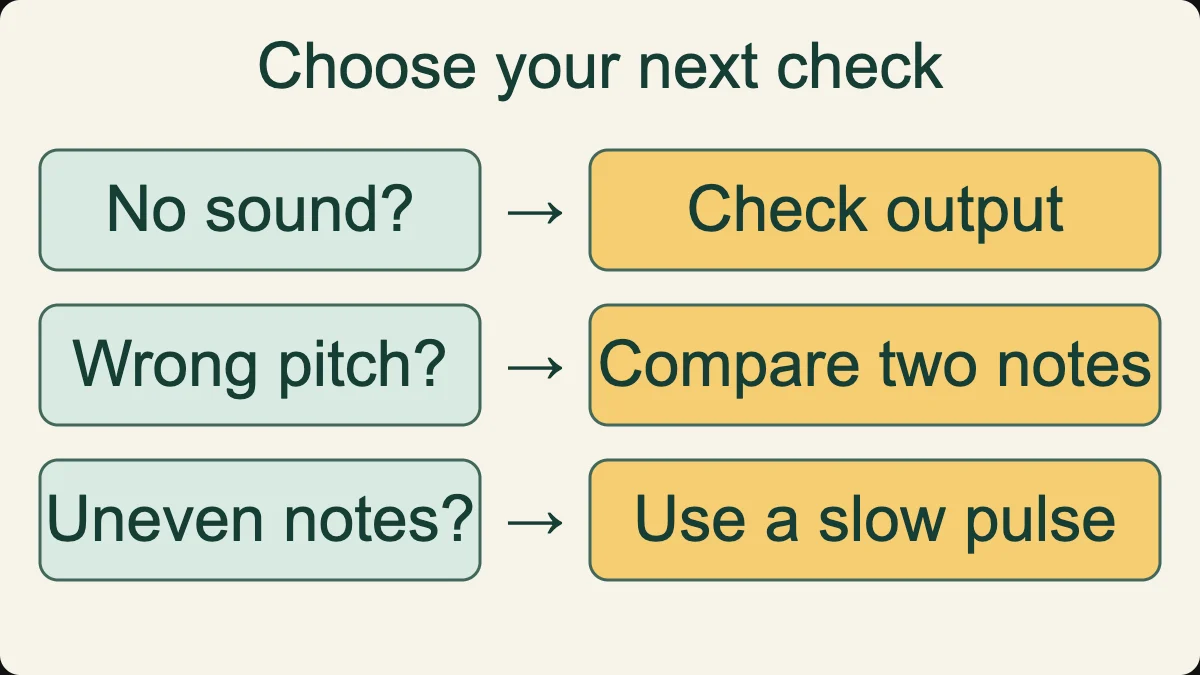
Choose C5 and then D5. Leave a little space between them so that you can hear where each sound begins. A xylophone-like tone has a clear attack and a relatively short tail. This makes the instrument useful for listening to timing: if the second tap arrives early, you hear the changed spacing immediately.
Repeat C5 twice before moving to D5. The repeated pitch lets you concentrate on the difference between one strike and two. Holding the button down does not create a continuous wind-like tone. Each new activation starts a new sound, just as the important event in this model is the strike rather than a held key.
On a touchscreen, use deliberate taps. On desktop, click a bar or reach it with the keyboard. Tab enters the controls, arrow keys move among the note buttons, and Enter or Space plays the selected note. You can practise a simple rhythm on a single focused button without continually moving the pointer across the screen.
Begin with a comfortable volume and use Stop sound when comparing patterns. The instrument has no microphone input, so it cannot hear your tapping on a table or your acoustic xylophone. It responds only to the buttons you activate on this page. That boundary keeps the task simple and avoids suggesting that the browser is grading a performance it has not recorded.
Read the bar labels before chasing colours
The natural notes in the displayed octave are C5, D5, E5, F5, G5, A5, B5, and C6. The remaining buttons supply C sharp, D sharp, F sharp, G sharp, and A sharp. These chromatic choices let you compare a semitone with a larger step. The interface uses colour for visual grouping, but the written note name is the reliable guide.
C5 and C6 are an octave apart. The repeated letter does not mean they are identical pitches. The number identifies the register, and the frequency display confirms that the upper C is higher. If you are following written music, check whether its octave notation refers to written or sounding pitch before transferring it directly to this screen.
The instrument lays out pitches in a simple order for browser use. A physical chromatic xylophone commonly groups bars in a keyboard-like arrangement, but the exact range and layout vary by model. This page should not be used to choose the size of a real instrument or to infer which bars an individual school instrument contains.
There is no separate sharp between E and F or between B and the next C. Those pairs are already a semitone apart. Play E5–F5 and then F5–G5. The second pair spans a whole tone. Seeing adjacent letters is not enough to tell you that the musical distances are equal.
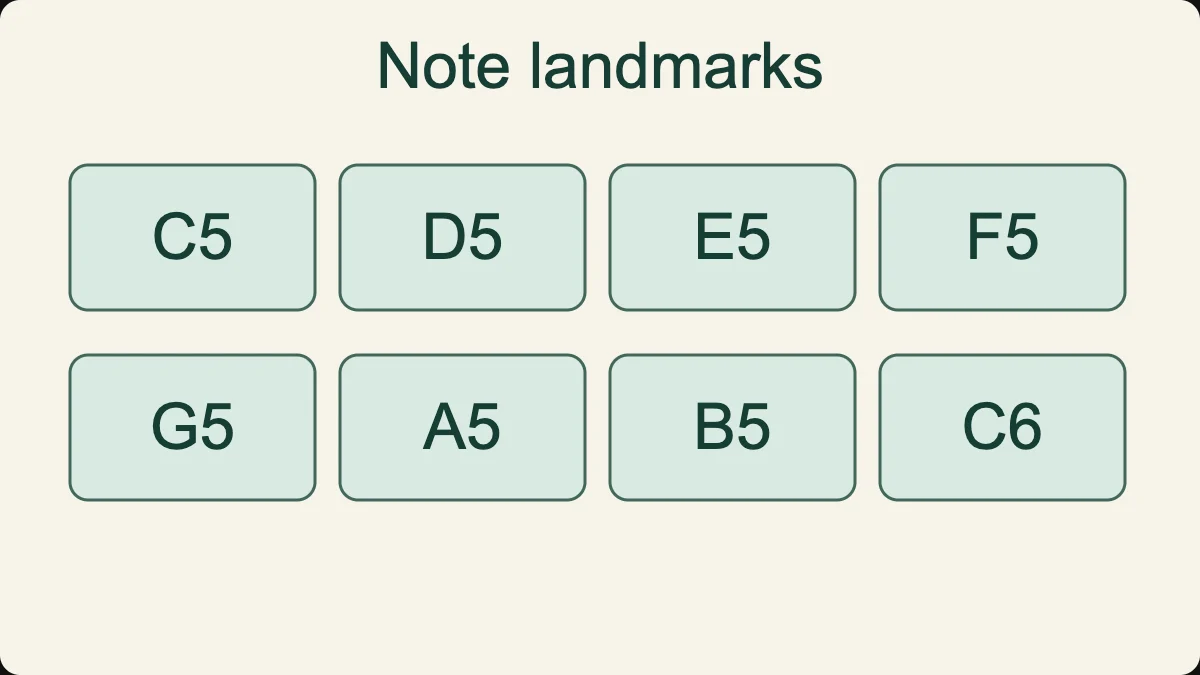
Locate a note without memorising the whole octave
Choose three landmarks: C5, F5, and C6. Find each one slowly, play it once, and return to C5. Once those anchors are familiar, add D5 and E5. The goal is to reduce visual searching gradually, not to race through the full row while guessing which bar you touched.
When playing on a small screen, notice whether your error was a wrong musical choice or a missed target. If you intended D5 but tapped E5, practise locating the buttons before adding a beat. If you deliberately chose E5 because you thought it matched the sound, compare D5 and E5 against a reference. The two problems need different corrections.
Why the beginning of each note matters
A sustained sound can hide an uneven start because the tone remains present for a long time. A short struck tone makes its beginning more obvious. Play four C5 taps and listen to the spaces between their attacks. Are they equal, or does the last pair arrive closer together? You can hear that question without knowing any formal rhythm notation.
Keep the volume similar while making this comparison. The browser buttons do not measure mallet force, and a louder device setting does not make your rhythm more accurate. On a physical xylophone, touch and mallet choice affect the tone; here the consistent electronic response helps isolate the timing of the taps.
The sound’s decay is not the same as a written note value. A bar may stop being clearly audible before the next beat arrives, but the intended musical duration can still occupy that time. Conversely, a ringing instrument may continue after a notated short note. In this tool, focus on starts and planned gaps rather than pretending every acoustic tail is an exact written duration.
Try one tap followed by a counted pause. Do not add a second tap merely because the first sound has faded. This is a useful discipline for percussion-based listening: the pulse continues even when there is little or no sound to follow.
Build a five-note pattern
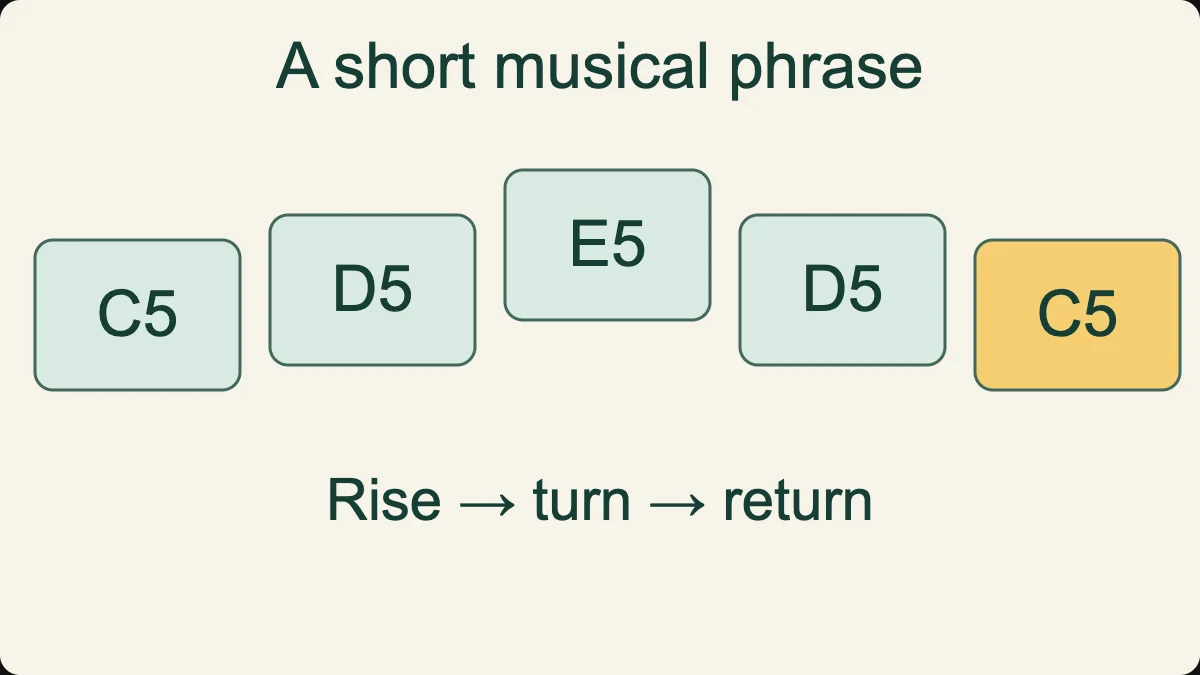
Play C5–D5–E5–D5–C5. Give the first four strikes equal spacing and let the ending have a little more room before you begin again. The line rises and returns. Because the notes are close together, you can focus on the contour without moving across the entire instrument.
Now change only the middle note to G5. The pattern becomes C5–D5–G5–D5–C5. You have introduced a wider jump while keeping the starting note, ending note, and number of strikes unchanged. Compare the two versions at the same tempo so that the pitch change remains the main difference.
Next keep the original notes but insert silence after E5. The gap changes the phrase’s grouping. Count through it rather than waiting until you feel like continuing. The resulting pattern is not longer because it contains more pitches; it is longer because its events occupy more time.
Make a second phrase that answers the first
Use C5–E5–G5 as a short opening. Answer with G5–E5–C5. One rises and the other descends. The pitch collection is the same, which makes it easy to hear the role of order. Reversing the sequence creates a different line without requiring any new note names.
After two repetitions, change the answer to F5–D5–C5. Listen to how the route back to C differs. You do not need to attach an emotional label to each version. A useful description is concrete: the answer begins lower, includes different intervals, or reaches the final note through a different step.
Write down the version you want to repeat. A short list with octave numbers prevents confusion when you later compare the pattern on another instrument. If you use the virtual piano, choose the same sounding register when possible rather than assuming every button labelled C is equivalent.
Separate pitch practice from rhythm practice
For pitch practice, ignore speed initially. Find each note of a pattern, play it, and verify its label. For rhythm practice, use one note and concentrate on when it begins. Once both tasks are manageable on their own, combine them. This avoids a common problem: a long melody feels uneven, but you cannot tell whether the difficulty is finding bars or keeping time.
Suppose C5–D5–E5–D5 is clear when played slowly, but the third note is late with a metronome. Practise only the D5-to-E5 movement before starting another full run. If the movement is easy without the pulse, slow the metronome and check whether you are preparing the next target early enough.
If four taps on C5 are uneven even without changing pitch, adding more notes is unlikely to help. Keep the task on C5 and count aloud or internally. You can use the online metronome as a reference. Choose a pulse that leaves room to listen between events, not one that forces a hurried response.
A successful repetition should be repeatable. One accidental run at a fast speed is weaker evidence than several controlled attempts at a comfortable speed. The page does not calculate a rhythm-accuracy score, so your observation should remain modest and specific.
Hear nearby and distant notes
Compare C5–D5, C5–G5, and C5–C6. The starting pitch stays fixed while the distance changes. Play the pairs with similar spacing and volume. Ask which pair has the closest notes and which has the widest gap. Reorder the examples to make sure you are hearing the relationship rather than remembering the sequence.
In this equal-tempered model, C5 to D5 spans two semitones, C5 to G5 spans seven, and C5 to C6 spans twelve. Those distances correspond to a major second, perfect fifth, and octave. The numbers describe pitch relationships; they do not tell you how many fingers or physical mallet movements a performer should use.
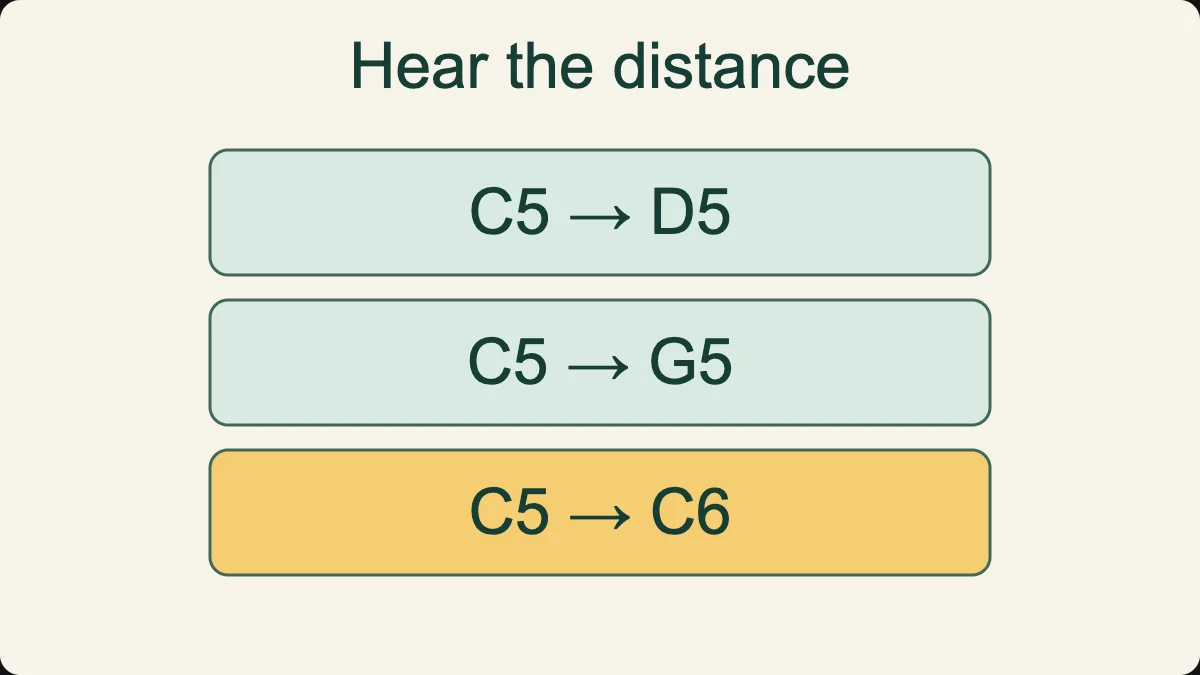
Try the pairs descending as well. C6–C5 is still an octave relationship, but its direction is reversed. A listener can recognise a distance in one direction more easily than the other, especially when first learning it. Treat that difference as a practice opportunity rather than a contradiction.
For a focused comparison beyond this short tool, try interval ear training. Keep its results separate from your ability to navigate xylophone bars. Choosing the right screen button quickly and recognising an interval by ear are related activities, but they are not the same measurement.
Count four beats, including the silent one
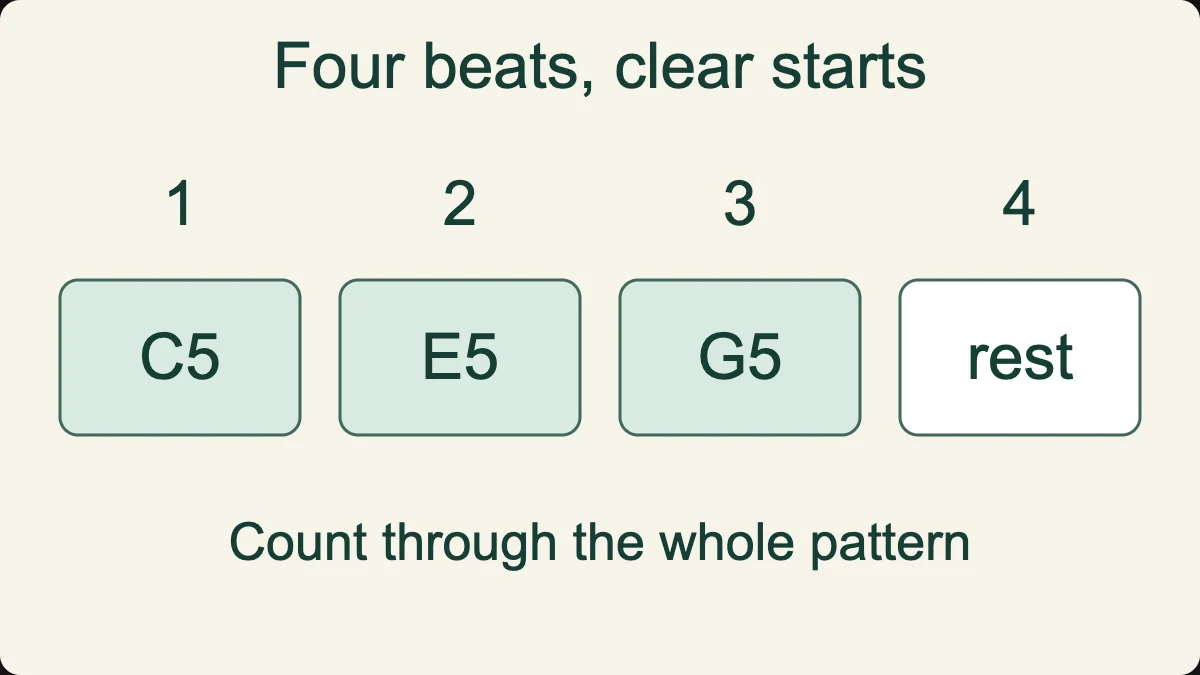
Play C5 on beat1, E5 on beat2, G5 on beat3, and nothing on beat4. Continue counting the fourth beat before returning to C5. This creates a short repeated pattern with a clear gap. The rest is intentional even though the instrument’s natural tail may fade before that beat.
Once the pattern is steady, move the gap to beat2. You now play C5, silence, E5, G5. The same three pitches occupy different positions in the bar. Listen to the changed grouping. This is a practical way to understand why rhythm cannot be recovered from note names alone.
Finally play C5 twice during the first beat, followed by one strike on each remaining beat. Say “one-and” for the paired taps if that helps. The second tap should divide the beat evenly rather than squeeze in just before beat2. If the division is unclear, slow down and keep every pitch on C5 until the spacing is more dependable.
The listening exercise is a pitch-order check
Listen and repeat plays a fixed three-note sequence and then waits for your answer. Choose three notes in the same order. The reported match count compares those selected pitches with the target positions. It does not measure the timing of your strikes, physical mallet control, or overall musicianship.
If you miss a note, replay and focus on the direction of the first movement. Does the second sound go higher or lower? Then attend to the final movement. Breaking the sequence into two relationships can be easier than trying to hold all three labels in memory immediately.
The pattern is intentionally repeatable. A higher score after several attempts can reflect learning that pattern. It should not be presented as a broad improvement score. Use a different task, such as the short music ear test, when you want to explore another aspect of listening.
A short session with a useful stopping point
Begin with four equal taps on C5. Then play the five-note rising-and-returning phrase. Next compare C5–D5 with C5–G5. Finish by placing one deliberate rest inside a four-beat pattern. If you can explain which part was difficult and what you changed, the session has produced a useful observation.
Do not increase both the speed and the number of notes at the same time. Choose one change. A familiar pattern at a slightly faster pace tests timing; an unfamiliar pattern at the same pace tests note choice and navigation. Changing everything together makes the result harder to interpret.
For a classroom demonstration, let one person choose a two-note order and another reproduce it. Keep the task short enough that both can verify the result. Avoid turning the activity into a public ranking of talent. A wrong answer provides information about the task, not a permanent label for the person.
For physical xylophone practice, use the browser to hear a pattern before working on its mallet technique. The screen cannot assess grip, rebound, reach, or posture. Those practical details need suitable instruction and an instrument setup that fits the player.
When playback or touch gets in the way
If the instrument is silent, tap a bar to start audio and check the browser tab’s mute setting. Confirm the selected output device and its volume. The page does not request a microphone because it has no need to record you. Granting microphone permission would not fix a muted speaker.
If the sound is delayed, compare the device speaker or wired headphones with a wireless connection at a comfortable level. Close demanding tabs if the browser is struggling. A delayed output can make a steady action feel late, so investigate the device before drawing a conclusion about your timing.
If touch navigation is unreliable, practise a smaller group of bars and centre that group on screen. A musical task should not become a test of reaching across a phone with one finger. Keyboard access is available when a physical keyboard is more comfortable than touch.
If notes blur, use Stop sound and reduce the pace. Although this xylophone model has a short decay, several rapid strikes can still overlap. Clear separation is helpful when comparing pitches. For a musical phrase you may choose closer spacing deliberately, but make that a choice rather than an accident.
Build a two-bar answer to a short phrase
Use eight steady beats to make a question and an answer. During the first four beats, play C5, D5, E5, then leave a rest. During the next four, play E5, D5, C5, then leave another rest. You have used the same three pitches in opposite directions. The two empty beats make the boundary between the ideas easier to hear.
Repeat the complete eight-beat pattern before changing anything. If you lose your place, count aloud and play only the first note of each four-beat group. Restore the middle notes after the larger structure is comfortable. This reduces the number of actions without changing the length of the exercise.
Now change only the answer: E5, G5, C5, rest. Compare that version with the stepwise answer. The larger movement from G5 to C5 gives your ear a different task. Neither version is a test of composition quality. You are making a controlled comparison between two short, original musical ideas.
Write the pitch order and the rests in separate columns if you want to remember the exercise. A list reading C, D, E, E, D, C loses the grouping and the gaps. Including the octave numbers also prevents a later practice session from accidentally moving some notes into a different register.
Understand what the bar material tells you
A xylophone and a glockenspiel can look similar in a small screen illustration, but they should not be treated as interchangeable instruments. Yamaha’s guide to mallet-instrument construction distinguishes wooden-bar xylophones from metal-bar glockenspiels. This browser model uses a short, wooden-style sound envelope; it is not a recording of either instrument.
That distinction matters when planning a listening exercise. A quickly fading sound makes repeated attacks conspicuous, while a longer ringing sound can overlap the following note. If you compare two tools, keep the pitch sequence and the time between taps constant. Otherwise a change in register or rhythm can be mistaken for a difference in sound character.
The displayed octave labels describe the sounding pitches produced here. Do not infer a printed-score transposition rule from the layout. When working from a published part, check the instrument and notation convention used in that part, then compare it with the available sounding range before practising.
Virtual xylophone questions
Is the sound an acoustic xylophone sample?
No. It is original Web Audio synthesis with a short attack and decay, intended to suggest a wooden-bar instrument. It does not reproduce a specific concert instrument, mallet, room, or performer. The tool is designed for simple note and rhythm exploration.
Why does holding a bar not sustain it?
This is a struck-tone model. A new activation starts a fading sound; holding the button does not continuously supply energy as a held wind-like or bowed tone would. Repeated notes require repeated taps or keyboard activations.
Is a xylophone the same as a glockenspiel?
No. The names refer to different instruments, and their materials, registers, and sound character can differ. Do not identify an instrument only by coloured bars in a web interface. This page explicitly uses a short wooden-style synthesis rather than claiming a metal-bell sound.
Can I use it to practise a complete piece?
You can play phrases that fit the displayed one-octave range. The tool is not a full orchestral keyboard, a score library, or a recording workstation. If a piece requires unavailable pitches, choose a shorter suitable passage rather than silently changing the notes.
What does a perfect listening result mean?
It means your three selected pitches matched the fixed example in order. It does not prove perfect pitch, grade your rhythm, or assess physical xylophone technique. Use the result to decide whether to repeat, simplify, or choose another short task.
Where can I continue?
Try the note-reading test for notation, the virtual drum kit for unpitched rhythm exploration, or KulakApp for structured listening practice. The mobile app is not being presented as a xylophone simulator or a replacement for instrumental lessons.
Before leaving, repeat one pattern from the beginning of the session. Compare the same notes at the same pace. A more deliberate start, a clearer rest, or fewer navigation errors is a specific observation you can carry into the next session. You do not need an exaggerated score or a longer article to make that observation useful.