Pentatonic scales: build major and minor patterns and make musical phrases
A pentatonic scale contains five distinct pitch classes within an octave. The common major pentatonic uses degrees 1, 2, 3, 5 and 6 of a major scale; the common minor pentatonic uses 1, flat 3, 4, 5 and flat 7 relative to a major-scale reference. C major pentatonic is C–D–E–G–A; A minor pentatonic is A–C–D–E–G. Learn the notes, then give them direction with rhythm, rests and a clear place to finish.
This guide focuses on those two widely taught pentatonic forms, not every five-note scale used around the world. All practice phrases below are original examples. You can try a short idea on the virtual piano, a keyboard or your own instrument. No special equipment is needed to understand the relationships, although instrument-specific technique is a separate subject.
Five notes does not mean five equal steps
Play C, D, E, G and A in ascending order, then return to C an octave higher. You have played six attacks but only five different pitch classes: the upper C repeats the starting class. This is why a written one-octave pattern can contain six noteheads and still be pentatonic. Count distinct note names in the collection, not the number of times your finger moves.
The distances from one note to the next are not all the same. In C major pentatonic, C to D and D to E are whole tones, E to G spans three semitones, G to A is a whole tone, and A to the next C spans three semitones. The step pattern is therefore 2–2–3–2–3 semitones. It adds to twelve, returning to the octave. Do not describe this scale as containing only whole steps.
Another construction begins with the full major scale and leaves out its fourth and seventh degrees. In C major, remove F and B, leaving C, D, E, G and A. The remaining notes keep their original scale-degree numbers. G is still degree 5 even though it is now the fourth note in the shorter list. This difference between a note’s position in a list and its degree relative to the tonic is worth learning immediately.
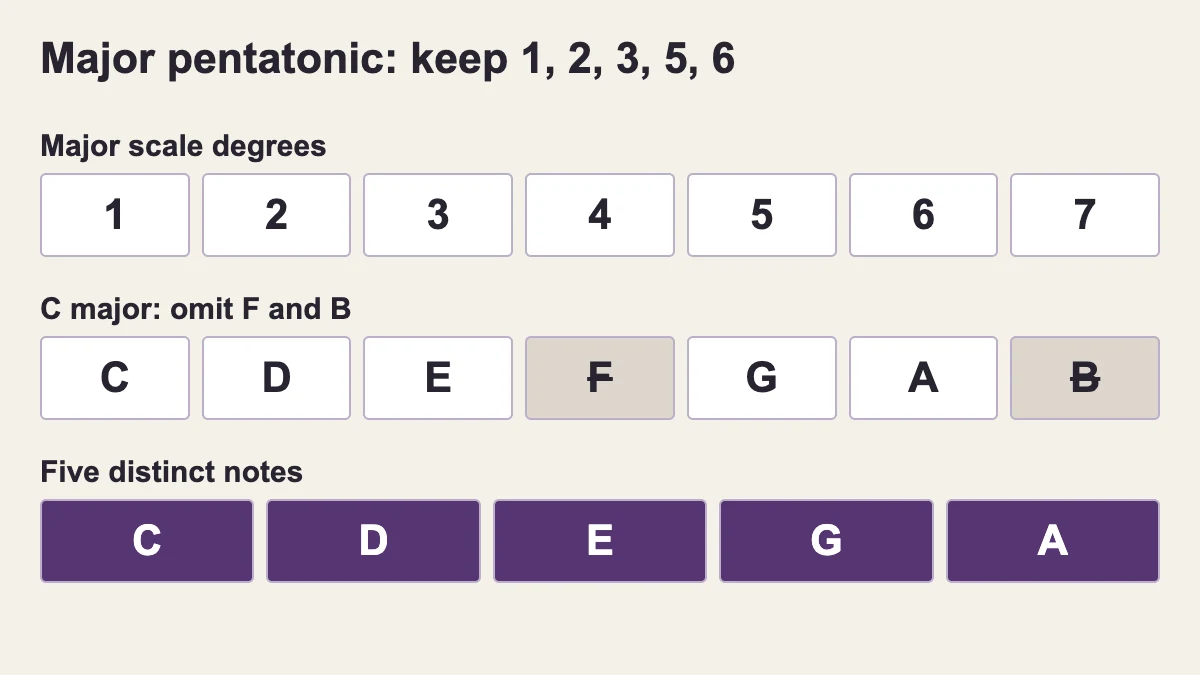
The diagram keeps the complete major-scale reference visible so you can see what was omitted. When writing your own version, label the notes before removing anything. If the underlying major scale is wrong, a correctly remembered “leave out four and seven” instruction will still produce the wrong answer. Check the source collection with the major scale guide when necessary.
Build minor pentatonic without confusing the flat signs
The common minor pentatonic formula is 1–flat 3–4–5–flat 7, measured against a major scale on the same tonic. On A, the notes are A, C, D, E and G. Flat 3 means that the major third C-sharp has been lowered to C; it does not mean the answer must literally contain a flat symbol. On C, the same formula produces C, E-flat, F, G and B-flat, so flat symbols do appear.
You can also start with the natural minor scale and omit its second and sixth degrees. A natural minor is A–B–C–D–E–F–G; omitting B and F leaves A–C–D–E–G. These are two routes to the same common form. Keep the reference explicit. “Lower the third” means something different if you have already begun from a minor collection whose third is lowered.
The ascending semitone steps of minor pentatonic are 3–2–2–3–2. Compare that pattern with the major form rather than mixing the two. From A to C there are three semitones; from C to D, two; from D to E, two; from E to G, three; and from G back to A, two. Counting these gaps gives you an independent check on a spelling or keyboard mistake.
| Major tonic | Major pentatonic notes | Relative minor pentatonic notes |
|---|---|---|
| C | C – D – E – G – A | A – C – D – E – G |
| G | G – A – B – D – E | E – G – A – B – D |
| D | D – E – F-sharp – A – B | B – D – E – F-sharp – A |
| A | A – B – C-sharp – E – F-sharp | F-sharp – A – B – C-sharp – E |
| E | E – F-sharp – G-sharp – B – C-sharp | C-sharp – E – F-sharp – G-sharp – B |
| B | B – C-sharp – D-sharp – F-sharp – G-sharp | G-sharp – B – C-sharp – D-sharp – F-sharp |
| F-sharp | F-sharp – G-sharp – A-sharp – C-sharp – D-sharp | D-sharp – F-sharp – G-sharp – A-sharp – C-sharp |
| D-flat | D-flat – E-flat – F – A-flat – B-flat | B-flat – D-flat – E-flat – F – A-flat |
| A-flat | A-flat – B-flat – C – E-flat – F | F – A-flat – B-flat – C – E-flat |
| E-flat | E-flat – F – G – B-flat – C | C – E-flat – F – G – B-flat |
| B-flat | B-flat – C – D – F – G | G – B-flat – C – D – F |
| F | F – G – A – C – D | D – F – G – A – C |
The same five notes can point toward a different home
C major pentatonic and A minor pentatonic share C, D, E, G and A. They differ in tonic and in the way a phrase emphasises that tonic. Merely starting on A once does not guarantee that a passage will sound like A minor. The ending, bass support, longer notes and repeated points of arrival all contribute to the perceived centre.
Try the original phrase E–G–A–G–E–D–C, ending with a longer C over a C bass note. Then try C–D–E–G–E–C–A, ending with a longer A over an A bass note. The note collection stays the same. The destination and accompaniment change. Keep the tempo and general volume similar so that the comparison is about the musical centre rather than an unrelated dramatic change in performance.
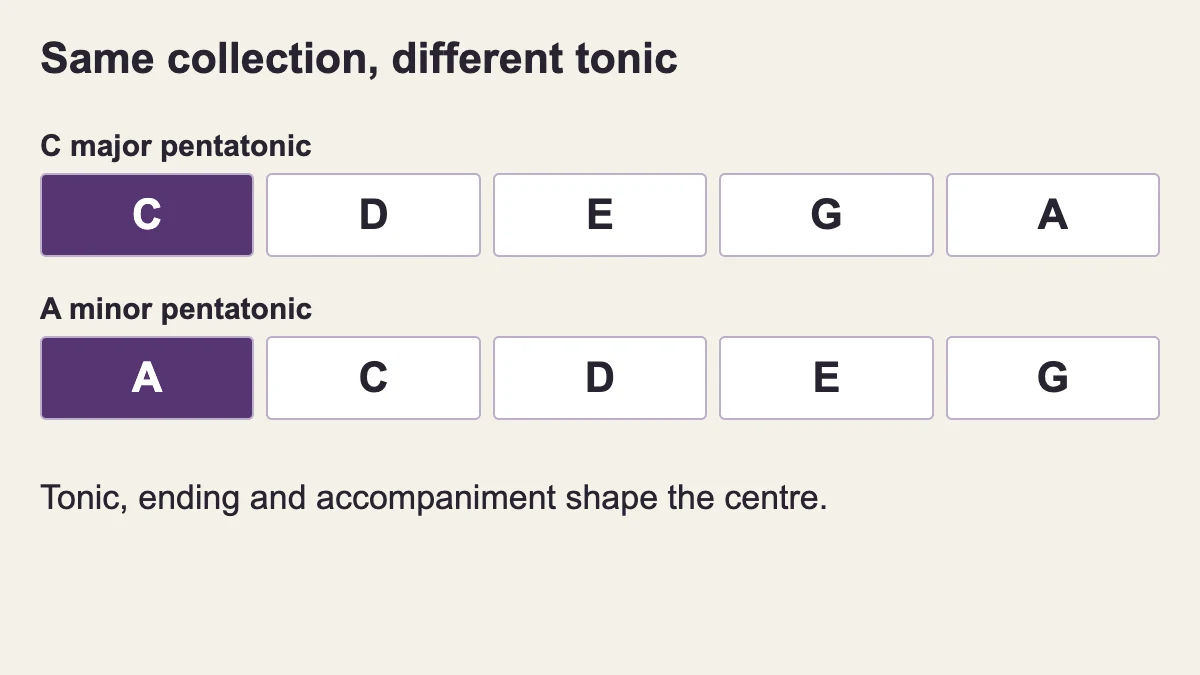
Next, reverse the experiment: keep the melodic phrase the same and change only the bass. Listen before deciding whether the new version feels settled, open or tense. There is no need to invent a score for a subjective reaction. Write a simple observation such as “the final C feels less final over A” and repeat the comparison. The purpose is to notice relationships, not to prove that major and minor always produce fixed emotions.
Relative and parallel pentatonic scales
C major pentatonic and A minor pentatonic are relative collections: they share notes but centre on different tonics. C major pentatonic and C minor pentatonic are parallel forms: they share the tonic C but not all their notes. The major version contains D, E and A alongside C and G; the minor version contains E-flat, F and B-flat alongside C and G.
That parallel comparison is useful for hearing the role of the third. Play C–E–G and then C–E-flat–G, keeping the register and rhythm fixed. Afterwards expand to the two five-note forms. You are not making C major pentatonic minor by lowering every note or by starting at a different spot in its own list. Changing the form on the same tonic changes specific pitch relationships.
The circle of fifths guide can help organise relative major/minor key relationships, while the minor scale guide explains the full seven-note forms. Neither chart replaces listening to where a phrase settles. Use written relationships to choose a manageable comparison, then test it with actual sound.
Turn a scale into a phrase instead of a staircase
Playing five ascending notes accurately is a useful first check, but it does not automatically create a convincing musical sentence. Start with only three notes from the collection. In C major pentatonic, choose E, G and A. Make a short question that finishes on A, leave a rest, then answer with G–E–C. The rest separates the two ideas and the final C provides a different destination.
Keep the first version rhythmically simple: one note on each beat and a longer final note. Then change only the rhythm, repeating one note and leaving another beat silent. If you alter the rhythm, direction, register and notes at the same time, you cannot easily hear which choice improved the phrase. Small controlled changes make creative practice easier to evaluate.
A useful limit is to allow no more than one leap before a step or repeated note. Another is to end every second phrase on a chosen chord tone. These are practice constraints, not composition laws. Their purpose is to stop your hand from automatically running the same scale shape while your attention drifts. Remove a constraint when it has helped you hear a particular feature.
Chord tones and the notes between them
Over a C major triad, C, E and G belong to the chord. D and A belong to C major pentatonic but not to that basic triad. A note can belong to the scale without providing the same resting effect as a chord tone. Try holding D over C–E–G, then move to E. Compare a long A with a return to G. Describe the difference you hear without treating every tension as an error.
When the harmony changes, recheck your destination. The note that sounded stable over one chord may feel less settled over the next. Beginners often hear that difference and conclude they used the wrong pentatonic pattern. Sometimes the collection is perfectly reasonable but the phrase needs a different emphasis or ending. Our piano chord reference helps you identify the actual chord tones rather than guessing from a scale name.
Do not assume one pentatonic collection is automatically suitable over every chord in any song. Style, chord quality and melodic intent matter. For early practice, use one clearly stated major or minor chord and the matching same-tonic form. Add changing harmony after you can hear the relationship in the simpler setting. This keeps the exercise understandable and avoids the unhelpful promise that five notes make mistakes impossible.
What changes when a blues note is added?
A common six-note minor blues scale adds the flattened fifth to minor pentatonic. On A, that gives A–C–D–E-flat–E–G. Because a sixth distinct pitch class has been added, this particular collection is no longer pentatonic. The added note can be used briefly to connect neighbouring notes, but its effect depends on the phrase and harmony. It is not a button that makes every pattern sound stylistically convincing.
First play A–C–D–E–G without the added note. Then compare A–C–D–E-flat–E–G slowly. Listen to the local movement around D, E-flat and E. Keep the rest of the example unchanged. You can hear what was introduced more clearly than by switching between two unrelated fast licks. No copyrighted song phrase is needed for this comparison.
Practice tasks with explained answers
Work without the answer for a moment, then check both the result and the reasoning. Some tasks ask you to construct a collection; others ask you to repair a formula, choose a destination or change only one feature of a phrase. The goal is to connect written notes with a decision you can actually hear, not to collect a high score by memorising the order of answers.
Count the collection, not the attacks
C–D–E–G–A–C contains six written notes. Why is it still C major pentatonic?
Show explained answer
The final C repeats the starting pitch class in another octave. There are five distinct members: C, D, E, G and A. Count those before counting noteheads. Repeating a note, changing its duration or moving it to another octave changes the phrase but does not automatically add a new member to the scale.
Find the missing degree
Someone writes C major pentatonic as C–D–E–F–G. It contains five notes. What condition has not been met?
Show explained answer
The note count is correct but the interval pattern is not the common major pentatonic form. Degree four F should be omitted and degree six A retained, giving C–D–E–G–A. Five-note collections can differ; specifying major pentatonic tells you more than simply requesting any five pitches. Check both the label and its formula.
A flat degree without a flat symbol
Why does A minor pentatonic use C rather than C-flat when its formula says flat 3?
Show explained answer
The formula refers to the A major third, C-sharp. Lowering that pitch by a semitone produces C natural. The flat sign in the degree formula expresses a relationship, not a command to attach a flat to every final note name. State your reference scale first, then spell the resulting pitch.
Construct G major pentatonic
Start from G–A–B–C–D–E–F-sharp. Which notes remain when degrees four and seven are omitted?
Show explained answer
G, A, B, D and E remain. C and F-sharp are removed. The full G major scale has a sharp, but this pentatonic subset happens not to contain that degree. Do not invent a sharp in the shorter collection just because its parent key has one. The formula selects particular degrees, not a required accidental count.
Construct D minor pentatonic
From D natural minor, D–E–F–G–A–B-flat–C, remove the two appropriate degrees.
Show explained answer
Remove degree two E and degree six B-flat. The result is D–F–G–A–C. Its gaps returning to D are three, two, two, three and two semitones. Use that step pattern to cross-check the answer. The minor character is not defined by how many flat signs survive in the final list.
Hear a different ending
Over a C major chord, compare E–G–A with E–G–C, holding the last note for the same duration. What should you observe?
Show explained answer
Both use C major pentatonic notes, but the final A is not a member of the basic C major triad, whereas C is its root. Listen for a different degree of arrival rather than declaring one phrase universally correct. Keep accompaniment and rhythm unchanged so the destination is the meaningful variable.
Change rhythm without changing the collection
Make two versions of C–E–G–E–D–C: one with equal durations and one with a rest before the final C.
Show explained answer
The collection stays unchanged. The rest alters grouping and expectation, so the final C may feel more separated or deliberate. Write the rhythm as well as the note names if you want to repeat the experiment. Counting scale members cannot tell you whether a phrase has effective rhythmic shape.
Identify an added blues note
A–C–D–E-flat–E–G contains the A minor pentatonic notes plus which addition, and how many distinct pitch classes now appear?
Show explained answer
E-flat is the added flattened fifth relative to A. Six distinct pitch classes appear, making this the common six-note minor blues collection rather than an unchanged pentatonic scale. Compare the movement through D–E-flat–E slowly. The added note has a local role; it does not justify using every chromatic pitch without considering the phrase.
Build a session around one audible problem
Start by choosing a single tonic and form. Name its five notes without playing, then check them slowly. Next, choose a two- or three-note fragment and give it a clear ending. Leave enough silence to remember the fragment before repeating it. If you cannot recall what you just played, shorten it. A smaller phrase that you can recognise is more useful than a long run that vanishes from memory immediately.
Use the online metronome for a steady reference once the notes are secure. Choose a comfortable tempo rather than a target copied from somebody else’s practice video. If you begin anticipating the click or pausing before a jump, reduce the task: fewer notes, one hand or a slower pulse. Change one of those conditions at a time so the improvement has an identifiable cause.
In the next stage, keep the same fragment but choose a different ending. Compare ending on the tonic, third and fifth of the supporting chord. Make a short note about which version sounded more final and which sounded ready to continue. There is no universal ranking; you are learning to make an intentional choice. Revisit the comparison at another register before assuming your observation applies to every performance.
At the end, write down the exact notes, rhythm and accompaniment you used. “Practised pentatonic” is too broad to help tomorrow. “C major pentatonic; E–G–A question, G–E–C answer; one beat per note; C bass” is a repeatable starting point. Add one observation, such as “the rest made the answer clearer,” and one next step. A useful record describes the task, not an invented talent score.
Common questions
Are all five-note scales the same major/minor pattern?
No. Pentatonic describes the number of distinct pitch classes, while different five-note collections can have different interval structures. This page covers two common forms used in beginner tonal practice. It does not reduce every musical tradition’s five-note system to one keyboard pattern or claim that all pentatonic music follows the same harmonic conventions.
Do I need to learn guitar box shapes to understand this?
No. Guitar shapes are instrument-specific ways of locating notes. The formula, tonic and pitch relationships apply independently of a particular fingering diagram. On piano, melodica, bass or another instrument, first find the correct notes and use technique appropriate to that instrument. Do not copy a guitar fingering explanation onto a keyboard and expect the physical instructions to transfer.
Is a pentatonic scale easier than a full major scale?
It offers fewer pitch choices, which can make a first improvisation more manageable. That does not remove the need for rhythm, phrasing and control. A five-note passage can be musically demanding, while a slow seven-note scale can be straightforward. Match the difficulty to the actual task rather than assuming that note count alone measures skill.
Should every practice phrase finish on the tonic?
No. Ending on the tonic is a helpful way to hear a clear arrival while learning. Other destinations can create continuation or a different colour. Use tonic endings as one controlled experiment, then deliberately compare alternatives. A rule that helps you isolate a concept should not become an unnecessary restriction on every musical idea you make.
Reference checks
The major and minor pitch formulas were checked against the instructor-written major pentatonic lesson and minor pentatonic lesson at StudyBass. KulakApp’s diagrams and phrase tasks are original; no source recording, notation image or song exercise is reproduced here.