Circle of fifths: find key signatures and understand related keys
The circle of fifths arranges keys so that neighbouring major keys differ by one note in their key signatures. Starting with C major, move clockwise through G, D, A and E to add sharps; move the other way through F, B-flat and E-flat to add flats. Use the chart to answer a particular question, such as finding a key signature or a relative minor, rather than trying to memorise an unexplained wheel.
This guide separates three ideas that are often squeezed into the same diagram: the order of key signatures, the relationship between major and minor keys, and the movement of chord roots. They are connected, but they are not interchangeable. You do not have to play every chord in circle order, and a key signature alone does not prove where a piece feels at home.
What does a step around the circle mean?
Count C, D, E, F, G: the interval from C upward to G spans five letter names, including both ends. On a normally tuned keyboard that perfect fifth spans seven semitones. The next clockwise relationship is G to D. You can place the new D in a comfortable register; the diagram concerns pitch classes and key relationships, not a melody that must keep climbing indefinitely.
A downward perfect fifth from C reaches F in the octave below. If you choose F above C instead, you have moved up a perfect fourth. This explains why the counter-clockwise direction is sometimes described using fourths. The destinations on the map can match even though the sounding intervals and register of an actual performance differ. Always say which direction and octave you mean when an exercise asks for an interval.
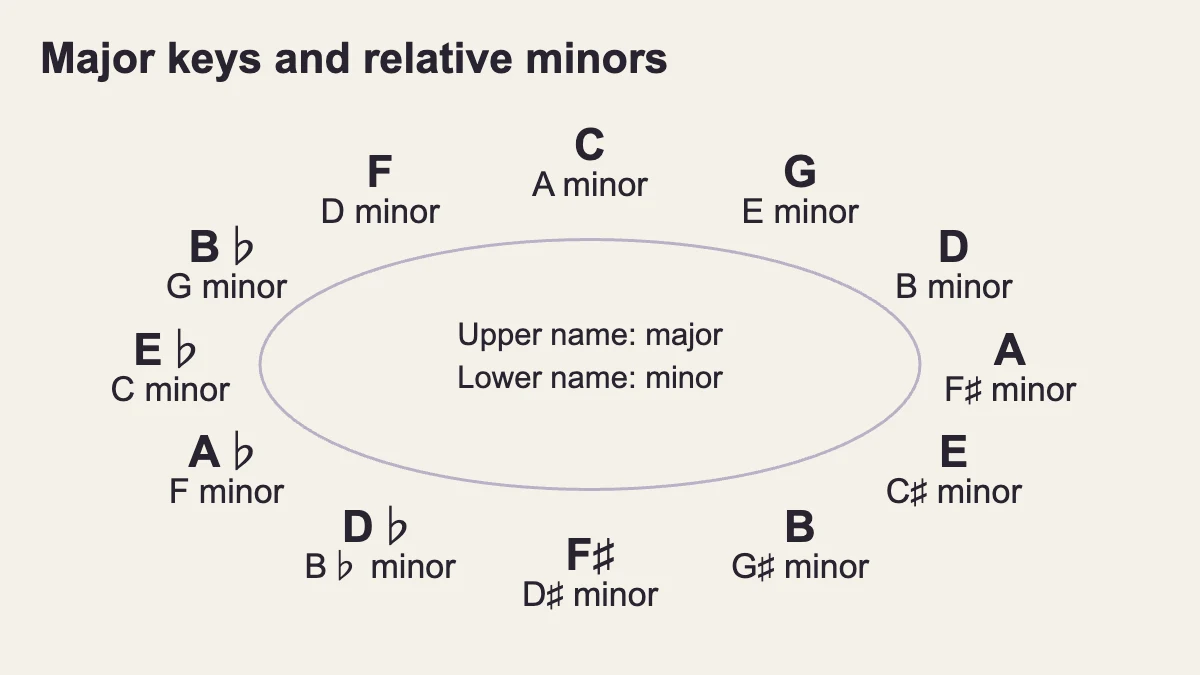
The diagram uses familiar spellings to keep twelve positions readable. At the meeting point of sharp and flat spellings, F-sharp and G-flat share a piano key in equal temperament but belong to differently written scales. Treat a slash between them as a spelling choice, not an instruction to combine both key signatures. For written music, continue with the spelling that makes the note names and harmonic relationships clear.
Read the signature before you name the key
A key signature is the group of sharps or flats placed after the clef. It affects the named pitches throughout the music, subject to the usual cancellation and local accidental rules. It is different from an accidental attached to an individual note. If you count every sharp you happen to see in a passage as part of the signature, you can mistake a brief chromatic alteration for an entirely different key.
First identify the actual signature. Then list the altered letter names in their conventional order. Sharps enter as F, C, G, D, A, E, B; flats enter as B, E, A, D, G, C, F. With three sharps, you have F-sharp, C-sharp and G-sharp, not any three black keys. The count and identity must agree. A piano key’s colour cannot replace its musical spelling: E-sharp is a white key despite having a sharp sign.
For a major key with sharps, the last sharp is its leading tone; go up a semitone using the next letter name to find the tonic. If the last sharp is C-sharp, the major key is D. With flats, the next-to-last flat names the major key when there are at least two flats. Two flats, B-flat and E-flat, therefore point to B-flat major. The one-flat case is F major; there is no next-to-last flat to inspect.
| Major key | Relative minor | Signature notes |
|---|---|---|
| C major | A minor | No sharps or flats |
| G major | E minor | F-sharp |
| D major | B minor | F-sharp, C-sharp |
| A major | F-sharp minor | F-sharp, C-sharp, G-sharp |
| E major | C-sharp minor | F-sharp, C-sharp, G-sharp, D-sharp |
| B major | G-sharp minor | F-sharp, C-sharp, G-sharp, D-sharp, A-sharp |
| F-sharp major | D-sharp minor | F-sharp, C-sharp, G-sharp, D-sharp, A-sharp, E-sharp |
| D-flat major | B-flat minor | B-flat, E-flat, A-flat, D-flat, G-flat |
| A-flat major | F minor | B-flat, E-flat, A-flat, D-flat |
| E-flat major | C minor | B-flat, E-flat, A-flat |
| B-flat major | G minor | B-flat, E-flat |
| F major | D minor | B-flat |
Do not force every question through a shortcut. C major has no sharps or flats, so neither last-sharp nor next-to-last-flat works. It is the reference case. Once you recognise that limitation, the rules become more reliable: each has a defined situation rather than being a trick you must somehow apply to every piece of notation.
Why one new sharp is enough
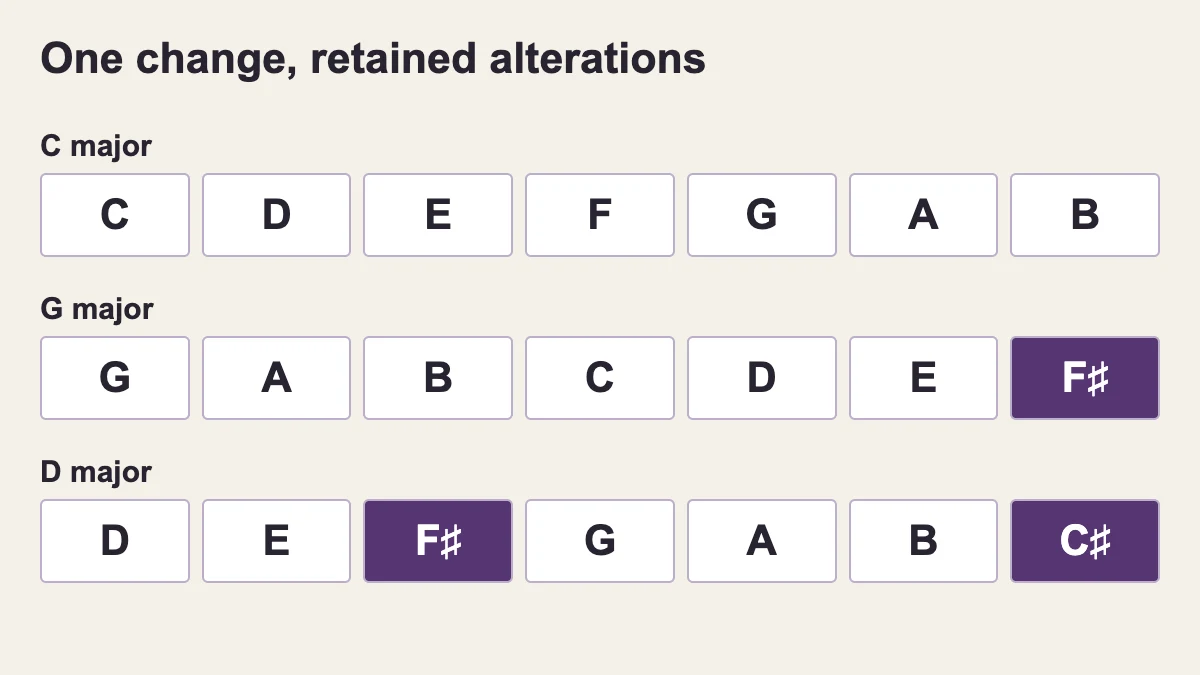
Compare the C major collection C, D, E, F, G, A, B with the G major collection G, A, B, C, D, E, F-sharp. Six letter-name pitches stay the same; F becomes F-sharp. The shared notes explain their adjacency on the circle. The new sharp supplies the correct semitone just below the new tonic G. It does not mean you sharpen every F because G sounds brighter or because the black keys are generally more advanced.
Now compare G major with D major. Retain F-sharp and change C to C-sharp. The circle keeps the previous alteration and adds one more. A common beginner error is to replace the previous sharp instead, leaving D major with only C-sharp. Check the entire signature, not just its newest sign. The diagram below makes the retained and changed notes separate so you can trace the relationship without relying on colour alone.
Relative minor is not parallel minor
A major key and its relative minor share a key signature. C major and A minor share an empty signature; G major and E minor share F-sharp. Find the sixth degree of the major scale to locate the relative minor tonic. Alternatively, move down a minor third from the major tonic, taking care with the spelling. The same notes may serve different centres, so a shared signature does not make the two keys musically identical.
Parallel keys share a tonic instead: C major and C minor. Their signatures differ. If a question asks for the relative minor of E-flat major, keeping E-flat as the tonic and calling the result E-flat minor answers a different question. The sixth degree of E-flat major is C, so the relative minor is C minor. Write the words “same signature” or “same tonic” beside a practice question before solving it if you often mix them up.
Minor-key music can raise its sixth or seventh degree without replacing the basic signature. In A minor, a local G-sharp can create a leading tone toward A. That does not turn the written signature into the one-sharp signature of E minor. Our natural, harmonic and melodic minor guide explains those changes. Here, keep the base signature separate from the accidentals a phrase needs.
Finding a likely tonal centre in real notation
Suppose you see one sharp. G major and E minor are immediate candidates, but the page may also use modes, move between keys or avoid a strong tonal centre. Look at more than the first note. Ask where phrases come to rest, which bass notes recur at important points and which chord supports the ending. A pickup or an opening chord can point away from the eventual tonic.
For a small listening experiment, play G–B–D, then D–F-sharp–A, then G–B–D again. Compare E–G–B, B–D-sharp–F-sharp, E–G–B. These original chord sequences make different arrivals possible even though G major and E minor share a base signature. Listen without promising yourself a particular emotional label: register, rhythm and voicing can change the impression substantially.
You can check these note names with the virtual piano. Play at a moderate listening level and start each sound yourself; no sound needs to run automatically while you read. A short keyboard check supports the explanation, but it is not evidence that you can already recognise every key by ear. For that, compare repeated examples and track what you actually identify.
A circle of keys is not a mandatory chord progression
On the key-signature circle, moving from C to G means comparing C major and G major. Inside a piece in C major, moving from a C chord to a G chord can stay entirely in C major. The letter G appears in both discussions, but the operation is different. One concerns a collection and tonal centre; the other concerns the current harmony within a phrase.
A descending-fifth root movement such as D to G to C can support a ii–V–I progression in C: D minor, G major, C major. Notice the chord qualities. Simply reading “D, G, C” around a diagram does not tell you that the first chord should be minor in this diatonic example. Build each chord from the chosen key or from an explicitly stated chromatic alteration before drawing harmonic conclusions.
Try D–F–A, G–B–D and C–E–G in that order. Then hold the pitch D where it belongs in the first two chords and move other notes a short distance. You are beginning to connect root relationships with voice leading. If forming the chords itself is still slow, return to the piano chord guide; the circle is a navigation aid, not a substitute for knowing which notes are in a chord.
Enharmonic spelling at the bottom of the wheel
In equal temperament, F-sharp major and G-flat major use the same piano keys but assign different letter names. F-sharp major contains E-sharp, while G-flat major contains C-flat. A chart that hides those spellings can make the keys look less complicated, but the simplification becomes misleading when you read a staff or write a melody. A seven-note scale normally needs each letter name once before the octave repeats.
Choose a notation and follow it consistently for the exercise. In F-sharp major, F-sharp–G-sharp–A-sharp is an ascending stepwise beginning. Replacing A-sharp with B-flat keeps the keyboard pitch but changes the written relationship. The problem is not that B-flat is an unpleasant sound; it is that your label no longer shows the intended third scale degree. This distinction matters when you transpose or discuss intervals with another musician.
The twelve-position wheel is also a simplification tied to the usual twelve-note keyboard system. You do not need tuning-history calculations to use it for beginner key signatures, but avoid claiming that every tuning system makes twelve perfect fifths close in exactly the same way. The practical scope here is conventional major/minor notation and an equal-tempered keyboard.
Solved practice: choose a method before answering
For each task, cover the answer, write your reasoning and only then compare. A correct key name reached by a guess is less useful than a short explanation you can reuse. The tasks deliberately vary: some ask for a signature, others a relative minor, a changed note or an error diagnosis. Work through a few at a time rather than treating the whole section as a speed test.
Two sharps, with a major-key answer
The signature contains F-sharp and C-sharp. Which major key fits, and why is G major not the answer?
Show explained answer
D major fits. The last sharp is C-sharp, a semitone below D. G major accounts for F-sharp but not the second sign. Name the complete signature before applying the leading-tone shortcut. On a keyboard, compare C and C-sharp before D to check the changed relationship.
Three flats without counting piano colours
A signature contains B-flat, E-flat and A-flat. Find its major tonic without counting black keys.
Show explained answer
E-flat major is the answer: the next-to-last flat is E-flat. The signature names altered letter pitches, not a quantity of black keys. Write E-flat as the tonic and keep all three flats when constructing the full scale. Omitting A-flat would give a different collection even if the tonic name stayed correct.
The one-flat exception
You see only B-flat in the signature. A friend says the next-to-last-flat rule cannot work, so the key is unknowable. What is missing?
Show explained answer
The rule has an exception, not a failure of notation. F major has one flat, B-flat. There is no next-to-last sign to read. Recognise this reference case directly, then check F–G–A–B-flat–C–D–E. D minor shares the signature, so the music still supplies the major/minor context.
Relative, not parallel
Find the relative minor of B-flat major. Explain why B-flat minor answers another question.
Show explained answer
G minor is relative: G is the sixth degree of B-flat major, and both share B-flat and E-flat. B-flat minor keeps the tonic instead and is parallel to B-flat major. Before calculating, state whether the question preserves the signature or the tonic; that single distinction prevents a common category mistake.
Keep the earlier alteration
Moving from G major to D major, a student replaces F-sharp with C-sharp. Repair the explanation.
Show explained answer
Keep F-sharp and add C-sharp. A clockwise step adds the next sharp; it does not exchange the entire signature. Write both collections with the same letter order to spot the one changed pitch. Then name D major’s two alterations together rather than remembering only its newest sharp.
Local leading tone in minor
An A minor phrase uses G-sharp before A. Must its base signature become one sharp?
Show explained answer
No. The G-sharp is a local leading-tone alteration, not the F-sharp signature shared by G major and E minor. Keep signature and accidentals separate. Inspect where the sign occurs on the page and what note it changes. Hearing a strong arrival on A supports the local explanation but does not rewrite the printed signature.
A spelling choice at one keyboard pitch
In F-sharp major, a student writes the seventh degree as F natural because the piano key matches E-sharp. What should change?
Show explained answer
Write E-sharp. The scale uses the letter E for degree seven and F-sharp for its tonic. F natural may locate the same key in equal temperament, but it hides the stepwise seventh-to-tonic relationship. Verify letter names as well as semitone distances; either check alone can miss this error.
Chord change or key change?
A piece in C major plays C–E–G followed by G–B–D. Does this automatically establish G major as a new key?
Show explained answer
No. The G major triad is already diatonic to C major. More musical context is needed to establish a new tonal centre. Keep the existing signature unless the notation or analysis gives a reason to change it. The key-signature circle describes related keys; it does not turn every chord change into modulation.
A short routine that builds several connections
Begin by drawing only C, G and F. Write their signatures underneath: none, F-sharp, B-flat. Add A minor, E minor and D minor beside the matching major keys. Say what each pair shares, then say what the three major keys differ in. This small map is enough to practise direction, signatures and relative keys without overwhelming the page with labels.
In the next session, add D major and B-flat major. Before looking at the chart, predict which existing alteration stays and which new one appears. Then play just the changed note followed by the new tonic. For D major, compare C natural to C-sharp before D; for B-flat major, compare E natural to E-flat within the scale. You are checking the reason for the written change, not merely its position in a list.
Record errors by category: wrong direction, forgotten previous accidental, incorrect relative tonic or inconsistent enharmonic spelling. A page of wrong answers labelled only “theory mistakes” gives you little guidance. If every error is a forgotten earlier sharp, spend the next session copying and naming complete signatures. If the notes are right but major/minor centres are confused, compare short endings by ear instead of rewriting the same diagram.
One practical record has four columns: task, your answer, correction and next check. For example, “three sharps; answered E major; correct A major; name all three sharps before finding the leading tone.” The final column turns a correction into a repeatable action. Revisit a missed task after working on a different one, rather than immediately copying the correct answer several times without recall.
Questions that often slow beginners down
Must I memorise the complete circle before playing music?
No. Start with the keys your current music uses and expand the map as needed. Knowing how to derive a signature is useful even before recall becomes quick. A player can make good musical progress while still consulting a chart; the aim is to reduce avoidable uncertainty, not to pass an invented entry test before touching an instrument.
Can the chart tell me which chord comes next?
It can suggest relationships, not decide the next chord for every style and phrase. Rhythm, melody, harmonic function, voice leading and the intended effect all matter. Use a nearby chord as an experiment and listen to the result. Do not label a progression wrong merely because its roots do not travel consecutively around the wheel.
Why do some diagrams show more than twelve written keys?
Some include both spellings at enharmonic positions, such as B/C-flat, F-sharp/G-flat and C-sharp/D-flat. They are showing written signatures as well as keyboard pitch classes. Check the legend. Counting labels from one chart and sectors from another can create an apparent contradiction when the diagrams are simply displaying different amounts of spelling information.
Should I practise the chart with a metronome?
Use a steady pulse when playing a short example, but do not rush the reasoning phase. First identify the key accurately; then practise making the physical change in time. Increasing tempo while the signature is still uncertain tends to mix a knowledge problem with a coordination problem, making both harder to diagnose.
After this guide, use the major scale notes and formula to check a full key, or try the pentatonic practice guide to make short phrases from a smaller collection. Keep each next step tied to a question you want to hear or play, not just another chart to memorise.
Reference checks
The key-signature and relative-key definitions were checked against the university textbook sections Major Key Signatures and Minor Key Signatures. The diagrams, examples, explanations and practice tasks on this page were created for KulakApp; they are not copied textbook exercises.