Minor scales: natural, harmonic and melodic forms explained through practice
Natural minor follows the step pattern whole, half, whole, whole, half, whole, whole. Harmonic minor raises its seventh degree by a half step. The familiar classical melodic-minor exercise raises both the sixth and seventh degrees when ascending, then returns through natural minor when descending. These are related ways of organising minor-key material, not instructions that every melody must obey simply because it moves up or down.
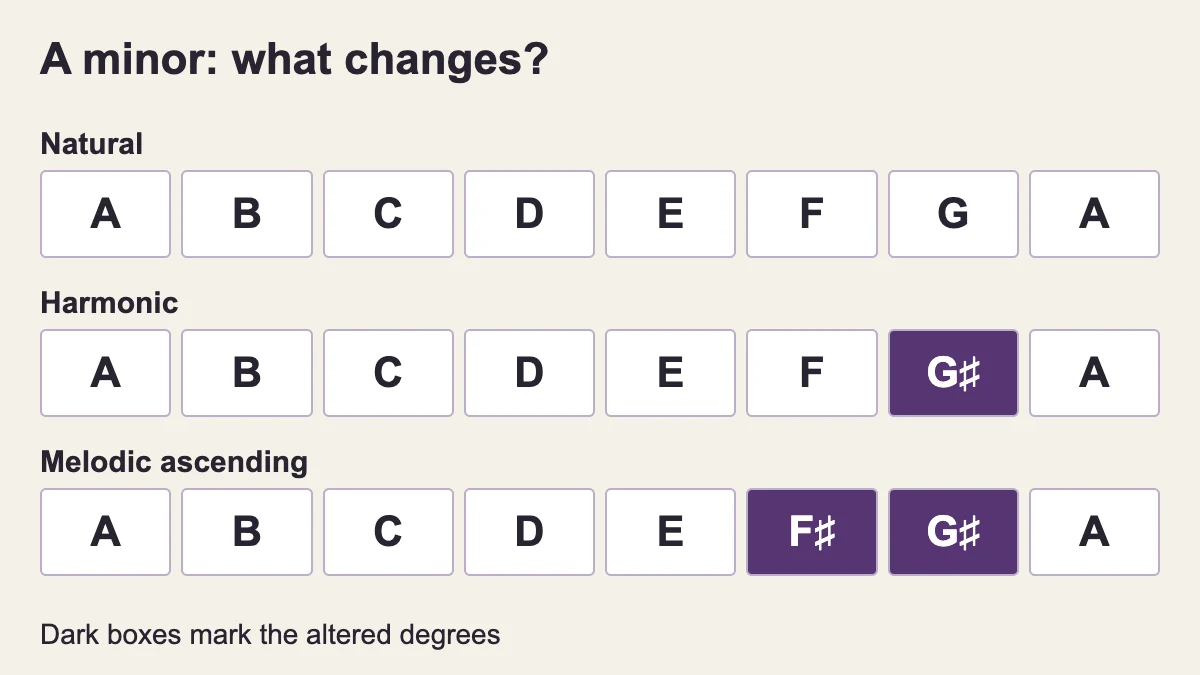
Start with A minor so the changes are visible: natural minor uses A, B, C, D, E, F, G; harmonic minor changes G to G-sharp; ascending melodic minor changes F to F-sharp as well. Keep A as your reference while comparing them. This guide develops that comparison with other roots, written-note checks, original listening tasks and explained answers.
Build a natural minor scale without guessing
A scale degree describes a note’s place relative to the starting pitch, or tonic. In A minor, A is degree one, B is two and C is three. These numbers are not finger numbers and do not specify an octave. They let you describe a relationship that can be recreated from another tonic without keeping the same letter names.
On an equal-tempered piano, a half step moves to the neighbouring key, black or white. A whole step is two half steps. Starting on A, move two half steps to B, one to C, two to D, two to E, one to F, two to G and two back to A an octave higher. Count movements, not the starting key: A represents zero distance at the beginning.
The natural-minor half steps occur between degrees two and three, and five and six. In A minor those pairs are B–C and E–F. Notice that the keyboard has no black key between each of these pairs. That is a consequence of this example’s note choices, not a rule that all minor scales use only white keys.
Try the same pattern from D. It produces D, E, F, G, A, B-flat, C, D. If you keep B-natural, the gap from A to B becomes a whole step where natural minor needs a half step. Finding that exact mismatch is more useful than deciding that the scale sounds vaguely wrong and starting over without knowing why.
Keep one letter for each degree
A seven-note scale normally uses each letter name once before returning to the tonic. For D minor, write D, E, F, G, A, B, C, D first, then add the required flat to B. Calling that key A-sharp instead would create two different A letters and omit B. The piano sound can match while the spelling fails to show the scale’s structure.
This two-stage method helps when the root already contains an accidental. For C-sharp natural minor, the letters remain C, D, E, F, G, A, B, C, adjusted to C-sharp, D-sharp, E, F-sharp, G-sharp, A, B, C-sharp. Do not choose a fresh letter whenever a black key appears. Choose the letter sequence first and let the required distance determine the accidental.
If sharps and flats still feel like names for black keys only, revisit the sharps and flats guide. A raised note can land on a white key. A lowered note can do the same. That becomes particularly important when comparing minor scales that already include flats in their natural form.
What harmonic minor changes
Harmonic minor raises degree seven of natural minor while leaving the other degrees unchanged. In A minor, G becomes G-sharp. The distance from G-sharp to the upper A is now a half step, creating a leading tone. Natural minor’s G lies a whole step below A and is commonly called the subtonic instead.
Listen to E–G–B, then E–G-sharp–B, followed each time by A–C–E. In the second version the E chord is major rather than minor. The change helps illustrate how the seventh degree of A minor affects a chord built on degree five. It does not mean the minor version of that chord is forbidden; the choice depends on the musical setting.
There is another consequence: F to G-sharp spans three half steps. Because the letters are adjacent, this is an augmented second, not a minor third in the written scale. The two intervals can occupy the same number of piano keys, but they describe different letter relationships. Say “six to raised seven” while checking that distinctive gap.
Harmonic minor’s ascending step sizes are two, one, two, two, one, three, one half steps. Use the numerical pattern as a check, not as a substitute for spelling. If you label G-sharp as A-flat in A harmonic minor, you can reproduce the pitches but obscure the seventh degree. The written name explains how that pitch leads to A.
Why melodic minor also changes degree six
The standard ascending melodic-minor form raises degrees six and seven of natural minor. In A minor the upper portion becomes E–F-sharp–G-sharp–A. Raising F reduces the augmented-second gap found between F and G-sharp in harmonic minor. The full ascending scale is A, B, C, D, E, F-sharp, G-sharp, A.
In the common classical scale exercise, the descent uses natural minor: A, G, F, E, D, C, B, A. This is a useful technical convention to learn, especially when a teacher or method book explicitly asks for melodic minor. It should not be expanded into the claim that every descending minor melody must lower six and seven. Actual harmony and melodic context also matter.
In jazz terminology, “melodic minor” often refers to the raised-six-and-seven form in either direction, also called jazz minor. The terminology difference is also explained in StudyBass’s melodic-minor lesson. Ask which convention an exercise uses before marking its descent wrong. This page labels the two directions explicitly whenever the classical exercise is intended.
Compare only the last four notes first. Natural minor gives E–F–G–A, harmonic minor gives E–F–G-sharp–A and ascending melodic minor gives E–F-sharp–G-sharp–A. The unchanged E and A frame the comparison. If you keep restarting a long scale from its lowest note, it is easy to lose track of the one or two pitches you meant to hear.
Raised does not always mean add a sharp
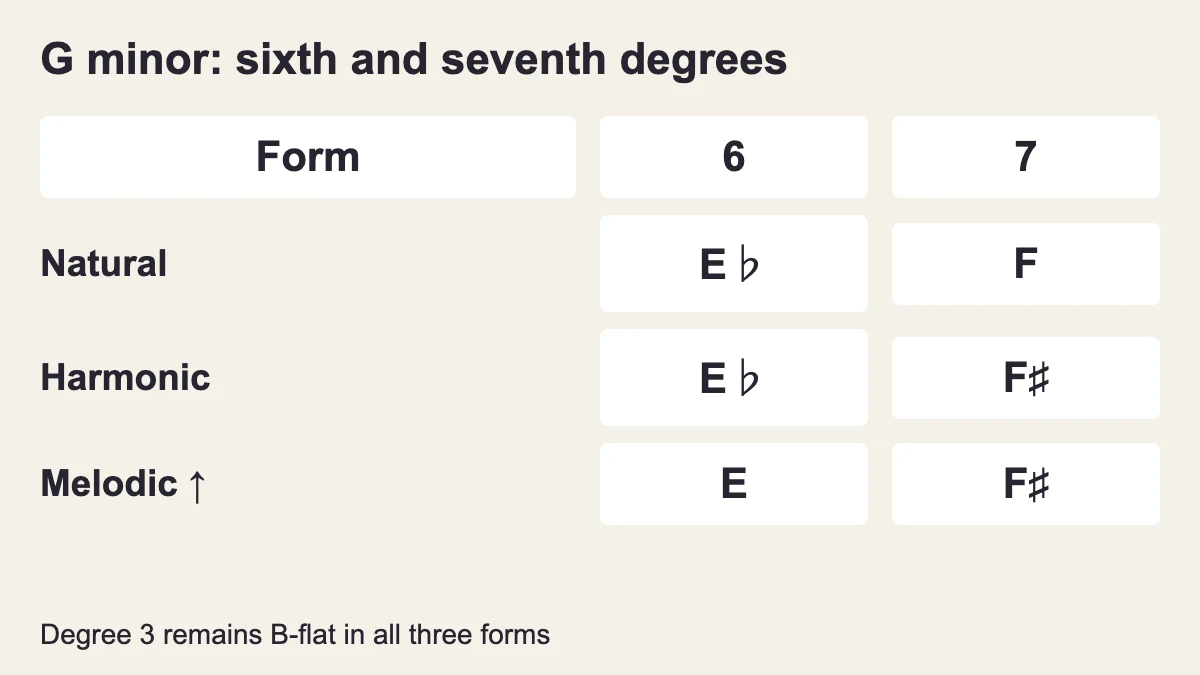
G natural minor uses G, A, B-flat, C, D, E-flat, F, G. To make harmonic minor, raise F to F-sharp. To make ascending melodic minor, also raise E-flat to E-natural. Adding an E-sharp would raise that sixth degree too far. The instruction is to move up a half step from the natural-minor version, not to attach a sharp symbol to every changed letter.
C minor provides another useful check. Its natural form includes A-flat and B-flat. Harmonic minor changes B-flat to B-natural; ascending melodic minor also changes A-flat to A-natural. Read the scale aloud with the full altered names. Dropping “flat” from your spoken comparison can hide precisely the information the exercise is supposed to teach.
Separate the operation from the notation: “raise degree six by one half step” is the operation; a natural or sharp sign is one possible written result. Once that distinction is clear, a less familiar key becomes a calculation you can inspect. You do not have to memorise a separate verbal rule for every accidental combination.
Five minor scales to compare carefully
The chart uses A, D, E, G and C because together they show white-key, sharp and flat examples without overwhelming the first practice session. Each row lists the ascent to the octave. The melodic column means the raised-six-and-seven ascending form. For a classical melodic-minor descent, reverse that row’s natural-minor sequence instead.
| Root | Form | Notes, returning to the octave |
|---|---|---|
| A minor | Natural | A – B – C – D – E – F – G – A |
| A minor | Harmonic | A – B – C – D – E – F – G-sharp – A |
| A minor | Melodic ascending | A – B – C – D – E – F-sharp – G-sharp – A |
| D minor | Natural | D – E – F – G – A – B-flat – C – D |
| D minor | Harmonic | D – E – F – G – A – B-flat – C-sharp – D |
| D minor | Melodic ascending | D – E – F – G – A – B – C-sharp – D |
| E minor | Natural | E – F-sharp – G – A – B – C – D – E |
| E minor | Harmonic | E – F-sharp – G – A – B – C – D-sharp – E |
| E minor | Melodic ascending | E – F-sharp – G – A – B – C-sharp – D-sharp – E |
| G minor | Natural | G – A – B-flat – C – D – E-flat – F – G |
| G minor | Harmonic | G – A – B-flat – C – D – E-flat – F-sharp – G |
| G minor | Melodic ascending | G – A – B-flat – C – D – E – F-sharp – G |
| C minor | Natural | C – D – E-flat – F – G – A-flat – B-flat – C |
| C minor | Harmonic | C – D – E-flat – F – G – A-flat – B – C |
| C minor | Melodic ascending | C – D – E-flat – F – G – A – B – C |
Choose one row and cover the harmonic and melodic columns. Write the natural form yourself, number its degrees, then change seven and finally six. Uncover the answers only after completing the calculation. If one note differs, compare that degree alone and check the half-step distance on a keyboard. Copying all fifteen sequences repeatedly is less diagnostic than finding exactly why one spelling went wrong.
Relative minor and parallel minor answer different questions
C major and A natural minor share a collection of notes and a key signature, so they are relative keys. Their tonic differs. C major and C minor share the same tonic but have different note collections, so they are parallel keys. In the parallel comparison, C natural minor lowers degrees three, six and seven relative to C major.
To find a relative natural minor from a major scale, locate the major scale’s sixth degree. In G major that is E, giving E natural minor with F-sharp. To compare parallel forms, keep G as the tonic instead: G major and G minor. Mixing these operations can produce an answer that has a valid scale but answers the wrong question.
Sharing notes does not make two keys musically interchangeable. Play a short original phrase that settles on C, then another that settles on A, using only white keys. Listen for the different points of rest. A note list or a key signature alone may not establish the key of an actual passage; phrase endings, emphasis and harmony provide additional evidence.
If the major-scale framework needs review, use major scales and their step pattern alongside this section. Compare one tonic at a time. Moving between several unrelated roots while changing both the scale form and the register makes a simple distinction unnecessarily difficult to hear.
Use chords to make the changed notes meaningful
Build the tonic triad of A minor from degrees one, three and five: A–C–E. It stays the same across the three forms discussed here because none changes those degrees. Now build a triad on E. With natural minor you get E–G–B; with raised seven you get E–G-sharp–B. The changed scale degree becomes the third of that chord.
This is why scale-degree numbers and chord-member numbers should not be confused. G-sharp is degree seven relative to A, but the third of an E-major triad. The note has not changed; the reference has. Write both descriptions under the example. That small exercise prepares you to read explanations of dominant harmony without treating every number as an absolute label.
The piano chord guide explains how to construct and check triads. Here, use only the two E chords and A minor at a modest volume. The purpose is to hear the altered pitch in context, not to assert that one sequence is universally better or that every minor-key piece must use the same cadence.
A listening comparison with one variable at a time
Use the virtual piano for a short comparison within the available range, or use your own instrument. Play A as a reference. Sound E–F–G–A, pause, and then E–F–G-sharp–A in the same register. Ask which note changed and whether the final approach to A became smaller. Keep loudness and tempo similar so they do not supply misleading clues.
Next compare E–F–G-sharp–A with E–F-sharp–G-sharp–A. This time the seventh is held constant and the sixth changes. Name the changed degree before repeating. If you cannot identify it, shorten the comparison to F versus F-sharp after the same E reference. A short, controlled contrast can be more useful than guessing the name of an entire unfamiliar scale.
For a written-and-listening task, draw three boxes labelled natural, harmonic and ascending melodic. Write only degrees six and seven in each. Then play the full scale once and point to the relevant box. Do not claim a musical ability score from this small exercise. It checks whether the explanation and the sound currently connect for this particular tonic.
Practise writing, hearing and playing separately
A written error may be a spelling problem even when the intended sound is correct. A keyboard error may be a movement problem even when the notes are named accurately. Keep these observations separate. First write a scale without touching an instrument, then verify the intervals, then play it slowly. If the final stage fails, do not automatically discard the work that was already correct.
On a physical instrument, use fingering appropriate to the instrument and key. This page does not give one universal finger pattern for all minor scales. A browser keyboard also cannot assess wrist movement, breath support or hand tension. If playing becomes uncomfortable, stop that physical task and seek suitable individual instruction rather than forcing extra repetitions to match an arbitrary tempo.
For notation in a lower register, the bass clef notes guide supplies staff landmarks and octave checks. You can write A2–B2–C3–D3–E3–F3–G3–A3 as an octave of A natural minor. Check the staff position and accidental separately so that learning a new clef does not obscure the scale formula.
A practice sequence you can adjust
- Write A natural minor from the whole/half-step pattern and label the degrees.
- Raise seven, name G-sharp and check the final half step to A.
- Raise six as well, name F-sharp and compare the upper four notes.
- Write a classical melodic-minor descent using natural minor in reverse.
- Repeat the same process in G minor, where raising six removes a flat.
- Choose one incorrect answer from your work and explain its correction in a sentence.
There is no required number of days for completing these tasks. Stay with a step until you can explain the changed notes without the chart. At the next session, begin from a different root or ask the questions in a different order. That checks whether you learned a relationship rather than the visual arrangement of one reference table.
Worked questions and error checks
Which note changes in E harmonic minor?
E natural minor is E–F-sharp–G–A–B–C–D–E. Degree seven is D, so harmonic minor changes it to D-sharp. The sixth remains C. If you also change C to C-sharp, you have constructed the ascending melodic form instead. Number the notes before altering them to make that difference visible.
Does G melodic minor need E-sharp?
No. G natural minor has E-flat as degree six. Raising it a half step gives E-natural. Its seventh F becomes F-sharp. The ascent is G–A–B-flat–C–D–E–F-sharp–G. B-flat stays unchanged because this operation does not alter degree three.
Is C-sharp the same correct spelling as D-flat in a scale?
Those names can indicate the same piano key, but they are not interchangeable in every written context. In D harmonic minor, degree seven is C-sharp, leading up to D. Calling it D-flat repeats the letter D and removes C from the scale. Check both sound distance and letter order before accepting an answer.
What happens when A harmonic minor descends?
If the instruction is simply to descend the harmonic-minor scale, reverse its notes: A–G-sharp–F–E–D–C–B–A. Do not automatically lower G-sharp because the direction changed. The familiar natural-minor descent belongs to the classical melodic-minor exercise, not to every scale with “minor” in its name.
Questions that often cause unnecessary confusion
Are minor scales always sad?
No single scale name determines an emotional response. Rhythm, register, harmony, timbre, phrasing and a listener’s experience also matter. For this exercise, describe the audible interval change rather than treating a mood word as a reliable answer key. “The seventh moved closer to the tonic” is a checkable observation.
Should I learn all keys at once?
Start with a root whose notes you can name and verify, then add a contrasting spelling such as G minor. A broad chart is a reference, not a daily workload. Being able to repair a mistaken sixth or seventh in two keys provides a stronger foundation than quickly reciting many scales without understanding the differences.
Sources and scope
The basic forms were checked against Music Theory for the 21st-Century Classroom: Minor Scales; chord context was checked against its Diatonic Chords in Minor section. All comparison charts, diagrams and practice tasks here were prepared for KulakApp rather than copied from those materials. This is a practical introduction, not a complete account of minor-key harmony or a promise of a particular learning outcome.