Piano chords: a beginner’s guide to notes, shapes and smooth changes
To build a basic piano chord, find its root, add its third and then its fifth. C major uses C, E and G; C minor changes E to E-flat. Learning those relationships is more useful than memorising a photograph of a hand. This guide gives you a chord chart, practical keyboard examples and a way to check whether your changes are becoming clearer.
Hear the notes, then hear the chord
Each button plays three notes separately, followed by the same notes together. Compare C major with C minor: C and G stay the same, while E moves down one semitone to E-flat. Listen for that single change before trying to identify a chord by its overall mood.
Choose a chord. Sound starts only when you press a button.
| Chord | Root | Third | Fifth | Semitones |
|---|---|---|---|---|
| C major | C4 | E4 | G4 | 0–4–7 |
| C minor | C4 | E♭4 | G4 | 0–3–7 |
These are short synthesized tones, not recordings of an acoustic piano. They keep the pitch comparison clear without downloading a sound library. The examples do not use your microphone or score your hearing.
After listening, find the same notes on the virtual piano. Play them slowly before playing them together. For a separate listening challenge, try the chord ear-training guide.
Keep the virtual piano nearby if you want to check note names without an instrument. A physical keyboard is better for practising touch and coordinated finger movement. The web instrument can help you locate and hear notes, but it cannot assess hand technique or replace an individual piano lesson.
Start with note names, not a fixed hand shape
The white keys repeat the letters A through G. Find a group of two black keys: the white key immediately to their left is C. Moving right gives D and E. The group of three black keys helps you locate F, G, A and B. These landmarks repeat in different registers, so the same chord can be played higher or lower.
A sharp raises a note by a half step; a flat lowers it by a half step. On an equal-tempered piano, a half step is the distance to the neighbouring key, whether white or black. There is no black key between E and F, or between B and C. Counting only black keys therefore gives the wrong interval.
For the first exercise, choose a C near the middle of the keyboard. Find E and G without playing them. Say the letters, play them separately, then sound them together if your instrument allows it. Separate playing helps you check the ingredients; simultaneous playing lets you hear the chord as a combined sound.
A basic three-note chord of this kind is a triad. Its root gives the chord its letter name, while the distances between the notes determine its quality. C major and C minor share a root but have different thirds. C major and F major have different roots but the same interval structure.
Count movements between keys, not the starting key
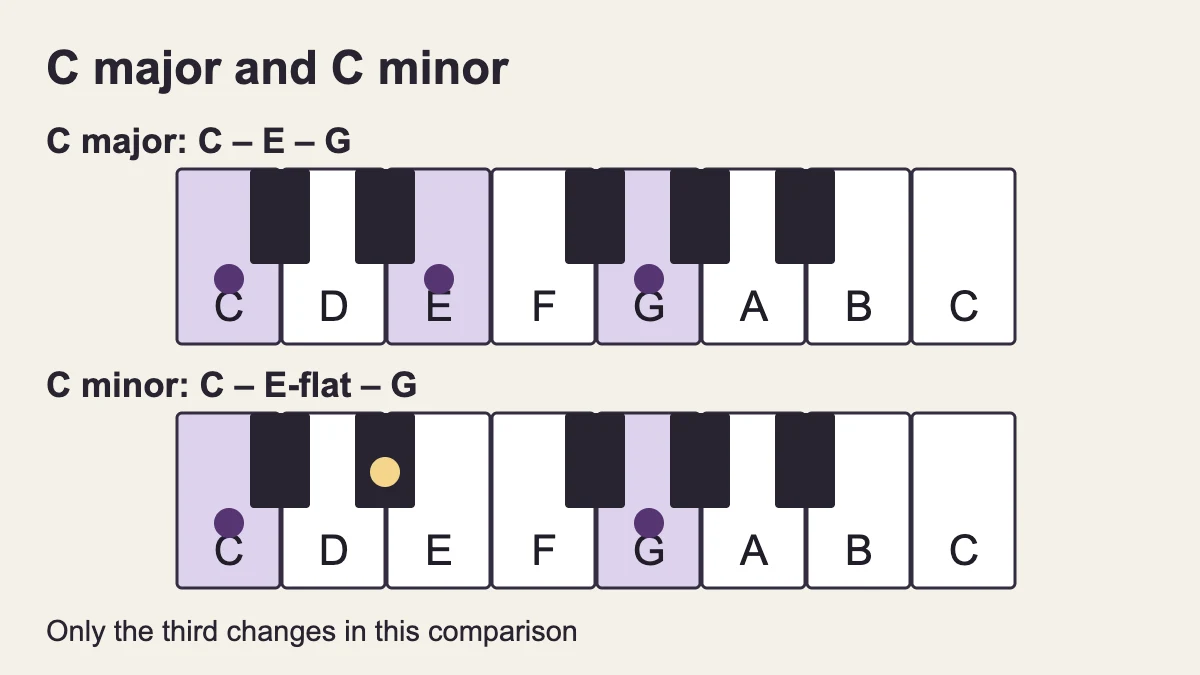
Starting at C, move four half steps: C-sharp, D, D-sharp, E. The starting C counts as zero distance. Move three more half steps from E: F, F-sharp, G. You have reached C–E–G. If you count C as your first step, both destinations will be wrong, even though your arithmetic looks orderly.
For C minor, move three half steps from C to E-flat, then four from E-flat to G. The outer distance is still seven half steps. Only the middle note changes in this comparison. Try the two chords in the same register and at a similar loudness, so register and dynamics do not distract from that change.
Four triad qualities, with one root for comparison
Major and minor triads are the starting point, but two other structures help explain chord symbols you may encounter. A diminished triad uses two stacked minor thirds; an augmented triad uses two stacked major thirds. Do not turn those labels into compulsory emotional descriptions. The sound of a chord also depends on its context, register, spacing and performance.
| Quality | Notes | Half-step distances from C |
|---|---|---|
| Major | C–E–G | 0, 4, 7 |
| Minor | C–E-flat–G | 0, 3, 7 |
| Diminished | C–E-flat–G-flat | 0, 3, 6 |
| Augmented | C–E–G-sharp | 0, 4, 8 |
The written letters matter as well as the keys. A C triad has some kind of C, E and G: alternate letter names. C diminished therefore uses G-flat rather than F-sharp, even though those names share a key on a normally tuned piano. The spelling tells you that the altered note is the fifth.
Work on one comparison at a time. First compare C major with C minor. Later compare C minor with C diminished and notice that the fifth moves. You do not need to memorise all four sounds in one sitting. Being able to describe exactly which note changed is a useful result on its own.
A piano chord chart you can check for yourself
The following chart gives major and minor triads on twelve common roots. It is a reference, not a demand to learn twenty-four chords immediately. Begin with C, F, G and A minor. When those names are familiar, add a root that uses a black key and verify it with the same distance method.
| Root | Major | Minor |
|---|---|---|
| C | C – E – G | C – E-flat – G |
| D-flat | D-flat – F – A-flat | D-flat – F-flat – A-flat |
| D | D – F-sharp – A | D – F – A |
| E-flat | E-flat – G – B-flat | E-flat – G-flat – B-flat |
| E | E – G-sharp – B | E – G – B |
| F | F – A – C | F – A-flat – C |
| F-sharp | F-sharp – A-sharp – C-sharp | F-sharp – A – C-sharp |
| G | G – B – D | G – B-flat – D |
| A-flat | A-flat – C – E-flat | A-flat – C-flat – E-flat |
| A | A – C-sharp – E | A – C – E |
| B-flat | B-flat – D – F | B-flat – D-flat – F |
| B | B – D-sharp – F-sharp | B – D – F-sharp |
Some entries contain an uncommon-looking name. D-flat minor includes F-flat, which is the same piano key as E. Replacing the written F-flat with E would hide the root–third–fifth lettering. B-flat major, meanwhile, is usually easier for a beginner to read than its enharmonic alternative A-sharp major. The chart chooses consistent root pairs so you can compare their thirds, not every possible name.
Cover the note column and try to reconstruct one row. For D major, first write the letters D, F and A. The third must be four half steps above D, so F becomes F-sharp. A is already seven half steps above D. Your answer is D–F-sharp–A, and you can explain each note instead of trusting a shape.
Now try F minor. The letter framework is F, A and C. A natural is four half steps above F, but a minor third needs three, so lower A to A-flat. Leave C unchanged. This second example checks whether you can use the rule in a new place rather than merely repeat the D major answer.
Read common chord symbols without adding extra notes
A plain capital letter such as C normally asks for a major chord. The symbol Cm asks for C minor. Cdim or C° indicates diminished, while Caug or C+ indicates augmented. Publishers and genres use some different conventions, so check the notation key when a chart supplies one.
A number after the letter changes the requested structure. C7 is not another name for the three-note C major chord: its basic spelling is C–E–G–B-flat. Cmaj7 uses B natural instead. Cm7 uses C–E-flat–G–B-flat. If you are learning triads, recognise that these symbols ask for additional information; do not pretend the seventh is irrelevant.
Likewise, Csus4 usually replaces the third with the fourth, giving C–F–G. Cadd9 keeps the third and adds D, usually understood above the octave in the chord’s construction. These examples show why reading the whole symbol matters. You can postpone practising extended chords without misidentifying what the chart says.
An inversion changes the bass, not the chord’s identity
C–E–G has C at the bottom and is in root position. Move that low C above the other notes and you get E–G–C: first inversion. Move the low E upward next and you get G–C–E: second inversion. The three letter names stay the same, but the lowest note changes.
Do not automatically rename E–G–C as an E chord. E is its bass note, while C remains the root of the C major triad. To identify an unfamiliar inversion, collect the note names and rearrange them into stacked thirds. C–E–G reveals the structure more clearly than reading the lowest note alone.
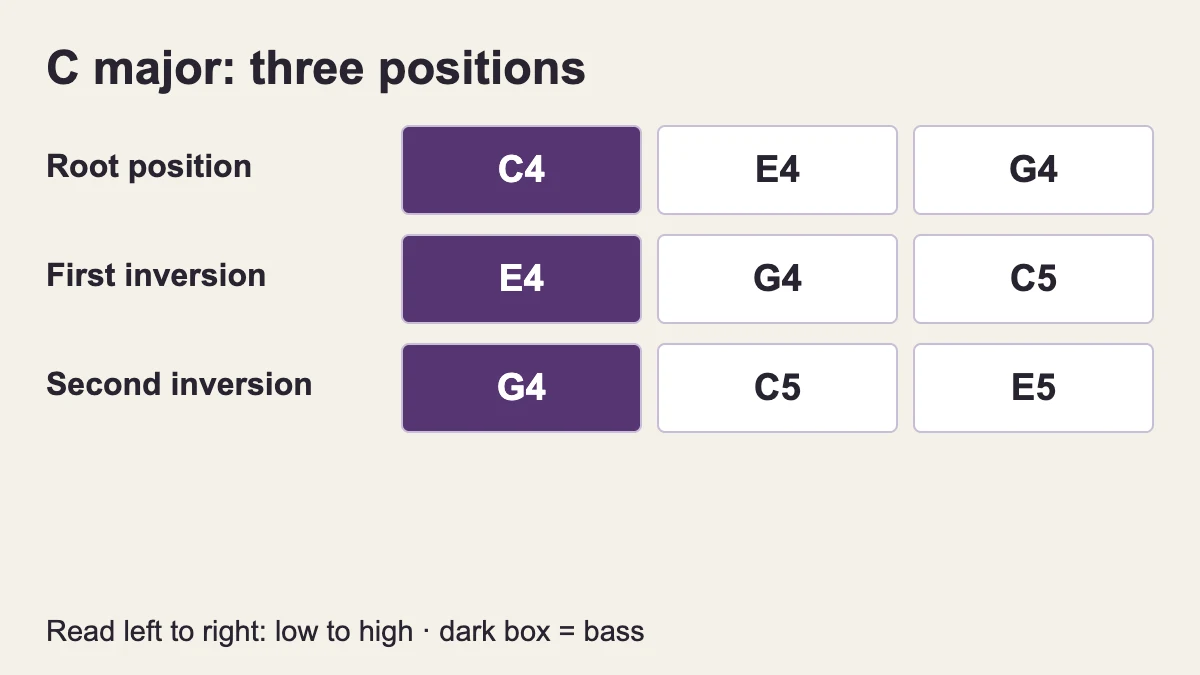
| Position | Low to high | Lowest chord tone |
|---|---|---|
| Root position | C4–E4–G4 | Root |
| First inversion | E4–G4–C5 | Third |
| Second inversion | G4–C5–E5 | Fifth |
The octave numbers here use scientific pitch notation, where middle C is C4. They distinguish an actual keyboard position from a note class. Some software labels octaves differently, so use the keyboard location and interval relationship if a device’s number does not match this example.
A slash symbol makes a bass request explicit. C/E means a C chord with E in the bass. If your left hand plays a lower C while your right hand plays E–G–C, the complete texture still has C at the bottom. Describe the whole sounding arrangement when discussing its inversion, not just the right hand.
Connect C, A minor, F and G without unnecessary jumps
Play every chord in root position first to verify its notes: C–E–G, A–C–E, F–A–C and G–B–D. That is a useful spelling exercise, but your hand may travel farther than necessary. A second exercise keeps the right-hand notes close and lets you notice shared tones.
| Chord | Right hand, low to high | What changes next? |
|---|---|---|
| C | C4–E4–G4 | Keep C and E; move G to A |
| Am | C4–E4–A4 | Keep C and A; move E to F |
| F | C4–F4–A4 | Move to B3–D4–G4 |
| G | B3–D4–G4 | Return to C4–E4–G4 |
The F-to-G change is different from the first two: this particular arrangement has no shared right-hand note to keep. Look at each destination before moving. You may choose another suitable voicing later; the table demonstrates one manageable path rather than a universally best arrangement.
Practise C to Am alone before completing the sequence. Play C, release, find Am, then return. When the destinations are reliable, keep the common notes where practical and change the remaining note. Do not force the fingers to stay down if doing so produces tension or an awkward movement.
Next add F. Say which note changes between Am and F before you play it. Finally practise F to G separately, then join all four chords. This isolates the difficult boundary instead of making you repeat three familiar changes whenever the fourth one goes wrong.
Choose fingers for the passage, not for an isolated picture
On the right hand, a simple root-position white-key triad is often introduced with fingers 1–3–5: thumb, middle finger and little finger. That is a starting option, not a rule that every chord and inversion must follow. Hand size, black-key placement, the next chord and surrounding melody all affect a useful choice.
Find a comfortable position before adding speed. If a suggested reach feels strained, release the notes and simplify the task. A teacher can help choose a workable fingering for your hand and passage. An article or screen diagram cannot observe how you are moving, so it should not prescribe one compulsory physical solution.
A helpful written note records both the chosen notes and the transition you are solving. “C to Am, G moves to A” tells you more than “practise chord shape.” If a fingering works slowly but collapses during the change, inspect that specific movement rather than assuming you have forgotten the chord.
Add rhythm only after the destinations are clear
Start with one chord per four counted beats. Count “one, two, three, four,” then change on the next one. The aim is an even interval between chord changes, not a particular impressive speed. The online metronome can provide a reference once you can find both destinations comfortably.
If you stop the count whenever a chord is difficult, the exercise becomes a sequence of unrelated shapes. Slow down or use a preparation bar instead: play the chord for four beats, take four silent beats to prepare, then play the next chord. The silence has a planned duration, so time continues even while you are organising the movement.
Later compare a block chord with a broken pattern. For C major, play C–E–G–E as four equal notes. The ingredients still belong to C major, but they arrive at different times. Keep this short pattern separate from the simultaneous-chord task so you know whether you are practising coordination, note order or harmonic recognition.
What should the left hand do?
For a first two-hand exercise, let the left hand play one root while the right hand plays a comfortable triad. Use C under C major, A under A minor, F under F major and G under G major. Check each hand independently before combining them on the first beat.
Choose a register that sounds clear on your instrument. Closely spaced low notes can be harder to distinguish, especially with a sustained sound. You do not need to double every right-hand note in the left hand. A single bass note already gives a useful reference for hearing the chord above it.
Adding a root in the left hand also changes how you describe inversions. In the exercise above, Am with C–E–A in the right hand and a lower A in the left hand has A as its overall bass. The right-hand arrangement is still useful to discuss, but it is not the complete bass position of the texture.
Hear the chord instead of relying only on its appearance
Choose two chords with the same root, such as F major and F minor. Play each slowly enough to hear the middle note. Then look away from the keys and listen to the complete sounds. If a comparison is unclear, return to the separate notes; guessing repeatedly without feedback is not the only available exercise.
Try a second comparison that keeps the quality but changes the position: C–E–G followed by E–G–C. You are hearing C major in both cases. The exercise separates quality from bass position and helps prevent the assumption that every different-sounding arrangement is a different chord name.
For a short listening check, use the chord ear-training exercise. Treat the result as feedback on the examples you heard, not a permanent verdict about your musical ability. Keyboard construction and aural identification are connected skills, but progress in one does not mean the other needs no practice.
A practice session with a specific purpose
Choose one target before starting: build an unfamiliar triad, identify a symbol, connect two positions or keep a steady change. A short session can contain all four activities, but trying to improve everything at once makes an error difficult to interpret. The following sequence is a flexible example, not a guaranteed timetable.
- Locate: choose two roots and say their note names before touching the keys.
- Construct: build one major and one minor triad, checking the third and fifth.
- Reposition: find one inversion without changing the note names.
- Connect: repeat a two-chord change with a planned count or preparation bar.
- Listen: compare one pair without watching your hand.
- Record: write the exact point that needs attention next time.
A useful record might say: “D major spelling correct; first inversion found after a pause; D to G loses the count.” That separates knowledge, location and timing. The next session can focus on the transition instead of relearning D–F-sharp–A from the beginning.
Change the task when it becomes easy, not merely the speed. Start on another root, reverse the order, read the symbol without the chart or explain the fingering choice aloud. Each change checks a different dependency. If everything changes simultaneously, you cannot tell which part became difficult.
Find the cause of a rough chord change
| What happens? | What to check | Smaller next task |
|---|---|---|
| One note sounds unexpected | Third, fifth and accidental spelling | Play the three notes separately |
| The chord is right but late | Preparation and distance between positions | Use two chords and a preparation bar |
| Every change makes a large jump | Whether a nearby inversion is available | Find one shared tone |
| Notes blur together | Release, register and sustain setting | Compare two short chords without sustain |
| The chord sounds different on another device | Timbre, octave and audio response | Compare identical notes in the same register |
Sustain is useful musically, but it can hide an unclear release during an early exercise. Try the same change without it to hear where one chord ends and the next begins. This is a diagnostic comparison, not a claim that using the pedal is wrong.
If a web key responds late, check the audio route and device before judging your playing. A browser keyboard is not a calibrated timing test. Similarly, a mouse cannot comfortably reproduce every simultaneous hand action available on a physical piano. Choose the tool for note checking and listening, and use appropriate equipment for physical technique.
Check your understanding before opening the chart
1. Which note changes when D major becomes D minor? F-sharp becomes F natural. D and A remain. The third moves from four to three half steps above the root.
2. What chord is E–G–C? It is C major in first inversion when E is the lowest sounding note. Reorder the letters as C–E–G to see the triad.
3. Is C/E the same request as Em? No. C/E asks for C major over E; Em asks for E–G–B. The common bass letter does not make the note collections identical.
4. Build B-flat minor. Start with B-flat, D and F, then lower the third to D-flat. The result is B-flat–D-flat–F.
5. Does playing C–E–G–E turn C major into four different chords? No. Those successive notes form a broken pattern drawn from one triad. Rhythm and note order changed, but no new chord collection was introduced.
Where to go after the first chord chart
To see where the root, third and fifth come from, continue with the major scale formula and worked examples. Use that guide for scale construction and this one for arranging chord tones on the keyboard; they answer different questions.
If spelling is the difficult part, revisit sharps, flats and neighbouring keys. If you know the keys but cannot describe their distances, work on musical intervals. Choose the missing connection rather than collecting more diagrams that solve the same problem.
You are ready to study longer chord sequences when you can name the ingredients, find a nearby position and keep a simple planned change. You do not need flawless speed before making music. Keep the exercise small enough to understand what you hear, and increase its demands one decision at a time.
References and exercise authorship
Triad terminology was checked against Open Music Theory: Triads; keyboard context was checked with Yamaha’s basic piano chord lesson. The tables, diagrams, transition exercise, diagnostic questions and practice sequence on this page were created for KulakApp. They do not reproduce a published song, recording or another teacher’s worksheet.