Sharps and flats: finding half steps on a keyboard
A sharp raises a note by one half step, while a flat lowers it by one half step. Count every neighbouring key, including black keys, rather than counting white keys alone. The nearest key above C is C sharp. The nearest key below D is D flat. On the equal-tempered keyboard used here, those names refer to the same key.
How to count a half step
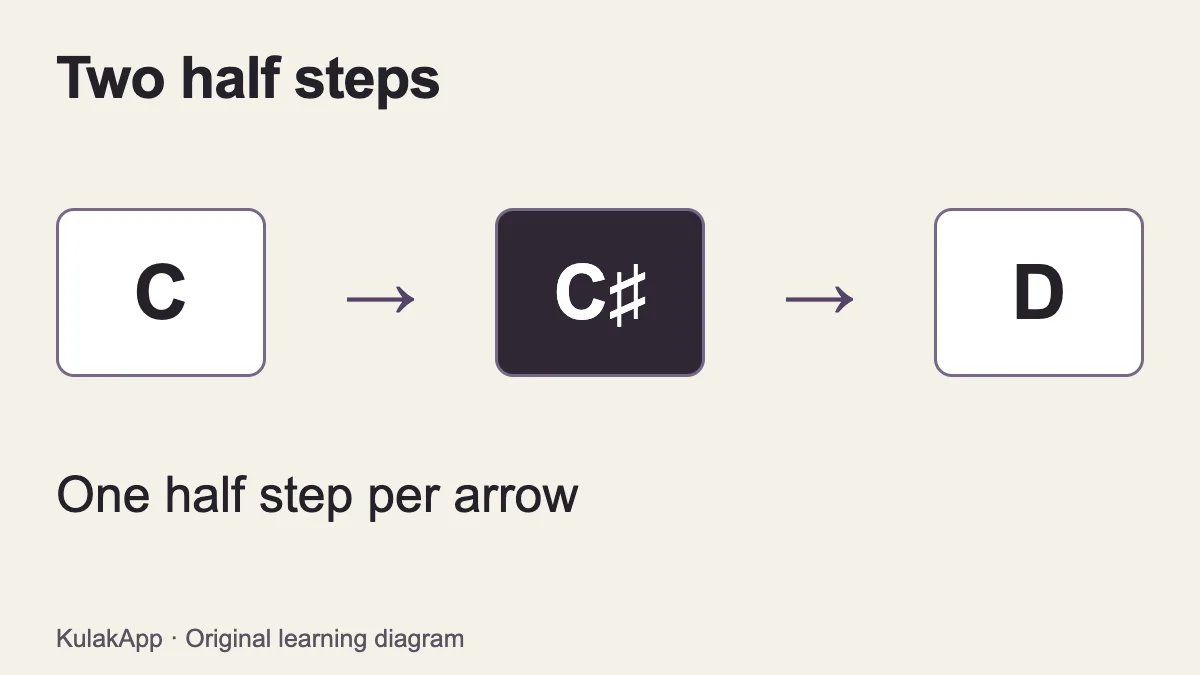
Treat the starting key as zero. The next key is one half step away. C and D have a black key between them, so C to D spans two half steps, also called a whole step. C to C sharp spans only one. Counting how many white keys your hand passes is not a reliable way to measure pitch distance.
There is no black key between E and F or between B and the next C. Those neighbouring white-key pairs are a half step apart. This means adjacent white keys do not always have the same musical distance between them. Compare C–D with E–F slowly. In both cases you move to the next white key, but the pitch distance is different.
A sharp does not always mean a black key
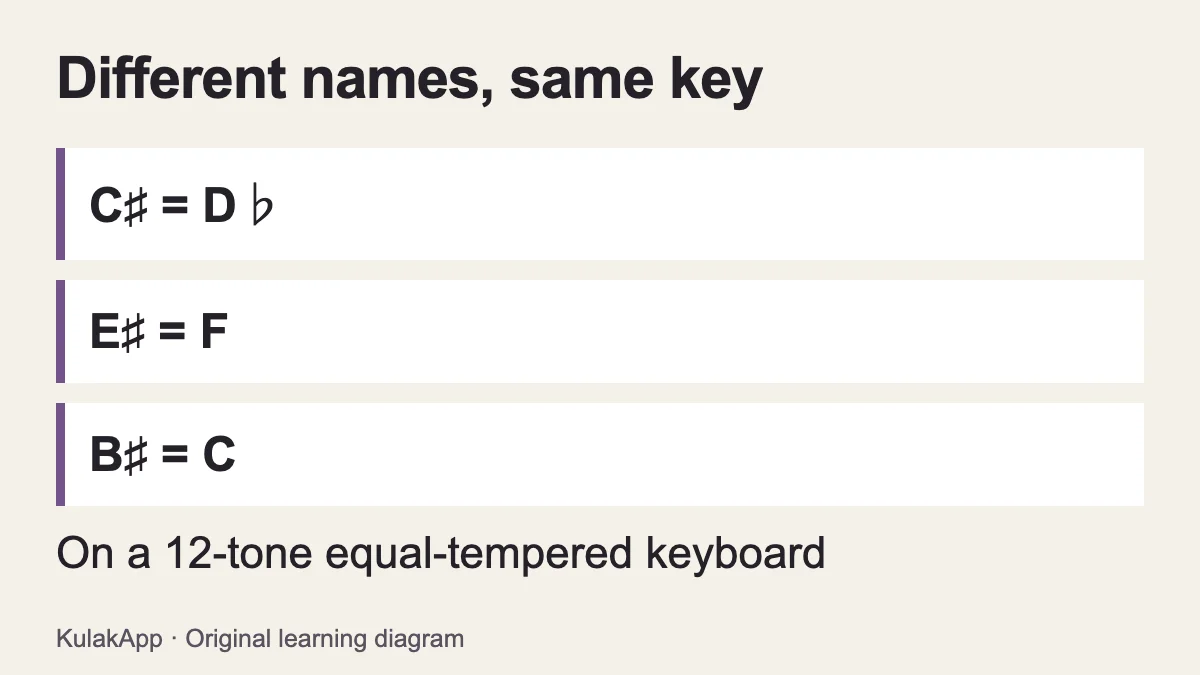
A sharp describes a change to a note, not a key colour. Raise E by one half step and you get E sharp, played on the same key as F in this system. B sharp is played on the next C key. It is therefore incorrect to say that E or B cannot have a sharp. The useful observation is that there is no separate black key between E and F or B and C.
The same reasoning works for flats. Lower F by one half step to get F flat, played on the E key. C flat uses the B key immediately below C. Rather than memorising these as unrelated exceptions, choose the direction first: one half step up for a sharp, one half step down for a flat. The destination may be black or white.
Why can one key have different names?
In twelve-tone equal temperament, C sharp and D flat have the same pitch. These are enharmonic spellings. In written music, however, choosing a spelling is not always arbitrary. The scale and the note’s role affect which name communicates the musical idea clearly. For now, remember that a shared key does not make the written names interchangeable in every piece.
This explanation does not claim that every tuning system treats all enharmonic notes as physically identical. It describes the twelve equally spaced pitch classes used by this virtual keyboard. Keeping that scope in mind prevents a practical keyboard shortcut from becoming an inaccurate rule about every kind of music.
What does a natural sign do?
A natural sign indicates the unaltered form of a note, cancelling a sharp or flat that would otherwise apply. For example, F natural returns to the ordinary F pitch rather than F sharp. Reading exactly where an accidental applies also involves the measure and the key signature. This guide focuses on locating individual pitches, not every notation rule for an entire score.
Four examples with answers
Try these on a keyboard before reading each answer. There is no timer. Find the starting note and move just one half step. The point is to connect the symbol with a direction and distance, rather than with the colour of a key.
- Lower D by a half step: D flat, the black key immediately below D. It is the same key as C sharp on this keyboard.
- Raise E by a half step: E sharp, played on F. Do not look for an extra key in between.
- Raise G by a half step: G sharp, the black key immediately above G.
- Lower F by a half step: F flat, played on E.
If you miss an answer, separate the steps. Did you find the correct starting note? Did you move in the right direction? Did you move one half step rather than two? A correct direction with the wrong distance still produces the wrong pitch. Playing the same pair forwards and backwards can make the change of direction easier to follow.
Connect the names with sounds
Play C–C sharp–D on the virtual melodica, or compare the same pattern on the virtual piano. A tool’s compact labels do not represent every possible spelling in a score. Treat them as a guide to the current keys, not as a replacement for learning notation in context.
Finding a written note and recognising the difference between two sounds are different jobs. Start by locating the keys visually, then listen to the pair. For example, alternate C–C sharp with C–D at a comfortable level. One pair is a half step and the other a whole step. Keep the starting note and volume setting the same so the comparison stays focused.
Once that feels familiar, try starting from another note rather than repeating C every time. Do not turn a short keyboard exercise into a verdict about your musical ability. It is a small practice task. KulakApp offers a next step for continued listening work, while the free web tools let you explore the idea before moving on.
Terminology reference: MEB, Müzik 6. Examples are original; no diagram or quotation was copied.