What Is Tempo in Music? BPM, Tempo Markings and Examples
Quick answer: Tempo is the speed of a piece of music. It is usually measured in BPM (beats per minute): 60 BPM is one beat per second and 120 BPM is two beats per second. In sheet music, tempo is written either as a number (for example ♩ = 96) or as an Italian term such as Andante or Allegro.
What tempo means
Tempo is Italian for “time”. In music it describes how fast or slow a piece moves. The steady pulse you tap your foot to is the beat, and tempo tells you how often those beats arrive. The same melody can sound calm or sad at a slow tempo and bright or urgent at a fast one, even though not a single note changes.
What BPM is and how to calculate it
- 60 BPM: one beat per second, like a clock’s second hand.
- 90 BPM: three beats every two seconds, close to a relaxed walk.
- 120 BPM: two beats per second; many pop songs and marches sit here.
- 180 BPM: three beats per second; fast rock, punk and some dance styles.
To find how long one beat lasts, divide 60 by the BPM. At 80 BPM one beat lasts 60 ÷ 80 = 0.75 seconds, which is also how producers sync delay effects to a song.
In notation, tempo is often written as a note symbol and a number: ♩ = 96 means 96 quarter notes per minute. A dotted quarter (♩.) as the unit is common in compound time such as 6/8. If note values are new to you, start with quarter, eighth and sixteenth notes.
Tempo markings and BPM ranges
Classical music traditionally uses Italian words. They describe a speed range and a character, not an exact number, and the ranges below are approximate: they vary between composers, periods and references.
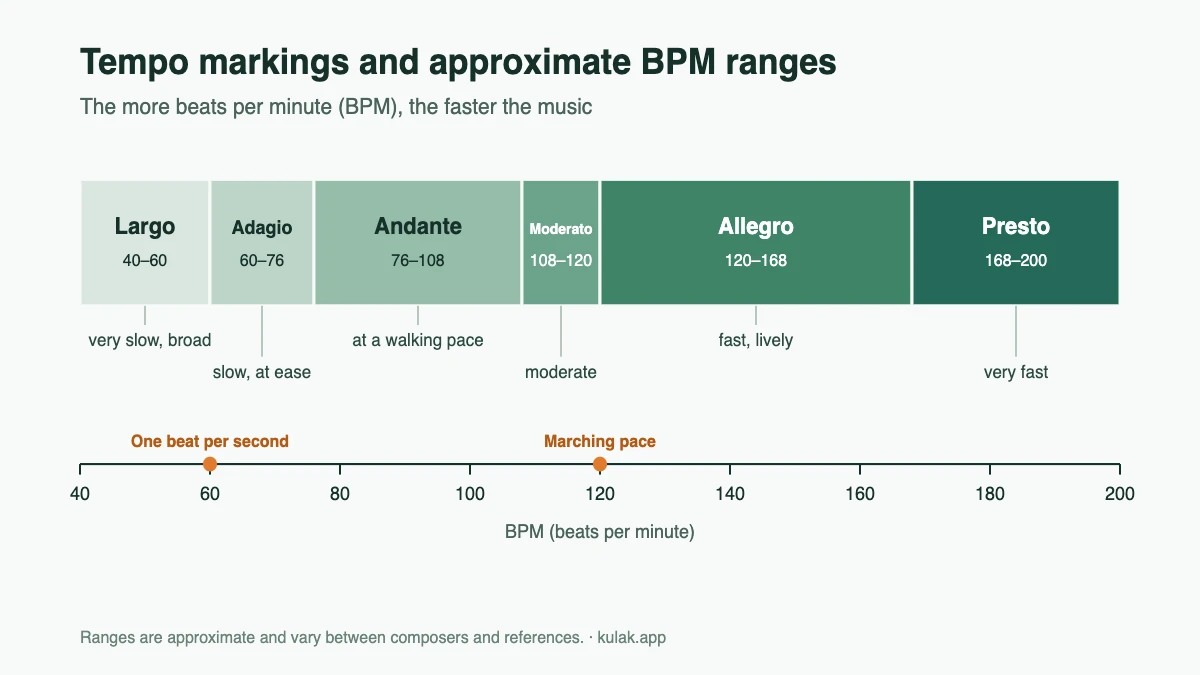
| Marking | Meaning | Approx. BPM | Character |
|---|---|---|---|
| Grave | serious, heavy | 25–45 | Very slow and solemn |
| Largo | broad | 40–60 | Very slow, spacious |
| Lento | slow | 45–60 | Slow and calm |
| Adagio | at ease | 60–76 | Slow, unhurried |
| Andante | walking | 76–108 | At a walking pace |
| Moderato | moderate | 108–120 | Neither fast nor slow |
| Allegretto | fairly lively | 100–128 | A little slower than Allegro |
| Allegro | cheerful, lively | 120–168 | Fast and bright |
| Vivace | lively | 156–176 | Fast and energetic |
| Presto | very fast | 168–200 | Very fast |
| Prestissimo | as fast as possible | 200+ | Extremely fast |
Modifiers refine the meaning: molto (very), poco (a little), non troppo (not too much), assai (quite). Allegro non troppo means “fast, but not too fast”.
Markings that change the tempo
| Marking | Abbreviation | What to do |
|---|---|---|
| Accelerando | accel. | Gradually speed up |
| Ritardando | rit. / ritard. | Gradually slow down |
| Rallentando | rall. | Slow down, often toward an ending |
| A tempo | — | Return to the previous tempo |
| Tempo primo | Tempo I | Return to the opening tempo |
| Rubato | — | Flex the tempo expressively |
| Fermata | 𝄐 | Hold the note or rest longer than written |
A ritardando near the end of a phrase signals “we are arriving”, often together with a cadence.
How to find the tempo of a song
- Find the beat. Tap along with your foot or hand. The kick and snare drum usually show the way.
- Count for 15 seconds. Use a stopwatch and count the beats.
- Multiply by 4. 30 beats in 15 seconds means about 120 BPM. For more accuracy count for 30 seconds and multiply by 2.
- Check with a metronome. Set the online metronome to your number and play it with the song. Adjust a few BPM up or down until they stay together.
Half-time and double-time: one listener may count a song at 70 BPM and another at 140. Both are tapping the same music at different pulse levels, and which one is “right” depends on the meter and which beat you feel as the main one. Once you know the tempo, you can also find the key of a song by ear.
Tempo vs rhythm vs meter
- Tempo: how fast the beats go.
- Meter (time signature): how beats are grouped, for example four per bar in 4/4. See bar lines and measures.
- Rhythm: the pattern of long and short sounds placed over those beats.
The same 4/4 rhythm can drive a 70 BPM ballad or a 128 BPM dance track: the pattern stays the same, only the tempo changes.
Practising with a metronome
- 2 minutes, internalise the beat: set 60 BPM and clap on every click. Close your eyes and land exactly on it.
- 3 minutes, subdivide: at the same tempo, fit two and then four even claps into each beat (“1-and”, “1-e-and-a”).
- 3 minutes, play slowly: play your piece at the slowest tempo you can manage without mistakes.
- 2 minutes, speed up gradually: after each clean run raise the tempo by 4–8 BPM. If you slip, go back one step.
Measure your sense of rhythm with the rhythm ear training guide, or try grooves on the virtual drums and with beginner drum beats.
FAQ
What is tempo in music, in simple terms?
It is the speed of the music, given in beats per minute (BPM) or with terms such as Andante and Allegro.
What does BPM mean?
Beats per minute. 60 BPM is one beat per second; 120 BPM is two beats per second.
Which tempo markings are the slowest and fastest?
Among common markings, Grave and Largo are the slowest and Presto and Prestissimo the fastest.
Is Andante fast or slow?
Andante is a moderately slow, walking tempo, roughly 76–108 BPM.
What tempo are most pop songs?
Most pop songs fall between about 90 and 130 BPM; ballads are slower and dance tracks faster.
Are tempo and rhythm the same?
No. Tempo is the speed of the beat; rhythm is the pattern of long and short sounds placed on it.