Quarter, eighth and sixteenth notes: how to count the difference
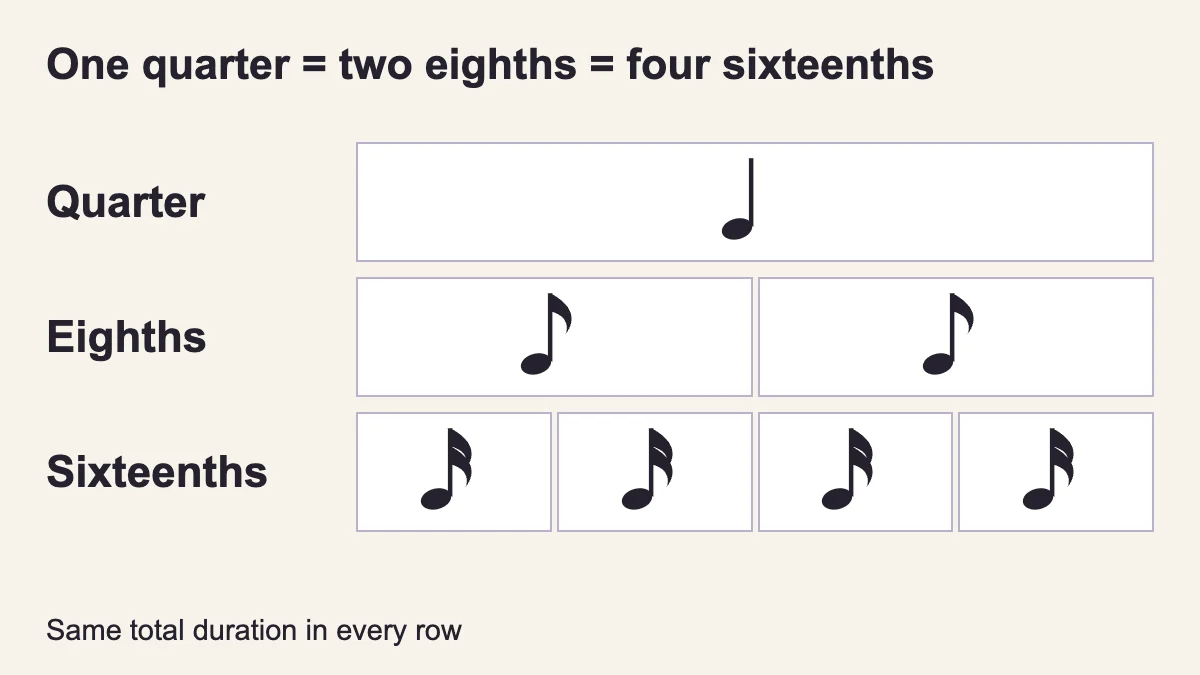
One quarter note lasts as long as two eighth notes or four sixteenth notes. When the quarter note is your beat unit, count one quarter per beat, two equal eighths per beat, or four equal sixteenths per beat. The ratio stays the same when the tempo changes; the number of seconds does not.
The examples in this guide use straight subdivisions and a quarter-note beat, mainly in 4/4. That context matters: a quarter note is not always the main beat in every meter. Start with the relationship between the written values, then decide which value your metronome click represents. You do not need to identify pitches to practise this part of rhythm reading.
Think in ratios before thinking in seconds
The names quarter, eighth and sixteenth describe fractions of a whole-note value. A quarter is twice the length of an eighth, and an eighth is twice the length of a sixteenth. These relationships do not require a particular tempo. A slow eighth note can last longer in seconds than a quarter note played at a much faster tempo.
In our quarter-note-beat examples, a quarter occupies one beat, an eighth half a beat and a sixteenth a quarter of a beat. A complete 4/4 bar can therefore contain four quarters, eight eighths or sixteen sixteenths. It can also contain a mixture, provided their combined duration fills the intended bar.
| Value | Beats occupied | Equal values filling four beats |
|---|---|---|
| Quarter note | 1 | 4 |
| Eighth note | 1/2 | 8 |
| Sixteenth note | 1/4 | 16 |
Do not interpret the word “eighth” as “beat eight.” The note might begin on beat one, between beats, or near the end of a bar. Its name describes its written length relative to other values. Its starting position is a separate question answered by the notes and rests before it.
Recognise the written shape without confusing it with pitch
A quarter note has a filled notehead and a stem without a flag. A standalone eighth note has one flag; a standalone sixteenth has two. When notes are grouped, beams can replace flags: one beam level for eighths, two for sixteenths. Mixed groups may contain both levels, with the shorter beam joining only the relevant notes.
The direction of the stem does not change the duration. Neither does moving the notehead higher or lower on the staff. Staff position helps identify pitch in pitched notation; note shape helps identify duration. If those two tasks feel tangled, practise a rhythm on a single repeated pitch before adding a melody.
Our note-reading test focuses on identifying pitches. Use it as a separate exercise rather than expecting a correct pitch answer to prove that you also understand the rhythm. A written passage asks both what to play and when to play it.
Give each equal part a place in your count
For quarters across four beats, count “1, 2, 3, 4.” For eighths, use “1 and 2 and 3 and 4 and.” Each “and” belongs halfway between the numbered beats. Keep the numbered beats at the same speed when you add the extra syllables.
A common English sixteenth-note count is “1 e and a, 2 e and a, 3 e and a, 4 e and a.” Each group of four syllables fits inside one quarter-note beat. Say the syllables evenly. The “and” is still halfway through the beat, so it aligns with the eighth-note subdivision you already counted.
| Position within the beat | Count syllable | Eighth-note attack here? |
|---|---|---|
| Beginning | 1 | Yes |
| One quarter of the way through | e | No |
| Halfway through | and | Yes |
| Three quarters of the way through | a | No |
Counting syllables are a learning aid, not the music itself. Other teaching systems use different spoken patterns. What matters here is that each label has a consistent place and that you do not compress the last syllable to reach the next number. If saying four syllables is difficult, slow the pulse before adding any instrument.
More attacks do not necessarily mean a faster tempo
Imagine the quarter-note pulse at 60 BPM. One beat lasts one second. Two equal eighths within it last half a second each; four equal sixteenths last a quarter of a second each. At a quarter-note pulse of 120 BPM, the same beat lasts half a second, so those durations become 0.25 and 0.125 seconds.
These are arithmetic examples, not suggested performance targets. They show why the tempo marking needs a beat unit. Saying only “120” leaves out what is occurring 120 times per minute. If the click represents eighth notes rather than quarters, the relationship changes.
Try alternating one bar of quarter-note taps with one bar of eighth-note taps over an unchanged click. The second bar contains more attacks, but both bars last the same time. If the next downbeat moves earlier, you have changed the pulse accidentally rather than merely changing the subdivision.
A rest occupies time even when nothing sounds
A quarter rest occupies the same written duration as a quarter note. The equivalent relationship holds for eighth and sixteenth rests. A rest instructs that part not to sound during its span; it does not remove that span from the timeline.
For a simple example, clap on “1,” stay silent through “2,” then clap on “3” and “4.” The silence lasts a complete quarter-note beat. You still count four beats. If you close the gap and clap the final two notes early, you have changed the rhythm.
Next divide beat two into eighths. Leave its first half silent and clap on “two-and.” Keep beat three where it was. This is more precise than saying “wait a little, then clap.” The rest has an exact relationship to the beat even though you cannot hear it as a separate sound.
Build a mixed bar from left to right
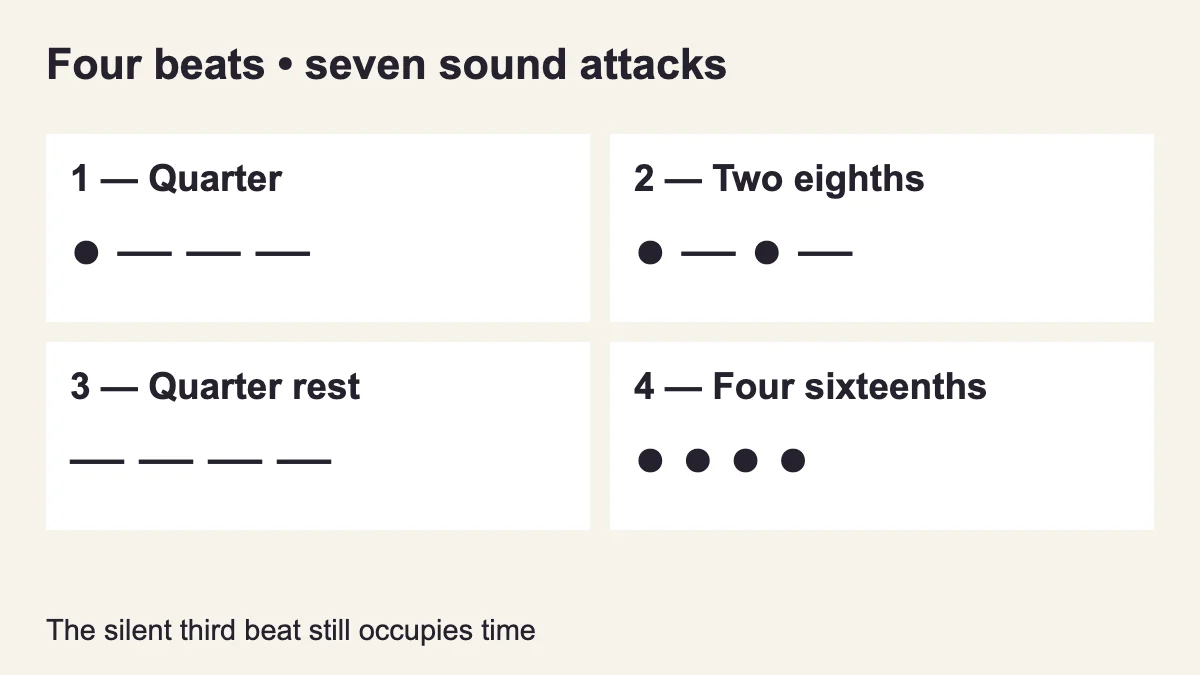
Use this original four-beat exercise: a quarter note; two eighth notes; a quarter rest; four sixteenth notes. The first event occupies beat one, the two eighths occupy beat two, the rest occupies beat three, and the four sixteenths occupy beat four. Together they fill one bar of 4/4.
The sounding attacks occur on 1, 2, 2-and, 4, 4-e, 4-and and 4-a. There are seven attacks, but four beats of time. Counting attacks alone would give the wrong length. The absence of a sound on beat three is an intentional part of the example.
Before clapping, speak a full sixteenth-note count through the bar. Mark the seven attack positions on paper. Then clap only at those positions while your spoken count continues. Once the placement is clear, you can use a less detailed count without changing the rhythm.
A second example fills one beat with an eighth followed by two sixteenths. Start the eighth on “1” and let its value span “1-e.” The two sixteenths begin on “and” and “a.” The attack sequence is therefore 1, and, a, not 1, e, and.
Reverse the order: two sixteenths followed by an eighth. Now attacks begin on 1, e and and; the final eighth spans and-a. Both examples contain three notes and last one quarter-note beat. They are not the same rhythm. The position of the longer value changes the spacing between the attacks.
Dots and ties extend values in different ways
A dot adds half of the note’s original value. A dotted quarter equals a quarter plus an eighth; a dotted eighth equals an eighth plus a sixteenth. In the quarter-note-beat context, their lengths are one and a half beats and three quarters of a beat respectively.
A dotted eighth followed by a sixteenth fills one quarter-note beat. Its two attacks begin on 1 and a in a sixteenth-note count. Compare that with two equal eighths, which attack on 1 and and. The total duration is the same, but the gap between the attacks is different.
A tie joins successive notes of the same pitch into one sustained duration. For a quarter tied to an eighth, begin the sound once and hold through their combined value rather than making a fresh attack at the second note. This differs from a slur, which can connect different pitches as a phrasing or articulation instruction.
On percussion, the physical sound may decay before its written value ends. Written duration still helps organise the part in time. Do not judge the notation solely by how long a particular drum sample rings. A clap also dies away quickly, yet you can use it to practise the attack positions of longer note values.
Check the arithmetic and the starting positions
Problem A: A bar contains one quarter, four eighths and one quarter rest. Does it fill 4/4 in our context? Yes: 1 + 4 × 1/2 + 1 = 4 beats. There are five sounding notes and one written rest, not six equal beats.
Problem B: One quarter, two eighths and three sixteenths are written as a complete 4/4 bar. What is missing? Their duration is 1 + 1 + 3/4 = 2 3/4 beats. The bar is short by 1 1/4 beats. One possible completion is a quarter rest and a sixteenth rest; other combinations can fill the same space.
Problem C: An eighth rest begins on beat one, followed by two sixteenth notes. Where do the notes begin? On 1-and and 1-a. The rest already occupies the first half of the beat. Starting on 1-e would make it too short.
Problem D: Four sixteenths replace two eighths at the same quarter-note tempo. Does that double the bar length? No. Both groups occupy one beat. The change doubles the number of attacks inside that beat.
Use a metronome to hold one variable steady
Set the metronome so one click corresponds to a quarter-note beat for these exercises. Listen first, then count without clapping. Add quarter taps, followed by eighths and then sixteenths. Return to quarters after each denser pattern to check that the main pulse has not moved.
Do not practise only increasingly dense rows. Mix sound and silence, and combine different lengths within a beat. The rhythm worksheets provide a separate way to mark and count positions. For a musical application with different sounds, compare the layers in our beginner drum beats.
When something goes wrong, identify whether you misread the value, placed its start incorrectly or lost the pulse while moving. Those are different tasks. Pointing to a timeline can help with the first two; slowing down and reducing the movement can help you inspect the third. None requires labelling yourself as naturally good or bad at rhythm.
Questions about note values
Are semiquavers different from sixteenth notes?
They are different names for the same written value. In British terminology, crotchet means quarter note, quaver means eighth note and semiquaver means sixteenth note. The counting relationships do not change with the vocabulary.
Does a beam make notes faster?
No. Beaming groups notes visually. The beam levels identify values in place of separate flags; they do not change a note’s length independently of that notation.
Are three notes inside a beat always triplets?
No. An eighth plus two sixteenths gives three attacks with unequal spacing. A triplet divides the specified span into three equal parts in its tuplet context. Check the notation rather than deciding from the number of attacks alone.
Reference and exercise notes
Basic duration relationships can be checked in Open Music Theory: rhythmic values; the distinction between a beat and its divisions is covered in its meter reference. The timelines, arithmetic problems and practice sequence on this page are original explanatory material, not extracts from a song or an examination.