How to read the rhythm grid
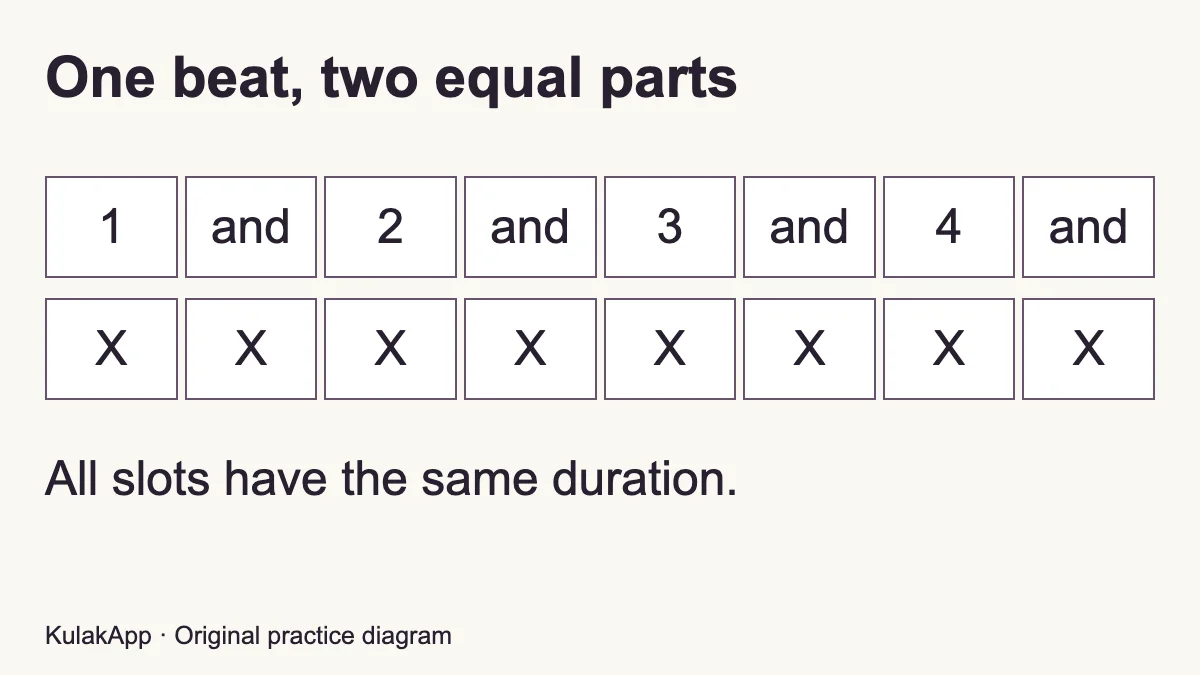
This worksheet uses a simple time grid, not standard music notation. Each bar has four main beats, divided into two equal parts per beat. That makes eight slots altogether. An X marks the start of a clap. A dot means that you do not start a new clap in that slot. Neither symbol tells you to change the speed of your counting.
The first slot is “one,” the second is “and,” and the third is “two.” Continue until the eighth slot, the “and” after four. Keep the spacing even. The boxes show where attacks happen, rather than how long a pitched note is held. These short clapping exercises do not introduce ties or the notation of sustained sounds.
Work through each row in three passes
- Read: speak every count without clapping. Identify which counts have an X.
- Play: keep speaking and add one clap at each X. Let the dotted slots pass without a clap.
- Check: compare your clap positions with the answer explanation. Repeat the small section that differed, rather than rushing through every row again.
The first row places claps on the four main beats. The second adds the halfway points between them. The third makes you maintain the count through silent slots. The final row combines closer and wider gaps in a single bar. You can stay on a row until its timing feels clear; completing the sheet quickly is not the objective.
Keep counting when there is no sound
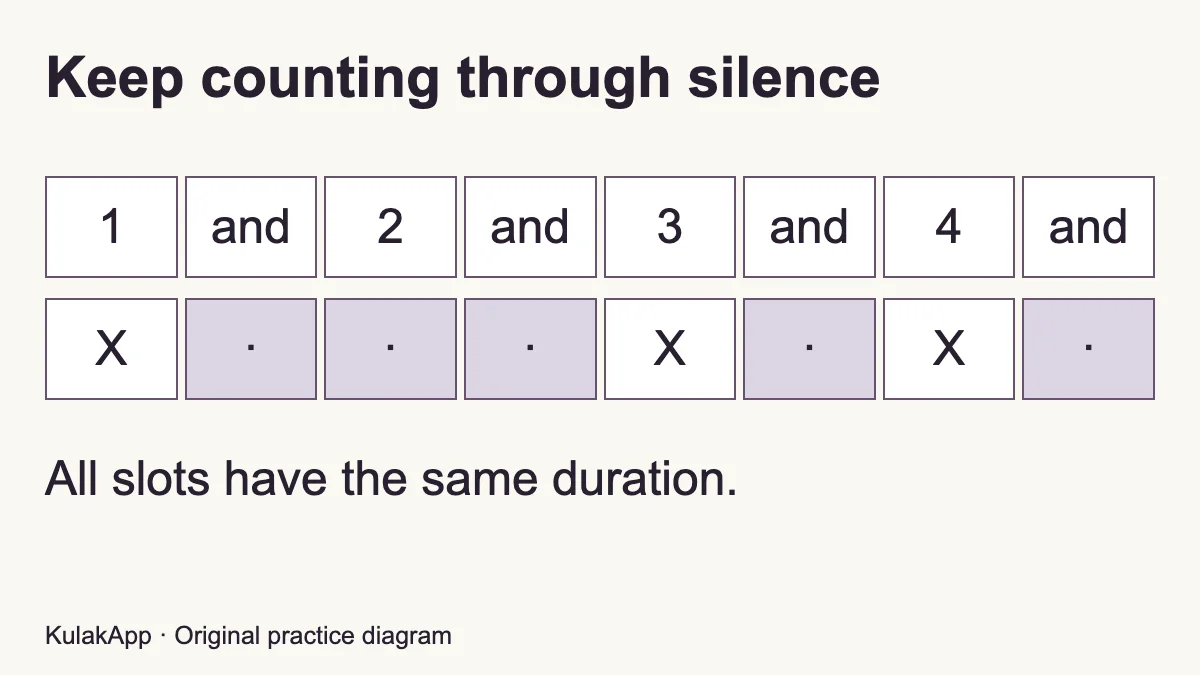
A common mistake is to treat an empty slot as something to skip. If you move straight from one X to the next, the gaps become too short. For example, when a dot falls on “two,” still say “two” at the expected time. Only the clap is missing. The beat itself has not disappeared.
You might find it helpful to tap a steady main beat with one hand while following the row with the other. If that adds too much coordination at once, return to speaking the count. Separating reading, counting and playing can make it easier to identify what is actually causing the difficulty.
Practising with a metronome
Set the metronome so that each click represents one main beat. The clicks line up with “one, two, three, four”; each “and” sits halfway between two clicks. At 60 BPM, the main beats are one second apart and adjacent slots are half a second apart.
Start at a tempo where you can maintain the count. If you hear extra clicks for subdivisions, check which clicks represent the main beat before you begin. A faster series of clicks does not necessarily mean a faster underlying tempo. This worksheet uses a four-beat bar; it is not a guide to every time signature.
Use the answers to locate a specific mistake
The answer key lists the counts on which each clap begins. It does not grade your overall musical ability. If you placed all the claps correctly but gradually accelerated, the positions alone will not reveal that. Listen to the spacing as well as checking the symbols.
After a row, make one useful observation: “I rushed the silence after beat two,” “I forgot the and after three,” or “I kept the count but confused the symbols.” Choose the next attempt from that observation. A precise description gives you something to change; a label such as “bad rhythm” does not.
For lessons and independent practice
In a lesson, one person can count while the other claps. Swap roles for the second attempt. A teacher can point to the exact slot that needs attention without turning the activity into a speed contest. These exercises are short enough to use as an opening listening-and-counting task rather than a complete lesson plan.
If you work alone, hide the answers until you have tried a row. Then compare and repeat. You do not need to submit your name, notes or results to this website. Personal notes remain on your own paper or device. There is no automated timing score in the worksheet.
Printing and permitted use
The PDF contains the exercise sheet and a separate answer explanation. Check the print preview and the fit-to-page option before printing. You can print the first page alone for an initial attempt. The browser Print button opens a simplified version of this page; requesting print does not confirm that a printer produced a copy.
The grids and practice patterns were created for KulakApp. You may print and use this specific worksheet free of charge for personal practice or your own lessons, keeping the KulakApp attribution. It contains no third-party song notation. This permission does not automatically extend to all other website content.
To connect the count with contrasting sounds, try the virtual drum kit. For remembering what you hear, continue with rhythm ear training. The worksheet is a starting activity, not an official examination, a diagnostic assessment or a promise of a particular result.
Connect the marked positions to note values
The note values guide separates attacks, sustained durations and rests. For an application using contrasting sounds, follow the beginner drum patterns.
Hear how the beat is grouped
Compare 3/4 and 6/8 time to hear why six equal eighth notes can form three pairs or two groups of three. The guide separates grouping from tempo and includes original counting exercises.