Bar Lines in Music: Types, Measures and How to Read Them
Quick answer: A bar line is the vertical line that divides the staff into measures (also called bars). Each measure holds the number of beats shown by the time signature, such as 2/4, 3/4 or 4/4. A single bar line ends a measure, a double bar line marks the end of a section, a thick line with two dots is a repeat sign, and a thin–thick final bar line ends the piece.
What is a bar line?
When you tap your foot to a song, the beats fall into natural groups: “ONE-two” in a march, “ONE-two-three” in a waltz. Written music shows these groups as measures, separated by vertical bar lines. A bar line makes no sound and is not a pause. It simply organises reading, so you can count steadily, find your place (“let’s start from bar 12”) and see where the next strong beat will land.
Time signatures and measures
The two numbers at the start of a piece tell you how much time fits in each measure. The top number is the number of beats; the bottom number is the note value that gets one beat. A bottom number of 4 means the quarter note is the beat.
| Time signature | Each measure holds | Count | Typical styles |
|---|---|---|---|
| 2/4 | 2 quarter-note beats | ONE – two | Marches, polkas, many children’s songs |
| 3/4 | 3 quarter-note beats | ONE – two – three | Waltzes, minuets |
| 4/4 | 4 quarter-note beats | ONE – two – THREE – four | Most pop, rock and everyday music |
| 6/8 | 6 eighth notes in two groups | ONE-two-three FOUR-five-six | Barcarolles, jigs, some folk tunes |
3/4 and 6/8 contain the same total duration but group it differently.
Types of bar lines
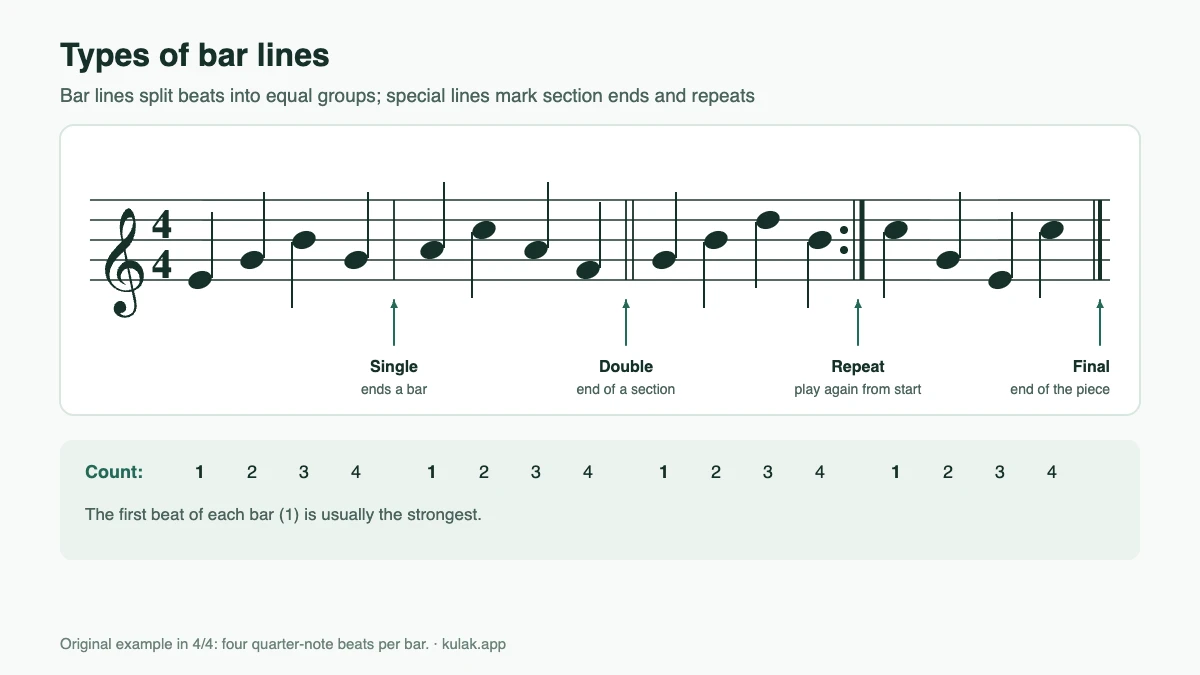
- Single bar line: the everyday line that closes one measure and opens the next.
- Double bar line (thin–thin): marks the end of a section or a change of key or time signature. The music continues.
- Final bar line (thin–thick): the end of the piece.
- Repeat signs: a thick and a thin line with two dots. The dots point toward the music that is repeated.
- Dashed bar line: sometimes used to split long measures for easier reading; it does not end the measure.
Reading repeat signs
A repeat has two halves. In a start repeat the dots sit to the right, facing the music: “the repeat begins here”. In an end repeat the dots sit to the left: “go back now”. If there is no start repeat, go back to the very beginning.
Repeated sections often have first and second endings, shown with brackets labelled “1.” and “2.”. Play the first ending the first time, then repeat; on the second pass skip the first ending and play the second. Words such as D.C. (da capo, from the beginning), D.S. (dal segno, from the sign) and Fine (the end) give further road-map instructions.
Strong and weak beats
The beat right after a bar line, the downbeat, is usually the strongest beat of the measure. In 4/4, beat 1 is strong, beat 3 is medium and beats 2 and 4 are weak. So bar lines show not only arithmetic but also the music’s breathing pattern.
A melody can begin before the first full measure, on a weak beat. This incomplete opening bar is called a pickup or anacrusis, and the final measure is often shortened to balance it. When rhythms deliberately push weight onto weak beats, you get syncopation.
How to check a measure adds up
- Read the time signature: in 4/4 the target is 4 beats.
- Add every note and rest in the measure: whole = 4, half = 2, quarter = 1, eighth = ½. Rests count too; see how to count rests.
- For dotted notes add half the value again: a dotted half = 3 (dotted notes explained).
- If the total does not match, a value has been misread or the bar is a pickup.
Example: in 3/4, a half note plus a quarter note = 2 + 1 = 3 beats, so the bar is complete. Add another quarter and it overflows. Practise the values on quarter, eighth and sixteenth notes and test yourself with the note reading test.
FAQ
What does a bar line do?
It divides music into measures of equal length according to the time signature, which makes counting and reading easier.
Is a measure the same as a bar?
Yes. “Measure” is more common in American English and “bar” in British English; both mean the space between two bar lines.
What is the difference between a double bar line and a final bar line?
A thin double bar line marks the end of a section and the music continues. A thin–thick final bar line marks the end of the piece.
Which way do the dots in a repeat sign face?
They face the music being repeated: dots on the right begin a repeated section, dots on the left end it.
Should I pause at a bar line?
No. A bar line is not a rest; the music continues without a break.