Dotted Notes: How to Count Dotted Half, Quarter and Eighth Notes
Quick answer: A dot placed after a note adds half of that note’s own value. With the quarter note as one beat, a dotted half note lasts 2 + 1 = 3 beats, a dotted quarter lasts 1 + ½ = 1½ beats and a dotted eighth lasts ½ + ¼ = ¾ of a beat. The easiest way to count dotted rhythms is to split each beat in two: “1-and-2-and”.
The dot rule
There is only one rule, and it works for every note value: a dot adds half of the note’s own length. In other words, a dotted note is always 1.5 times its plain value. The dot goes to the right of the notehead. A dot above or below the notehead is something else entirely: a staccato mark, meaning “short and detached”.
Dotted note values chart
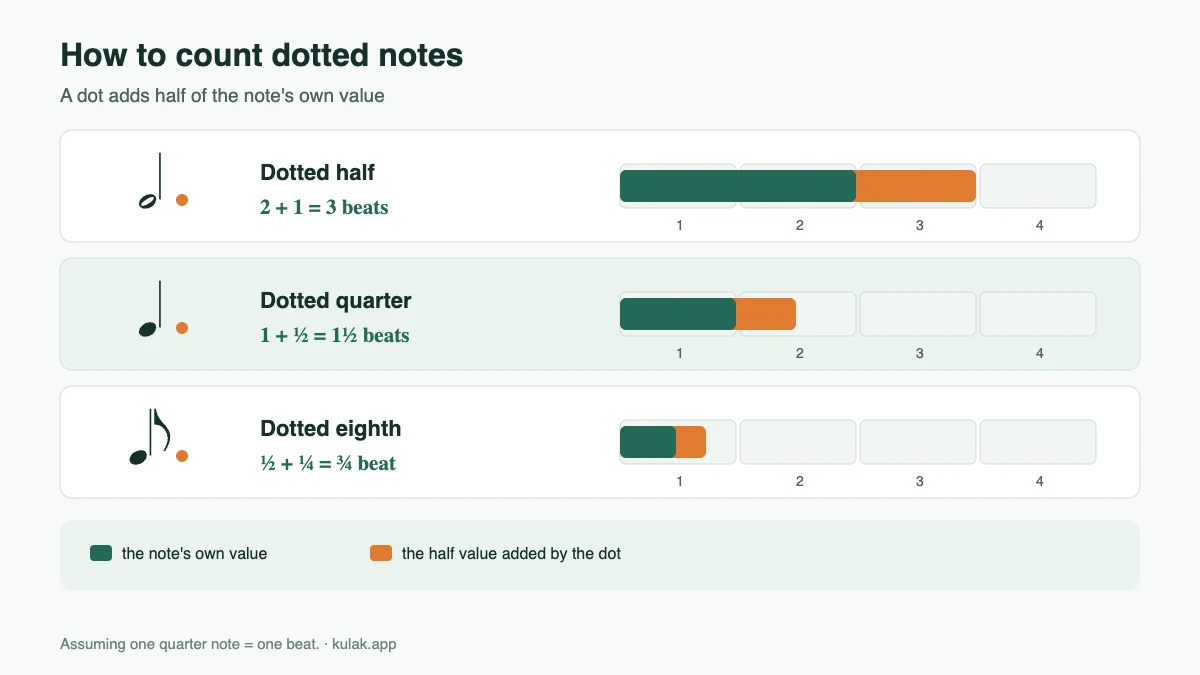
| Dotted note | Sum | Length (quarter = 1) | Same as |
|---|---|---|---|
| Dotted whole | 4 + 2 | 6 beats | Whole + half |
| Dotted half | 2 + 1 | 3 beats | Half + quarter |
| Dotted quarter | 1 + ½ | 1½ beats | Quarter + eighth |
| Dotted eighth | ½ + ¼ | ¾ beat | Eighth + sixteenth |
If the plain values are still new, start with quarter, eighth and sixteenth notes.
Counting a dotted half note
A dotted half lasts three beats, so in 3/4 it fills a whole measure on its own, which is why it often ends waltzes and 3/4 songs. In 4/4 it is usually followed by a quarter note or a quarter rest. Count: hold the sound through “1 – 2 – 3” and release at the end of 3. When clapping, clap on 1 and keep your hands in the air through 2 and 3 to feel the sound continuing.
Counting a dotted quarter note
The dotted quarter is the one that trips most beginners, because it ends in the middle of a beat. Split the count: 1 – and – 2 – and.
- The dotted quarter starts on “1” and lasts through “1-and-2”, which is 1½ beats.
- The eighth note that usually follows falls on the “and” of 2.
- Together, this long–short pattern (dotted quarter + eighth) fills exactly two beats and appears in countless familiar melodies.
Practice trick: play the pattern first without the dot, as quarter + eighth + eighth. Then tie the first eighth to the quarter so it is not played again. What remains is a dotted quarter and a single eighth, and you can hear why the dot adds “half a value”.
Dots versus ties
A dot and a tie both lengthen a sound. A dotted quarter equals a quarter tied to an eighth. The difference: a tie can cross a bar line, a dot cannot. If a sound continues into the next measure, a tie is used.
Double dots and dotted rests
With a double dot, the second dot adds half of what the first dot added. A double-dotted half note is 2 + 1 + ½ = 3½ beats. Rests can be dotted too, with the same rule: a dotted quarter rest is 1½ beats of silence. See how to count rests.
Practice drills
Set the online metronome to 60 BPM. Count each line aloud, then clap it, and check the total fills the measure.
| Time | Pattern | Check |
|---|---|---|
| 3/4 | Dotted half | 3 = 3 ✓ |
| 4/4 | Dotted half + quarter | 3 + 1 = 4 ✓ |
| 2/4 | Dotted quarter + eighth | 1½ + ½ = 2 ✓ |
| 4/4 | Dotted quarter + eighth + half | 1½ + ½ + 2 = 4 ✓ |
| 4/4 | Quarter + dotted quarter + eighth + quarter | 1 + 1½ + ½ + 1 = 4 ✓ |
To recognise these patterns by ear, try rhythm ear training or print the rhythm worksheets.
FAQ
What does a dot after a note mean?
It adds half of the note’s own value, making the note one and a half times as long.
How many beats is a dotted half note?
Three beats when the quarter note is the beat.
How many beats is a dotted quarter note?
One and a half beats. It is usually followed by an eighth note, and the pair fills two beats.
Does a dot above a note change its length?
No. A dot above or below a note is a staccato mark. Only a dot to the right of the notehead adds duration.
Can a dot cross a bar line?
No. Use a tie when a sound continues into the next measure.