Melodica notes: find the keys without memorising the whole keyboard
To find C on a melodica, look for a complete group of two black keys. C is the white key immediately to the left of that pair. Moving toward the higher notes, the white keys then read C, D, E, F, G, A, B, and C again. You can use that repeating pattern on different keyboard sizes without assuming that the instrument’s first key is C.
This is a guide to finding note names, not a collection of song arrangements. If you want to hear the notes as you work, open the virtual melodica. Keep this chart nearby for checking, then cover the labels and try locating the notes yourself.
Use the black-key groups as landmarks
Rather than starting at the left edge and counting every key, find a group of two black keys somewhere in the middle. The white key before the pair is C. The white key between the pair is D; the white key just after it is E. That gives you three notes from one recognisable shape.
Now find a group of three black keys. The white key before that group is F. Continuing upward through the surrounding white keys gives G, A and B. A new pair of black keys follows, and the next C begins the pattern again.
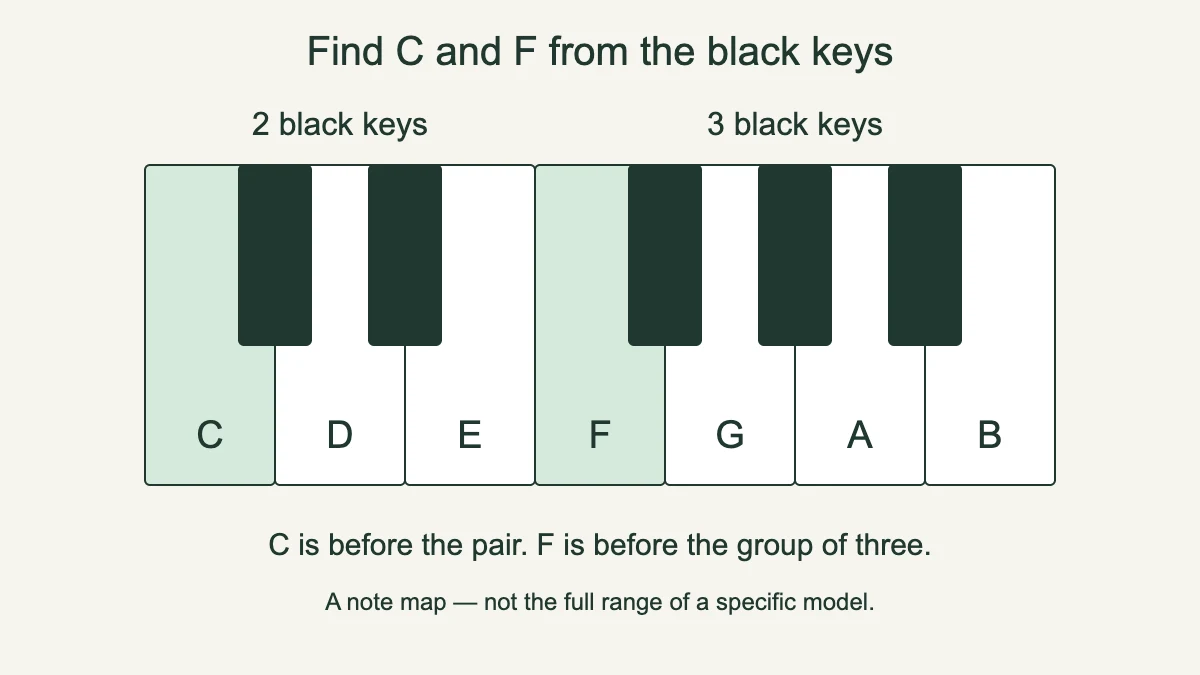
For a quick check, point to D without starting from C. Then find A using the three-black-key group. D sits between the two black keys; A sits between the second and third black keys of a group of three. These local landmarks help you recover after losing your place.
The very end of a keyboard may show an incomplete group. Do not treat a lone black key at the edge as a new type of pattern. Find a complete group farther in, name a reliable white key there, and work back toward the edge. Your instrument’s manual can confirm its lowest and highest pitches.
Melodica note names: letters and do–re–mi
English-language charts usually use the letters A to G. Turkish beginner materials commonly use Do, Re, Mi, Fa, Sol, La and Si as note names. The table below uses that fixed-name convention. It does not describe movable-do solfège, where syllables can represent a note’s role in the current key.
| Letter | Fixed name | Landmark |
|---|---|---|
| C | Do | Before two black keys |
| D | Re | Between two black keys |
| E | Mi | After two black keys |
| F | Fa | Before three black keys |
| G | Sol | Between the first and second of three black keys |
| A | La | Between the second and third of three black keys |
| B | Si | After three black keys |
Try reading C–E–D–F aloud before touching the instrument. In the fixed-name convention, that is Do–Mi–Re–Fa. The exercise is a translation between labels, not a request to move to a different set of keys. If a chart uses unfamiliar naming conventions, check its legend before combining it with this one.
What are the black keys called?
A sharp raises a written note by a semitone; a flat lowers it by a semitone. On this keyboard, C-sharp and D-flat identify the black key between C and D. The same pattern gives D-sharp/E-flat, F-sharp/G-flat, G-sharp/A-flat and A-sharp/B-flat. The written spelling depends on the musical context, even when the key you press is the same.
Two important gaps have no black key: E–F and B–C. Do not skip F when looking for E-sharp, or skip C when looking for B-sharp. Accidentals describe changes in pitch, not a rule that a sharp must always mean a black key. For a worked explanation, continue with sharps and flats on a keyboard.
Practise one boundary at a time. Locate E and its next higher key, F. Then locate F and its next higher key, F-sharp. Saying the names while you point helps separate the white-key alphabet from the smaller steps between adjacent keys.
The same letter can appear in several places
A larger keyboard contains several Cs, Ds and other repeated names. They are not interchangeable when a melody specifies a register. C4 and C5 share the letter C, but C5 is an octave above C4. In scientific pitch notation, the octave number changes at C, so B4 is followed by C5.
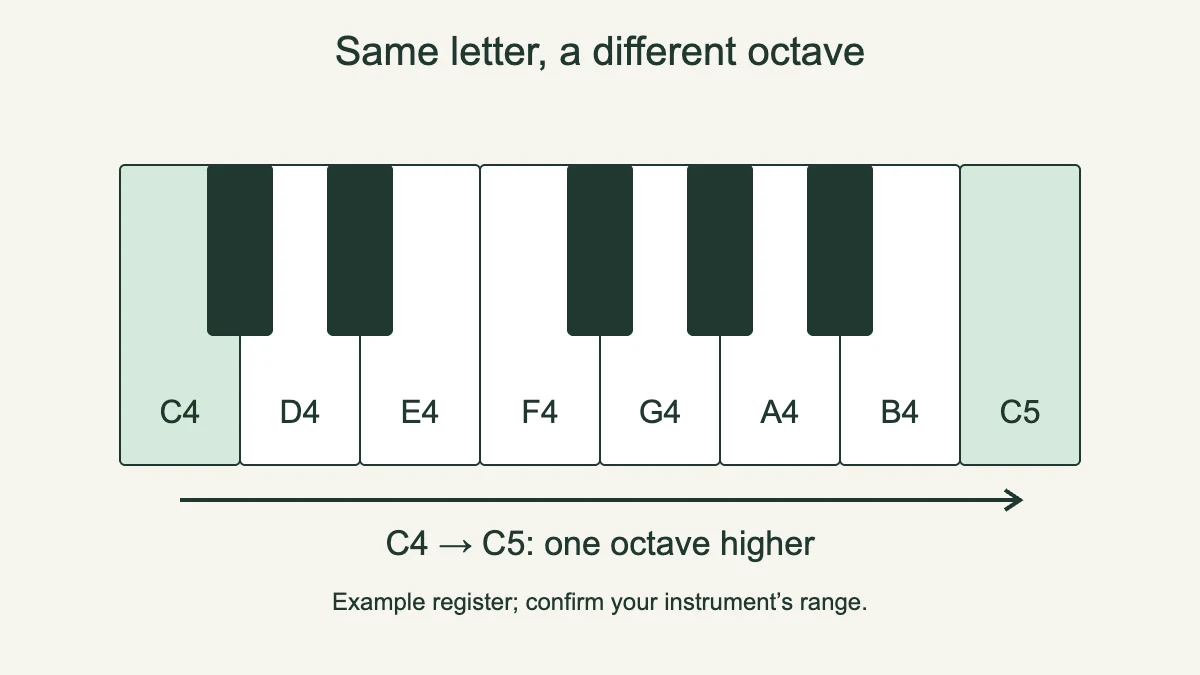
Do not label a physical key C4 just because it is the first C you can see. The black-key pattern tells you the letter; it does not establish the octave number. Confirm the instrument’s range from its documentation. Likewise, a cropped screenshot of a web keyboard may omit lower keys without changing the names of the remaining ones.
On a small screen, use the virtual instrument’s range control to reach another register. A key outside the visible section has not disappeared from musical notation. Before following an exercise, check that the displayed range includes all of its pitches.
Note names, finger numbers and keyboard shortcuts are different
A pitch label tells you what to sound. A finger number suggests how to reach it on a physical instrument. A computer shortcut tells you which computer key triggers the sound in a particular website. Confusing these systems can make a correct chart look wrong.
For example, the 4 in C4 is an octave number, not an instruction to use your fourth finger. A letter printed as a computer shortcut may trigger a different musical letter. Read the interface labels before playing. Our melodica fingering guide deals with physical finger choices separately.
Five checks before you move on
Try each question on a keyboard without opening the answer. These checks cover note location and naming only; they are not a test of overall musical ability.
1. Which white key is between a pair of black keys?
D. The three white keys around that pair are C, D and E. You can identify D directly from the pair rather than counting from the instrument’s edge.
2. Which white key comes immediately before a group of three black keys?
F. Moving upward around the group gives F, G, A and B.
3. Which key is one semitone above E?
F. There is no intervening black key. Moving to F-sharp would go too far.
4. Where do you find D-flat?
On the black key between C and D. On the keyboard it is also called C-sharp; the spelling depends on context.
5. Does moving from C4 to C5 keep the exact same pitch?
No. The letter name stays C, but the pitch moves up an octave. Repeated names are a reason to check register rather than ignore it.
Turn the chart into something you can use
Choose three targets: one C, one F and one D. Find them out of order, using their nearby black keys. Once that is comfortable, add A and B. There is no benefit in racing through all the labels if you still need to restart from the lowest note after every mistake.
Next, point to C–D–F–E without sounding it. Check the destinations, then play the sequence slowly in the online melodica or on your instrument. Notice the difference between knowing the destination and moving there on time. Keep those two problems separate when deciding what to practise next.
A letter sequence alone does not tell you how long each note lasts. To play a complete phrase, you also need rhythm, register and any accidentals. Learn to read these together rather than assuming that every written letter takes the same amount of time. The treble-clef note-reading test offers a separate short check of staff positions.
Common questions
Do 32-key and 37-key melodicas use different note names?
The naming pattern is the same. Their available ranges can differ; check the specific model rather than inferring every pitch from the key count.
Do I need stickers on every key?
You can use labels as a temporary reference. Try covering some of them and recovering the notes from the black-key groups so the labels do not become your only way to find a pitch.
Is learning the chart enough to read music?
No. It helps you locate pitches. Reading music also includes rhythm, staff positions, accidentals and following a phrase without stopping at every symbol.
Can a virtual melodica check my breathing?
No. The web keyboard lets you hear and choose notes; it does not measure your airflow or reproduce the physical technique of a wind instrument.
Continue from naming notes to recognising sounds
Once you can locate a note, compare it with another: did the melody rise, fall or repeat? Start with finding notes by ear. For continued listening practice, explore KulakApp through the app overview and download links. Note location and ear training support each other, but neither replaces practising the physical instrument.
Sources and scope
For standard keyboard notation, see Open Music Theory on half steps and accidentals. Examples and answer explanations here were written for this guide. No song score, manufacturer illustration or third-party recording is reproduced.