How to Find Notes by Ear
Break a melody into short phrases, match the first pitch and use direction and distance to find each next note without random guessing.
Finding notes by ear does not mean naming every pitch instantly. It means holding a short phrase in memory, choosing a reference note, hearing how the melody moves and checking each decision on your voice or instrument. The method becomes much clearer when you solve two or three notes at a time instead of chasing an entire song.
Start with a phrase you can sing
Choose a familiar melody with a clear lead line. Listen to one short phrase, pause the recording and sing it back. If the phrase disappears as soon as the audio stops, shorten it. Your voice does not need to sound polished; it is being used as a portable reference that keeps the melody available while you search on an instrument.
How to match the first note
Sing the opening pitch and try a note near the middle of your instrument. Decide whether the played note is lower or higher than your sung note. Move in that direction by small steps. The task is matching two sounds, not guessing a letter name from memory. Use the free online virtual piano if you do not have an instrument nearby.
Use direction before interval names
Once the first note is secure, sing the first two notes together. Did the melody rise, fall or repeat? Was the change a step or a noticeable leap? These simple decisions remove many impossible answers. Formal interval names are useful later, but you can begin finding melodies before you can label every distance.
| What you hear | What to test first | Common mistake |
|---|---|---|
| The pitch repeats | Play the same key again | Mistaking a rhythm change for a pitch change |
| A small rise or fall | Try nearby keys | Jumping too far too soon |
| A clear leap | Confirm direction, then compare distance | Guessing a note name before listening |
Divide the melody into motifs
A phrase that lasts only a few seconds can still overload working memory. Divide it into two- or three-note motifs. Solve the first motif until you can sing and play it smoothly, add the next one, then join them. Keep the original rhythm: correct pitches with misplaced durations may no longer sound like the melody you are trying to reproduce.
How to check whether a note is correct
Do not judge a note only in isolation. Play it with the note before it, then replay the entire motif. Compare immediately with the recording and once more after the recording stops. If two candidates seem possible, alternate them in the same context. The better match usually becomes clearer when the surrounding notes are included.
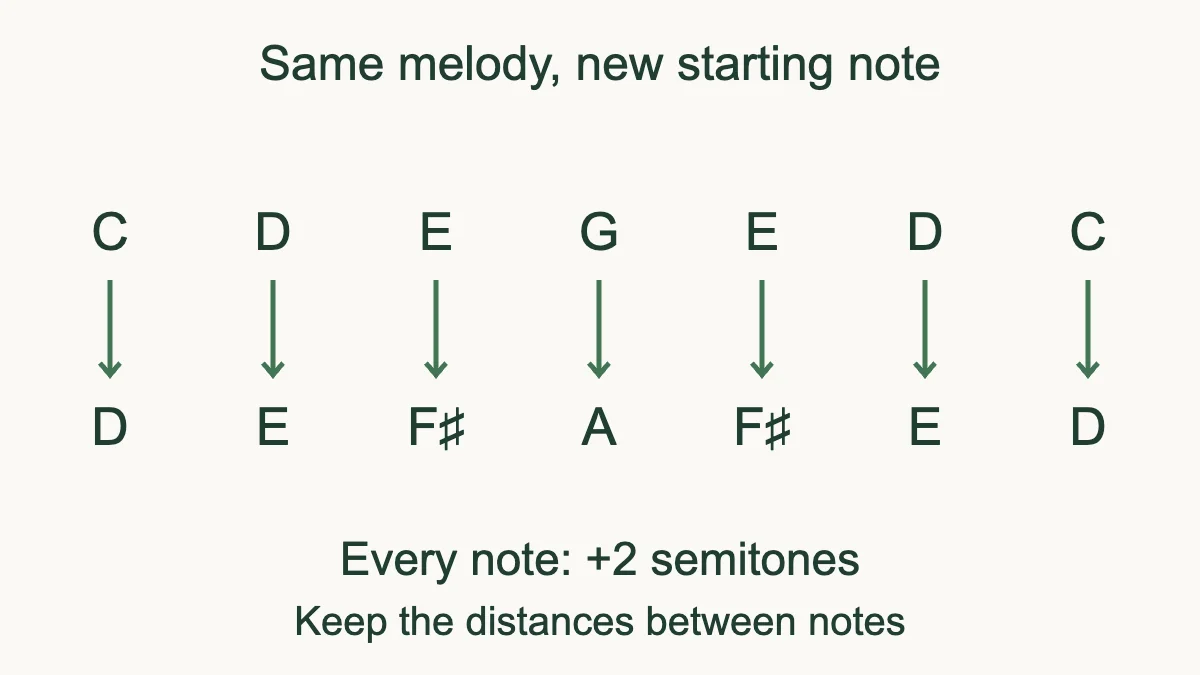
Try the phrase from another starting pitch after you solve it. If you can preserve the relationships, you have learned more than one fixed keyboard pattern.
Try a complete example: find a seven-note phrase
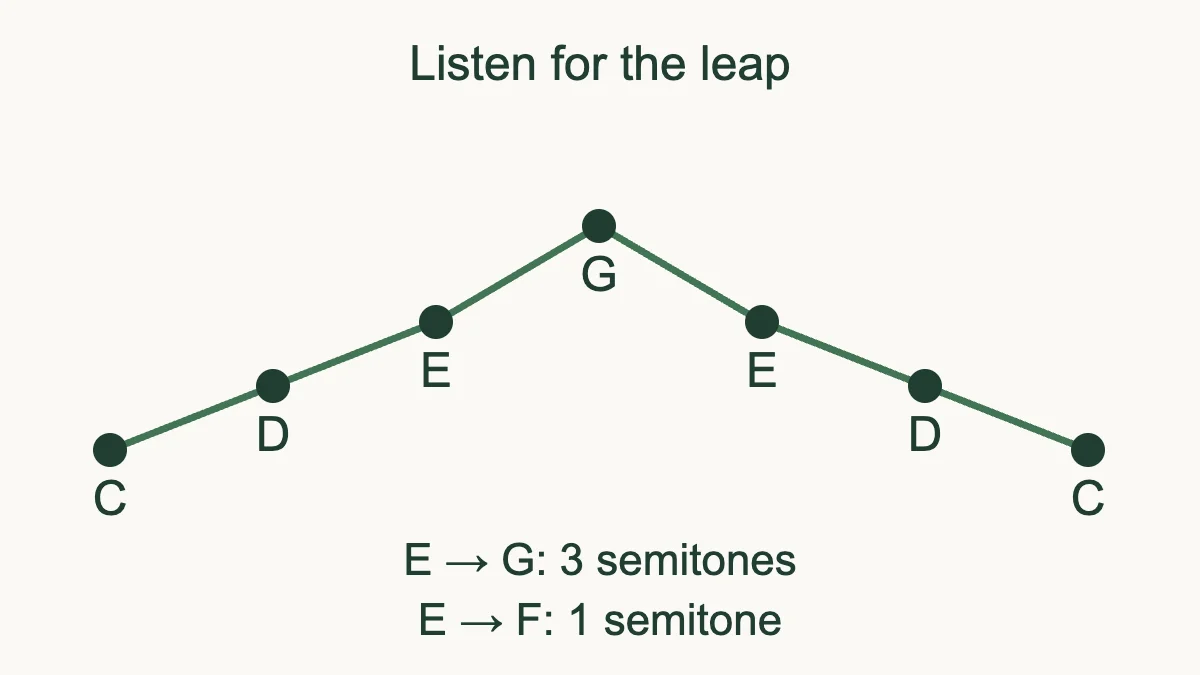
Use the virtual piano to play C–D–E–G–E–D–C slowly, giving every note the same length. These notes form an original teaching pattern, not a quotation from a song. Play the phrase once, look away from the letters, then sing or hum it. If seven notes are too much to remember, begin with C–D–E.
Find the error instead of replaying the whole phrase
Compare C–D–E–F–E–D–C with the original. Both outlines rise and fall, so direction alone cannot identify the mistake. The fourth note is different. Isolate E–G–E and compare it with E–F–E. E to G spans three semitones; E to F spans one. Sing only those three notes, then rejoin the whole phrase.
| Part | Pitch movement | Listen for |
|---|---|---|
| C–D–E | Up two semitones, then two | Two rising steps |
| E–G–E | Up three, down three | A leap and return to the same E |
| E–D–C | Down two, then two | The opening steps in reverse |
Start on D: does the same shape still work?
Keep the distances, not the colours of the keys. Starting on D gives D–E–F♯–A–F♯–E–D. Using F natural would make the E–F movement one semitone instead of two, changing the phrase. This is a practical way to distinguish hearing relationships from memorising white-key positions.
After your attempt, record one useful observation: “I found the first three notes but replaced the leap with a step,” for example. Next time, work on that contrast rather than repeatedly guessing all seven notes. This self-check is not a scored hearing or ability test.
Five mistakes that slow the process
- Trying to transcribe the full song before solving one phrase.
- Pressing random keys rapidly and accepting the first familiar result.
- Ignoring rhythm while searching for pitch.
- Leaving the recording on continuously instead of testing memory.
- Moving to notation before you can sing or play the phrase reliably.
A focused 15-minute routine
- Three minutes: compare higher, lower and repeated pitches.
- Four minutes: sing and find the first two notes of one melody.
- Five minutes: add a second motif and join both parts.
- Three minutes: turn off the recording and reproduce the phrase from memory.
Track fewer random attempts, quicker direction decisions and clearer singing—not only the number of correct notes. For a broader starting check, use the free ear training test. It is a short sample, not a diagnosis or a fixed judgment of musical ability.
Continue with structured listening practice
Use the web tools for a focused start, then continue broader interval, chord, melody and rhythm exercises in KulakApp.