Easy melodica melodies: three short tunes with letter notes and audio
Start with a short melody that you can finish, not a long list of notes that you have to restart every few seconds. The three original practice tunes below use only C4, D4, E4, F4 and G4. Each lasts four bars in 4/4, with a reference recording at 72 quarter-note beats per minute. Learn the pitches first, then fit them into the written rhythm.
These are new educational examples prepared for KulakApp, not arrangements of familiar songs. The audio uses a synthesised reference tone rather than a recorded physical melodica. You can check the notes on our virtual melodica, but breath control and physical fingering need practice on your own instrument.
How to read the examples
The letter tells you the pitch, and the number in a name such as C4 identifies its octave. The duration after each note tells you how many quarter-note beats it lasts. C4 for 1 beat is a quarter note; C4 for 2 beats is a half note. A 0.5-beat note is an eighth note. A 3-beat note lasts three quarter-note beats, equivalent to a dotted half note in this meter.
Every bar adds up to four beats. Count “1, 2, 3, 4” at an even pace, and let a long note continue while the count moves forward. Do not play it again on every beat. A rest means silence for its stated duration; the underlying count continues.
For the eighth-note pairs in the last tune, count “1 and 2 and 3 and 4 and.” An eighth note occupies half of one numbered beat, not a whole beat. The tempo has not doubled: the notes are simply shorter. Our guide to note values explains the relationship in more detail.
Before playing, find C4–G4 on a correctly labelled keyboard or confirm the register in your instrument documentation. If the octave label is unfamiliar, use the melodica note map. Do not assume the first visible C is always C4. The reference examples stay in one five-note area to keep the musical task manageable.
Small Return: hear the phrase come back to C
The opening moves upward from C through D to E, then gives E time to settle. In bar two, the melody reaches G and moves back through E to D. Notice the change from neighbouring notes in the opening to the larger movements in the second bar. The final C lasts three beats, so the ending is not just a quick extra note.
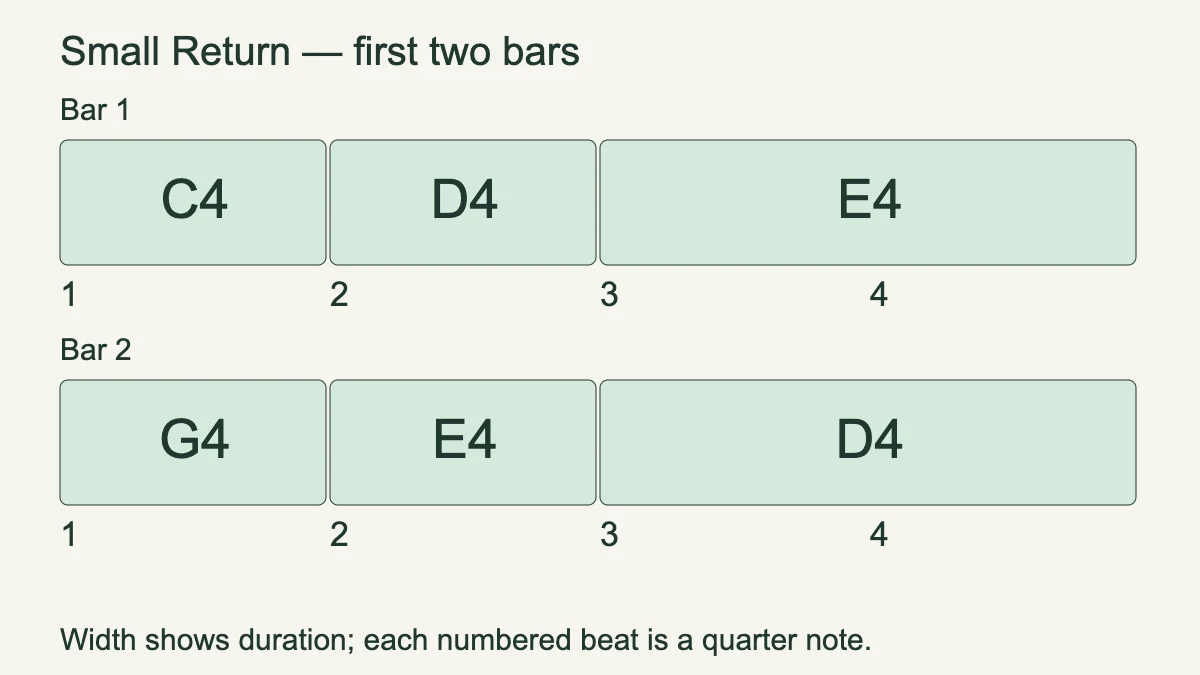
Reference audio: Small Return, 72 BPM.
| Bar | Notes and durations |
|---|---|
| 1 | C4 (1 beat); D4 (1 beat); E4 (2 beats) |
| 2 | G4 (1 beat); E4 (1 beat); D4 (2 beats) |
| 3 | E4 (1 beat); F4 (1 beat); D4 (1 beat); E4 (1 beat) |
| 4 | D4 (1 beat); C4 (3 beats) |
Listen once without playing and trace the direction with a finger: up, up, stay; up, down, down. Then find the first note of each bar—C, G, E and D—before attempting the full line. This gives you recovery points if you lose your place. You should not have to return to the beginning after every mistake.
Practise the last bar by itself. Play D on beat one and C on beat two; keep C sounding through beats three and four. If you release C as soon as you say “three,” the ending is short. Count all the way to the next bar boundary before stopping.
An Answer After the Rest: keep the beat through silence
This tune introduces a one-beat rest at the end of bars one and three. The rest is part of the rhythm, not a signal to wait until you feel ready. After E–G–E in the first bar, count beat four silently and begin D on beat one of the next bar.
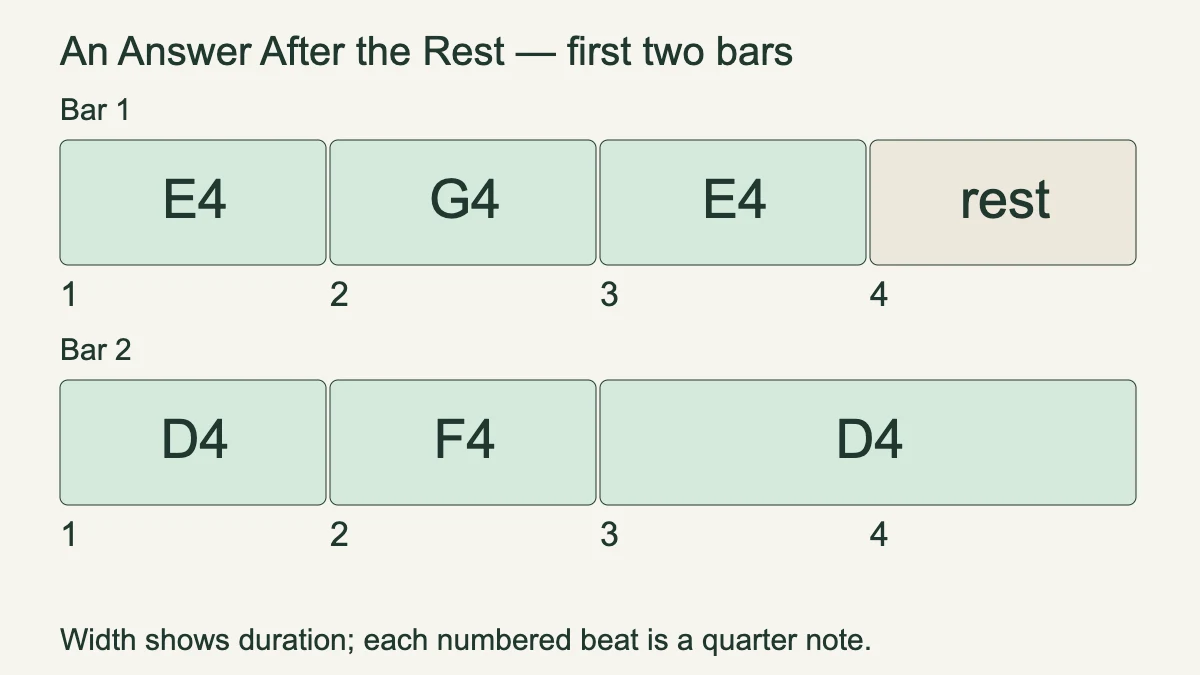
Reference audio: An Answer After the Rest, 72 BPM.
| Bar | Notes and durations |
|---|---|
| 1 | E4 (1 beat); G4 (1 beat); E4 (1 beat); Rest (1 beat) |
| 2 | D4 (1 beat); F4 (1 beat); D4 (2 beats) |
| 3 | C4 (1 beat); E4 (1 beat); G4 (1 beat); Rest (1 beat) |
| 4 | F4 (1 beat); D4 (1 beat); C4 (2 beats) |
Tap four steady beats on the table while saying the first bar: “E, G, E, rest.” Keep tapping when your voice stops. Then add the next D without an extra pause. If the transition is uneven, practise only the end of bar one and the beginning of bar two.
On a physical melodica, a written rest may provide an opportunity to renew your breath, but the example does not prescribe a breathing technique. Use a comfortable approach and your teacher’s guidance. Never hold your breath or force a phrase merely to match an exercise. The web tool cannot assess airflow.
Two Short Steps: fit two notes inside one beat
The opening C and D are eighth notes: together they fill beat one. E occupies beat two, and G continues through beats three and four. The listening task is to hear that the two shorter notes belong inside the same steady pulse used by the first two tunes.
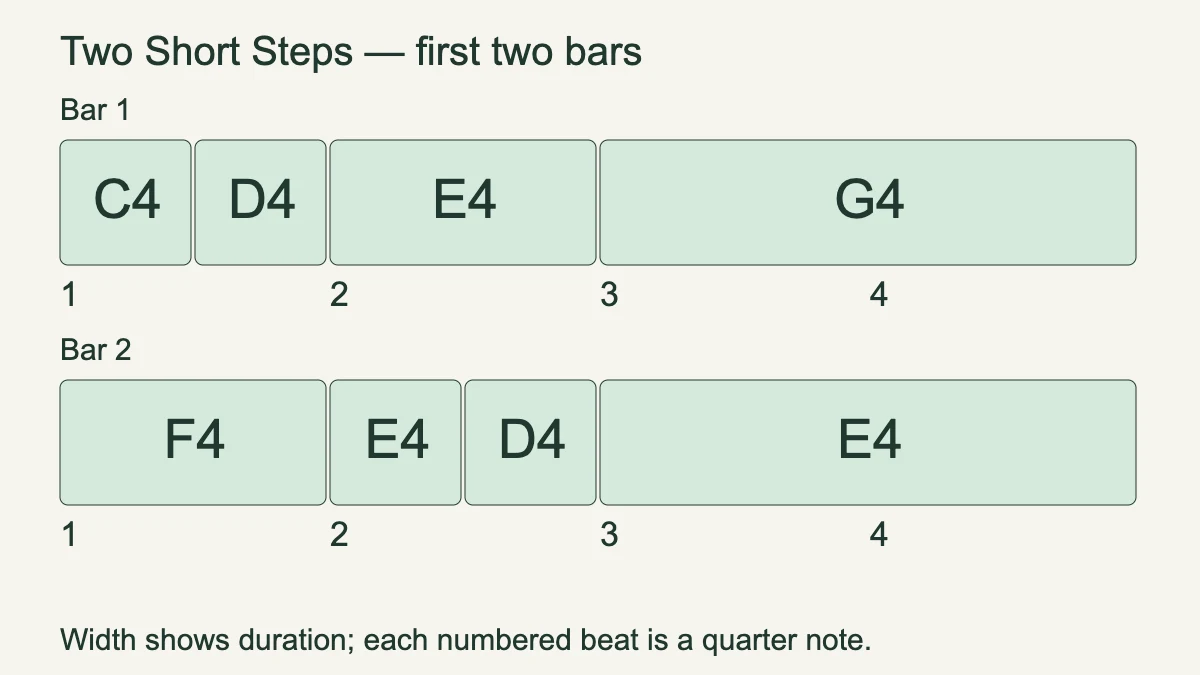
Reference audio: Two Short Steps, 72 BPM.
| Bar | Notes and durations |
|---|---|
| 1 | C4 (0.5 beats); D4 (0.5 beats); E4 (1 beat); G4 (2 beats) |
| 2 | F4 (1 beat); E4 (0.5 beats); D4 (0.5 beats); E4 (2 beats) |
| 3 | D4 (0.5 beats); E4 (0.5 beats); F4 (1 beat); D4 (1 beat); G4 (1 beat) |
| 4 | E4 (1 beat); D4 (1 beat); C4 (2 beats) |
Say “C–D, E, G—” while counting “1-and, 2, 3, 4.” The dash represents the continuation of G; it does not add a new attack. If the rhythm rushes, leave out the pitches and clap the durations first. Reintroduce the notes only after the count feels stable.
Bar two places its short pair somewhere different: E and D occur on beat two and its “and.” F is on beat one, while the final E lasts through beats three and four. Avoid assuming every eighth-note pair must begin the bar. Read its position as well as its duration.
The last bar deliberately uses no eighth notes. Let the ending breathe within the pulse rather than inventing extra notes to maintain the earlier activity. A phrase can become simpler as it closes.
Fix one musical problem at a time
If the pitch is wrong, stop the rhythm and locate the intended key. If the pitch is correct but late, check the move into that key. If the whole line speeds up, count or tap without playing. These are different problems, so repeating the entire tune faster is unlikely to identify the cause.
| What you notice | What to try next |
|---|---|
| Every note seems correct, but the recording sounds higher | Check the octave labels rather than moving one key at a time. |
| The next bar starts late after a rest | Keep tapping during the silence and connect just that bar boundary. |
| The ending finishes too soon | Count the full duration of the last note, including beats without a new attack. |
| The eighth-note pair sounds like two full beats | Speak numbered beats and “and” subdivisions before playing. |
| The reference sounds unlike your instrument | Compare pitch and rhythm, not timbre; the reference is synthesised. |
Use the online metronome separately if you want a slower reference pulse. The embedded recordings stay at 72 BPM; starting a different metronome tempo alongside them will not change their speed. First listen to the audio, pause it, then practise against your chosen pulse.
A useful repeat begins slightly before the difficult event. For a late D after the rest, include the preceding E and silent beat. Playing D alone may make the key feel familiar without solving the timing of its entrance. Once the connection works, restore the neighbouring bars.
Choose a comfortable fingering, then keep it consistent
All three tunes remain between C and G, so a right-hand five-note position can be a starting option on a physical instrument. That is not a requirement for every hand or setup. Consult the melodica fingering guide for the distinction between note names and finger numbers, and adjust with a teacher if a movement feels strained.
Computer shortcuts and touchscreen gestures are different controls. Successfully clicking the pitches demonstrates that you selected the notes; it does not establish that your physical fingering is secure. Conversely, an awkward browser gesture is not evidence of poor musical ability.
Check what you learned without turning it into a score
After playing a tune, describe one specific result. “I kept counting through both rests” is useful. “I played it perfectly” is harder to check. You might note a correctly held ending, a recurring octave error or a transition that needs another slow attempt.
Then listen again and predict the next direction before it happens. Does the phrase step upward, skip downward or repeat? This connects reading with listening. For another approach, try finding notes by ear. A short successful exercise is a starting point, not a complete assessment of musicianship.
Common questions
Are these the notes to famous songs?
No. These are newly prepared practice sequences with descriptive titles. They are not advertised as arrangements of commercial songs.
Why are octave numbers included?
A letter can name notes in several registers. The number tells you which pitch the recording uses, making comparison more precise.
Can I play the examples an octave higher?
You can explore that if your instrument reaches the notes, but your performance will be an octave above the supplied reference. Move all pitches consistently rather than changing only an awkward note.
Does the audio start automatically?
No. Use the audio control for the example you want to hear. Stop one example before starting another so their phrases do not overlap.
Will these exercises teach full melodica technique?
No. They focus on short pitch and rhythm patterns. Tone production, posture, breath and physical coordination need separate work on the instrument.
Keep the next step small
Choose the tune that addresses your current difficulty rather than playing all three repeatedly. For continued interval, chord and rhythm listening practice, see the KulakApp overview and store links. These web examples provide a short starting exercise, not personalised progress tracking or a complete instrument course.
How the examples were made
The pitch sequences, duration tables, diagrams and reference tones were prepared for this lesson. Each bar is checked to contain four quarter-note beats. No third-party recording or song score is included. The recorded notes use equal-tempered tuning with A4 at 440 Hz; the tone is a reference, not a claim to reproduce a particular melodica model.