How to Read Sheet Music: A Beginner’s Guide to Notes, Rhythm, and Clefs
Short answer: to read sheet music, learn what the staff shows, identify the clef, read the note names, understand rhythm and time signatures, and connect each symbol to a physical sound on your instrument. You do not need to memorise every note at once. A small, consistent practice routine is more effective than trying to decode an entire page immediately.
Learning how to read sheet music gives you a common language for piano, guitar, violin, flute, voice, and almost every other instrument. It helps you learn unfamiliar music, communicate with other musicians, practise rhythm accurately, and understand how a melody fits a key. This beginner guide explains the notation system from the staff upward, with examples, tables, common mistakes, and a practical study plan.
What is a music staff?
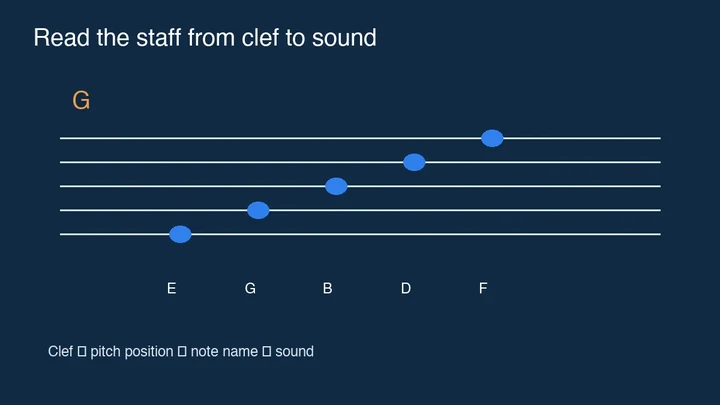
A staff, also called a stave, is a group of five horizontal lines and the four spaces between them. Notes are placed on lines or spaces to show relative pitch. A note higher on the staff represents a higher pitch; a note lower on the staff represents a lower pitch. The staff does not have a permanent meaning until a clef is placed at its beginning.
Think of the staff as a coordinate system. The vertical position tells you which pitch area to read, while the horizontal position tells you when the sound happens. This simple distinction prevents a common beginner error: reading the notes correctly but ignoring the spacing and rhythm between them.
| Symbol or area | What it tells you | Beginner question |
|---|---|---|
| Staff | Relative pitch positions | Is the note higher or lower? |
| Clef | Which pitch names belong to the lines and spaces | Which reference note should I use? |
| Notehead | The pitch position and part of the duration | Which note is this? |
| Stem and flag | Additional rhythm information | How long is the sound? |
| Bar line | Separates measures | Where does the beat group restart? |
Clefs: treble, bass, and more
A clef establishes a reference point on the staff. The treble clef, or G clef, places G4 on the second line from the bottom. The bass clef, or F clef, places F3 on the fourth line. Alto and tenor clefs use the C clef and appear frequently in viola, cello, bassoon, and other instruments. Begin with the clef used by your instrument instead of trying to learn every clef simultaneously.
Treble clef
Treble clef is common for right-hand piano parts, violin, flute, guitar, and many vocal melodies. Its lines from bottom to top are E, G, B, D, F. Its spaces spell F, A, C, E. The spaces form the word FACE in English, but a memory phrase is only a starting aid: always connect the symbol to the actual pitch and sound.
Bass clef
Bass clef is common for left-hand piano parts, cello, bass guitar, trombone, and low voices. Its lines from bottom to top are G, B, D, F, A. Its spaces spell A, C, E, G. The two dots around the fourth line identify F3. Use our bass clef notes guide for focused practice.
If you are learning treble clef, our treble clef notes guide gives you a narrower exercise. You can also use the free note reading test to check recognition speed after studying.
How to read pitch on the staff
Notes move alphabetically through A, B, C, D, E, F, and G, then repeat. Moving from one line to the next line, or from one space to the next space, means moving by a staff step. Moving from a line to the neighbouring space is also a step. A note that skips a line or space represents a larger interval.
Middle C is a useful bridge between treble and bass clef on piano. It is written on a short ledger line below treble staff and above bass staff. Ledger lines extend the staff for notes outside its normal range. Do not treat them as a new system; count line and space positions outward from the clef reference.
Intervals and contours
An interval is the distance between two pitches. When two notes are adjacent positions on the staff, they form a second by letter name; when one position is skipped, they form a third. You do not need to calculate every interval before playing, but noticing repeated shapes helps you read phrases rather than isolated symbols.
Look for repeated groups, scale fragments, arpeggios, and sequences. A line that rises by steps should feel like a connected phrase. A line that repeatedly jumps by thirds may outline a chord. This visual information becomes faster and more musical with practice.
How to read rhythm and note values
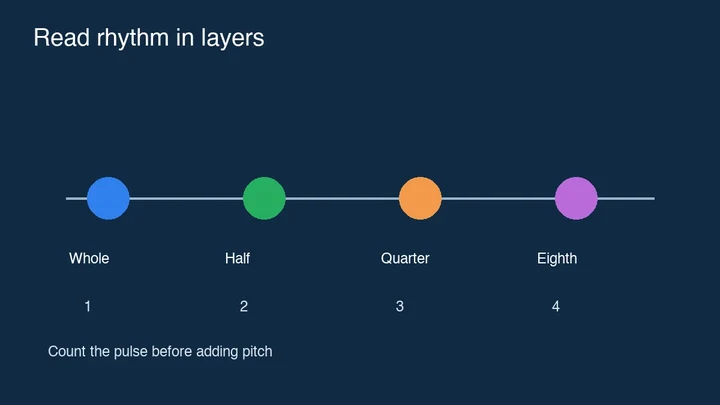
Pitch tells you what note to play; rhythm tells you when and for how long to play it. In common notation, a whole note lasts four quarter-note beats in 4/4, a half note lasts two, a quarter note lasts one, an eighth note lasts half a beat, and a sixteenth note lasts a quarter of a beat. These values are relative to the beat and time signature.
| Symbol name | Typical beat value | How to practise it |
|---|---|---|
| Whole note/rest | 4 beats | Count 1–2–3–4 without restarting. |
| Half note/rest | 2 beats | Count 1–2, then continue the measure. |
| Quarter note/rest | 1 beat | Tap every counted beat. |
| Eighth note/rest | 1/2 beat | Count “1 and 2 and”. |
| Sixteenth note/rest | 1/4 beat | Use “1 e and a” slowly. |
A rest is not empty time. It has a measured duration and belongs to the rhythm. Keep counting during rests instead of stopping your internal pulse. Our music rests guide covers this point in more detail.
Time signatures
A time signature appears after the clef. The top number tells you how many beats or subdivisions are grouped in a measure; the bottom number tells you which note value represents the basic unit. In 4/4, four quarter-note beats are grouped together. In 3/4, three quarter-note beats are grouped together. In 6/8, six eighth-note units are commonly felt as two groups of three.
Do not read the top number as a speed. Tempo tells you how fast the beat moves; the time signature tells you how beats are organised. In 6/8, for example, the six eighth notes are usually felt as two groups of three, while 3/4 is felt as three quarter-note beats.
Key signatures, sharps, flats, and naturals
A key signature appears after the clef and before the time signature. It tells you which notes are normally sharp or flat throughout the piece. An accidental changes a note for a bar or according to the notation rules. A sharp raises a pitch by a semitone, a flat lowers it by a semitone, and a natural cancels a previous sharp or flat.
Key signatures reduce repetition. Instead of writing the same accidental beside every note, the composer places it once at the beginning. The key signature does not always prove the tonal centre by itself, but it narrows the likely scale choices.
| Key | Signature | Relative minor |
|---|---|---|
| C major | No sharps or flats | A minor |
| G major | F-sharp | E minor |
| D major | F-sharp, C-sharp | B minor |
| F major | B-flat | D minor |
| B-flat major | B-flat, E-flat | G minor |
A practical workflow for reading a new piece
- Scan before playing. Identify the clef, key signature, time signature, tempo marking, repeats, and accidentals.
- Find the reference notes. Locate a few familiar notes and mark the first and last important pitches.
- Speak or tap the rhythm. Count the measure before adding pitch.
- Read in small groups. Notice steps, skips, repeated patterns, and chord shapes.
- Play slowly. Keep a steady pulse and do not stop at every mistake.
- Repeat with fewer supports. Move from note names to contours, then to fluent reading.
Common beginner mistakes
Using only memory phrases
Memory phrases can help you start, but they are slow when every note requires a sentence. Combine them with anchor notes, interval shapes, and repeated pattern recognition.
Ignoring rhythm until the end
A piece with correct pitches but incorrect rhythm is still incorrect. Count aloud, use a metronome, and practise difficult measures separately.
Reading one note at a time forever
Early note-by-note reading is normal. Progress means recognising groups and anticipating the direction of the phrase. Look one or two notes ahead without losing the beat.
Playing too fast
Speed hides mistakes and weakens memory. Choose a tempo at which you can maintain the pulse and correct errors without stopping.
Confusing a key signature with an accidental
A key signature applies as a standing rule; a written accidental may alter a note temporarily. Check the measure and the notation context before changing a pitch.
A four-week practice plan
| Week | Focus | Daily task |
|---|---|---|
| 1 | Reference notes | Name notes in one clef and locate them on your instrument. |
| 2 | Rhythm | Clap quarter, half, eighth, and rest patterns with a steady pulse. |
| 3 | Short melodies | Read four- to eight-measure phrases slowly without stopping. |
| 4 | Fluency | Combine pitch, rhythm, dynamics, and expression in simple pieces. |
Keep a small record of the notes or rhythms that cause mistakes. Review those patterns at the start of the next session. A focused five-minute correction is usually more useful than replaying an entire piece carelessly.
Frequently asked questions
How long does it take to learn to read sheet music?
Many beginners can recognise a small range of notes within a few focused sessions, but fluent reading takes regular practice. Progress depends on the clef, instrument, rhythm complexity, and consistency of practice.
Should I learn treble or bass clef first?
Start with the clef you use most. Pianists usually need both, while a violinist may begin with treble clef and a cellist with bass or tenor clef.
Is reading sheet music the same as playing by ear?
No. Reading uses visual notation; playing by ear uses listening and memory. They support each other, and practising both can improve musicianship.
What is the fastest way to memorise note names?
Use reference notes, short daily drills, and immediate instrument feedback. Add interval and contour recognition instead of relying only on alphabet phrases.
Why do I read notes correctly but still sound wrong?
Rhythm, key signatures, accidentals, fingering, and tempo can all cause problems. Separate the rhythm from pitch, slow down, and check the measure where the error begins.
Try the free note reading test → Practise with the online metronome →