How to read treble clef notes
Music-reading workshop
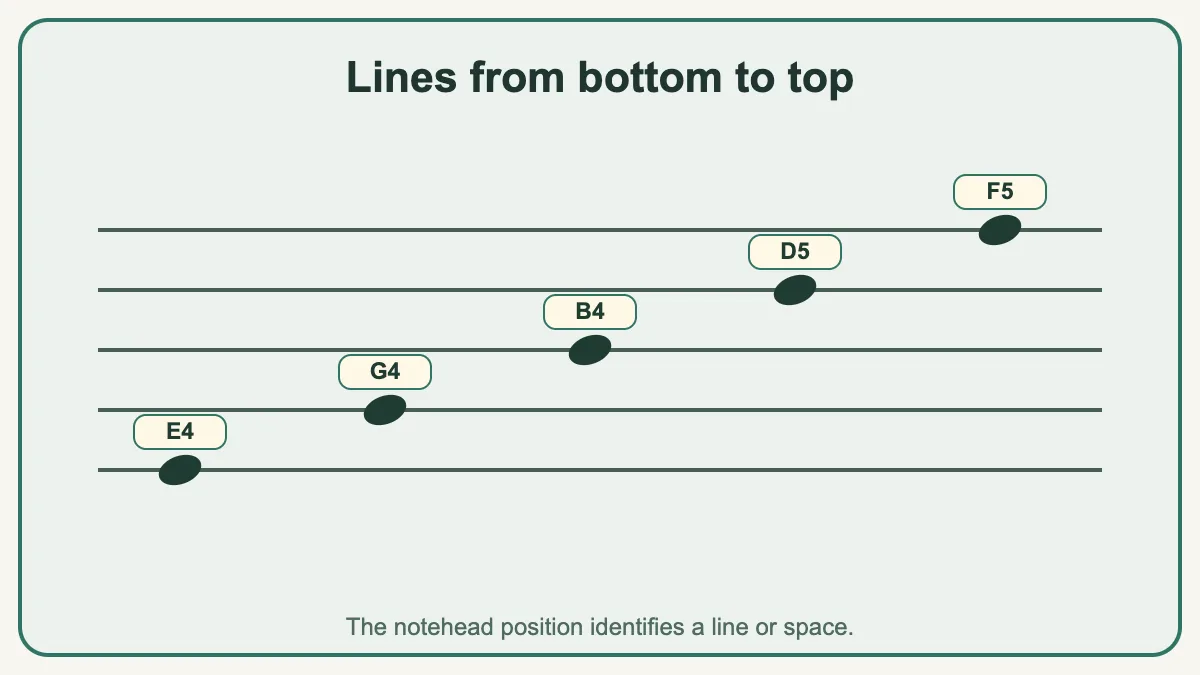
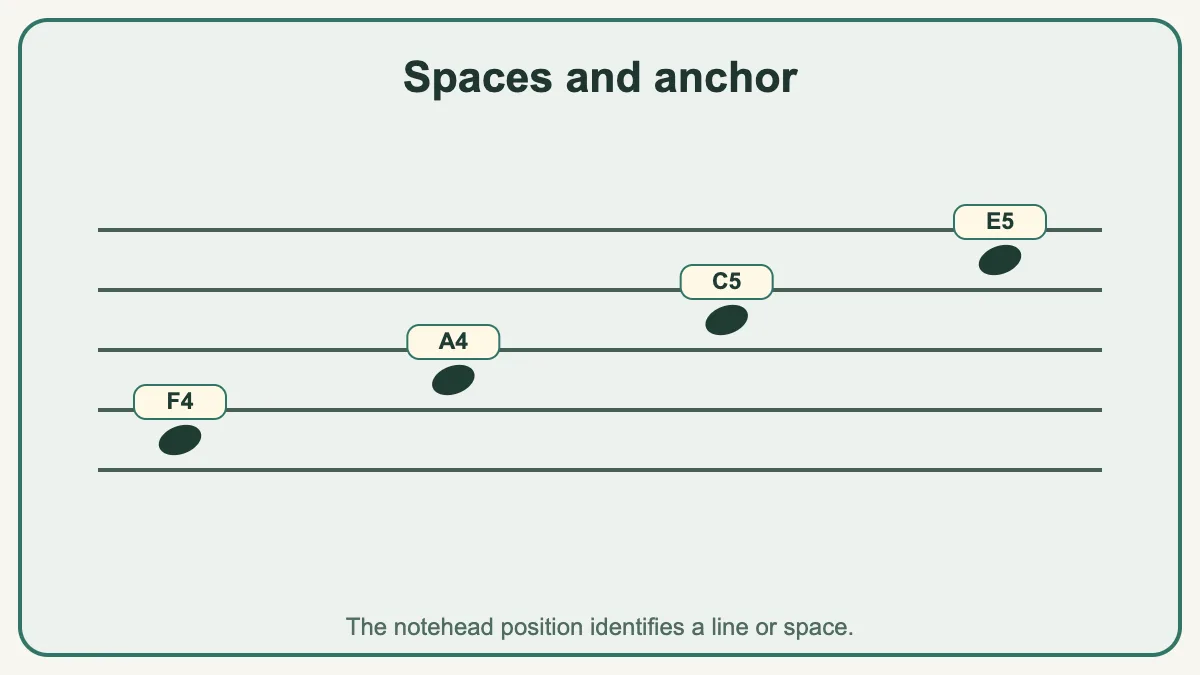
The treble clef fixes the second line of the five-line staff as G4. From that anchor you can name every nearby note by moving one line or space at a time: the lines from bottom to top are E4, G4, B4, D5 and F5, and the spaces are F4, A4, C5 and E5. This guide is about written pitch; rhythm values are a separate question.
Start with the five lines
The curl of the treble clef circles the G line, the second line from the bottom. Point to it and move up one position to A4 in the space, then one more to B4 on the next line; moving down gives F4 in the space and E4 on the bottom line. The same alternation of line and space continues across the whole staff.
Name the four spaces
First decide whether a notehead sits on a line or in a space; counting a space as the next line shifts every later answer by one. English-speaking learners often remember the spaces as FACE. Keep the octave with the name: the C in the third space is C5, not middle C4.
Read from a nearby landmark
Counting from the bottom line every time is slow near the top of the staff. Keep three anchors instead: G4 on line two, B4 on the middle line and F5 on the top line. From B4, the space above is C5 and the space below is A4; from F5, the space below is E5. Start with G4 alone if three anchors feel like too much, and add the others once it is reliable. Test mnemonics in reverse and mixed order too; if FACE only works from F to E, use it as a temporary aid.

Recognise steps, repeated notes and skips
Once you know the first note, read the relationship to the next one. A repeated note stays at the same height; a step moves from a line to the adjacent space or the reverse; a third skips one position, line to line or space to space. G4–A4–B4–A4–G4 rises two steps and returns. G4–B4–D5–B4–G4 uses thirds. Both start and end on G4, but the middle note and the distance travelled differ.
A third on the staff is a letter distance, not a full description of the sound: G–B and A–C are both thirds, but unaltered they form a major and a minor third. Name the letters first; compare the sounds afterwards on the virtual piano.

From staff to keyboard without losing your place
The white key just left of any pair of black keys is C, but that tells you the letter, not the octave. Middle C is C4 and sits on a ledger line below the treble staff; the C in the third space is C5, an octave higher. Mixing up those two Cs is one of the most common reading errors. Practise three locations first, C4, G4 and C5, looking back at the staff after each key instead of watching your hands.
In scientific pitch notation the octave number changes at C, so the notes in the middle of the staff run A4, B4, C5, D5. Saying the number aloud now and then reveals octave mistakes that “C” alone would hide. Some apps number octaves differently, so check a tool’s convention before comparing.
Sharps, flats and clefs
A sharp raises the pitch of a note but does not move it on the staff: F-sharp still sits in the first space, where F4 is written. Treble clef also does not mean “right hand” in every piece; piano music often places the right hand there, but either hand can read it, and many instruments and voices use treble clef on their own. Changing to bass clef changes the names of every position; the bass clef guide covers the lower staff.
Read a phrase in layers
Before adding speed, read a short phrase in three passes: first say only line or space for each note, then name the notes with their octaves, then play or sing them at a slow, even pulse. G4–A4–B4–C5 crosses from line two to space three; say each step before you play it. If a name was right but your finger went to the wrong key, practise the keyboard movement separately rather than re-reading the staff.

A two-minute reading card
Draw five lines and name the bottom one E4. Place G4, C5, F5 and A4 in that order. Without looking at the names you just wrote, describe each location as a line or a space. If someone points to C5, you should be able to say “third space.” This is a check of the G-line anchor, not a speed contest.
Show the answer and count
G4 is line two, C5 space three, F5 line five and A4 space two. If you put A4 on the third line, you have confused it with B4.
Check your understanding
Answer aloud or on paper before opening each response. If you miss one, return to the first diagrams and identify the step you skipped.
Which line is G in treble clef?
The second line from the bottom is G4.
Is C5 on a line?
No. C5 lies in the third space of the treble staff.
Are bass-clef positions the same?
No. Changing the clef changes the pitch names of the positions.
Continue listening in KulakApp
This guide explains written music. After the short web exercises, use the app for a broader listening routine and progress tracking.
Fact check: Open University: staff and clefs · University of Puget Sound: octave registers. Examples and diagrams are original KulakApp work.