Ledger Lines in Music: How to Read Notes Above and Below the Staff
Quick answer: Ledger lines are short horizontal lines added above or below the staff for notes that are too high or too low to fit on its five lines. Read them as if the staff simply continued: start from a note you know and count line, space, line. In treble clef, the first ledger line below the staff is middle C (C4) and the first ledger line above the staff is A5.
What are ledger lines?
The treble staff shows nine notes comfortably, from E4 on the bottom line to F5 on the top line. Instruments such as piano, violin and flute reach far beyond that, so instead of drawing a bigger staff, composers add short lines only where they are needed. These ledger lines (sometimes spelled “leger”) are spaced exactly like the staff lines, so the counting never changes. The key question is whether a note sits on a ledger line, with the line through its middle, or in a space next to it.
Treble clef ledger-line notes
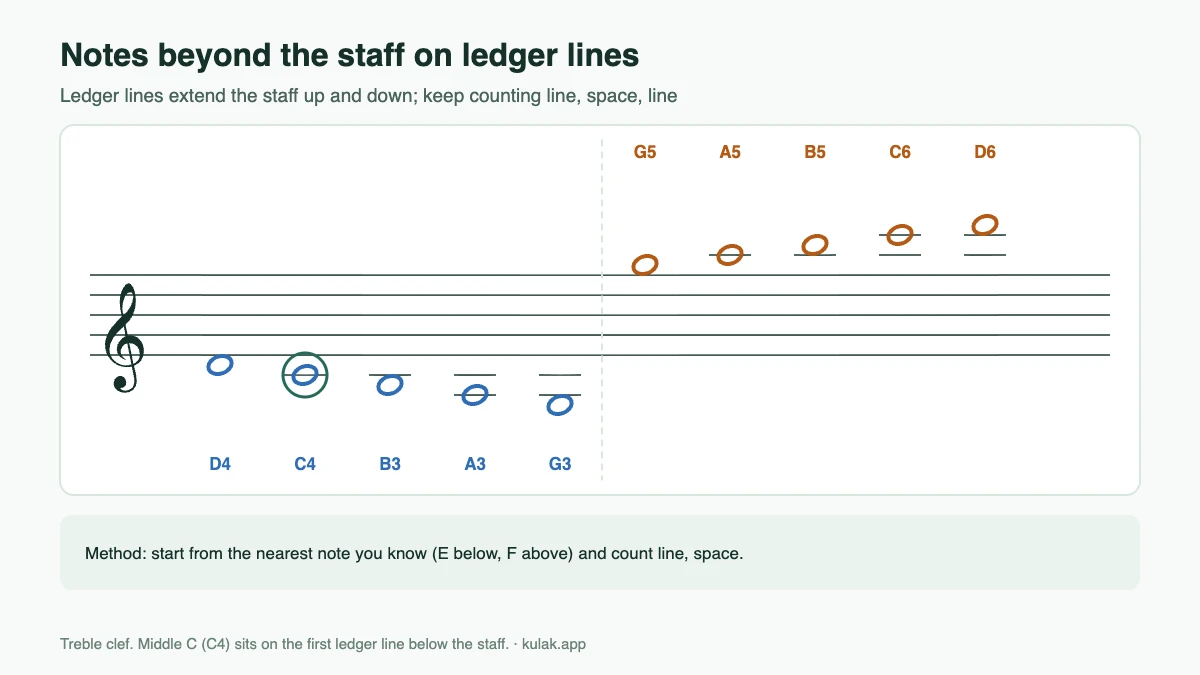
| Position | Note | What it looks like |
|---|---|---|
| Space just below the staff | D4 | Hangs under the bottom line, no ledger line |
| 1st ledger line below | C4 (middle C) | One ledger line through the note |
| Below the 1st ledger line | B3 | Hangs under one ledger line |
| 2nd ledger line below | A3 | Two ledger lines, the lower one through the note |
| Space just above the staff | G5 | Sits on the top line, no ledger line |
| 1st ledger line above | A5 | One ledger line through the note |
| Above the 1st ledger line | B5 | Sits on one ledger line |
| 2nd ledger line above | C6 | Two ledger lines, the upper one through the note |
For the notes inside the staff, see how to read treble clef notes.
Bass clef ledger-line notes
The logic is the same in bass clef; only the landmarks change. The top line of the bass staff is A3, so the first ledger line above it is again middle C (C4). Middle C is the bridge between the clefs: one ledger line below the treble staff, one ledger line above the bass staff. Below the bass staff, the first ledger line is E2. See bass clef notes for a full guide.
A fast reading method
- Choose a landmark. Below the treble staff use E4 (bottom line) or middle C; above it use F5 (top line).
- Count the ledger lines between the landmark and the note. Every line and every space is one letter step.
- Line or space? If a line runs through the note, it is on a line. If the note sits outside the last ledger line, it is in a space.
- Step through the alphabet: downward C–B–A–G, upward G–A–B–C–D.
Example: two ledger lines below the staff, with the lower one through the note. First ledger line = C4, the space below = B3, second ledger line = A3. The note is A3.
8va: avoiding too many ledger lines
Long stacks of ledger lines are hard to read, so very high passages are often marked 8va with a dashed line: play one octave higher than written. 8vb under the staff means one octave lower. When the dashed line ends, or the word loco appears, play as written again.
Daily practice
- Flashcards: pick three notes below and three above the staff and name them a few times each day.
- Connect to the keyboard: find middle C on the virtual piano, then play B3, A3, A5 and C6. Linking position and sound helps memory.
- Test yourself: use the note reading test to track speed and accuracy.
- Melodica players: 32- and 37-key melodicas use the notes above the staff a lot; melodica notes shows where they are.
FAQ
What is a ledger line in music?
A short line added above or below the staff for a note that does not fit on the five staff lines.
Where is middle C written?
On the first ledger line below the treble staff, or the first ledger line above the bass staff.
What note is on the first ledger line above the treble staff?
A5. The space just below it, on top of the staff, is G5.
Do I need to memorise every ledger-line note?
No. Learn a few landmarks (middle C, E4, F5) and count line–space from there.
What does 8va mean?
Play the marked notes one octave higher than written; 8vb means one octave lower.