Bass clef notes: read the staff, find middle C and practise with confidence
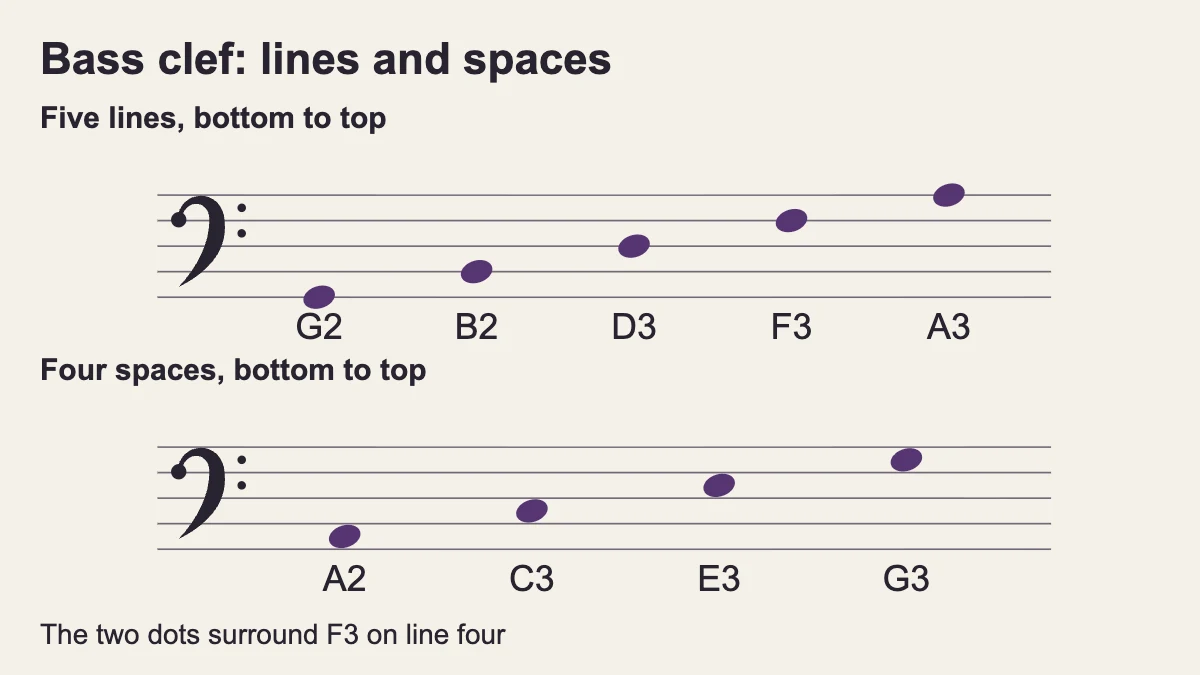
Bass clef notes follow the same seven-letter musical alphabet as treble clef, but the staff has a different reference point. The two dots surround the fourth line from the bottom: F below middle C. From bottom to top, the lines read G, B, D, F, A and the spaces read A, C, E, G. Start with that F landmark, then use nearby steps and skips rather than counting the whole staff for every note.
This guide uses standard bass clef without octave-transposing marks. Scientific pitch names make the register explicit: middle C is C4, and the F marked by the clef is F3. You can check pitches on a keyboard, but a keyboard picture alone does not teach staff reading. The exercises below connect position, letter name, register and musical direction in manageable stages.
What the bass clef actually tells you
A clef assigns pitches to the staff. It does not specify the rhythm, how loudly to play or which finger to use. With standard bass clef, F3 sits on the fourth line counted upward. The space immediately above is G3; the space immediately below is E3. Finding those two neighbours already gives you a small area that you can read without a long mnemonic.
Look at the centre of the notehead, not the top of its stem. A notehead centred on a line is a line note. A notehead sitting between two lines is a space note. The stem can point up or down without changing the pitch. If you follow the stem tip instead of the head, the apparent note location can shift by several steps.
For a paper exercise, draw five evenly spaced lines and label them one to five from the bottom. Mark line four as F3. Place a notehead in the space below it and name E3; place another above it and name G3. Erase the labels, repeat the task and explain aloud which feature of the clef anchors your answer.
Bass clef lines and spaces, with octave names
The compact chart is useful for checking an answer after you try it, not for keeping permanently beside every note. Read the entries upward once, then ask for positions out of order. For example, locate the second space before the first line. That small change prevents a memorised sequence from doing all the work.
| Position | Note and octave |
|---|---|
| Line 1 | G2 |
| Space 1 | A2 |
| Line 2 | B2 |
| Space 2 | C3 |
| Line 3 | D3 |
| Space 3 | E3 |
| Line 4 | F3 |
| Space 4 | G3 |
| Line 5 | A3 |
The four spaces spell A–C–E–G. Some learners find “All Cows Eat Grass” helpful. Treat a mnemonic as a temporary lookup aid: it gives letters but not a complete performance. It does not tell you the octave, accidentals, duration or where the next note moves. If you have to restart the sentence for each symbol, return to a nearby landmark instead.
Do not mix the line sequence and the space sequence into one continuous run. G–B–D–F–A moves through lines and skips each intervening space. A fully ascending sequence through every staff position is G–A–B–C–D–E–F–G–A. The second version explains why moving from one line to its neighbouring space changes the letter by one step.
Three landmarks that reduce counting
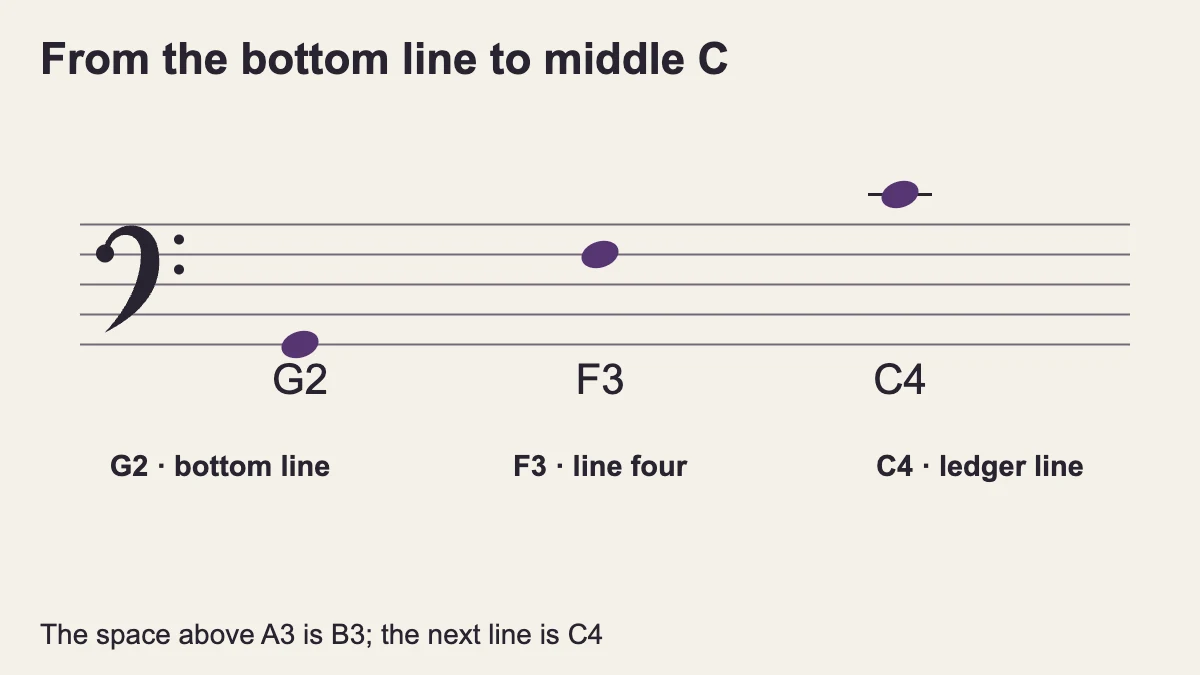
Use F3 on line four, C3 in space two and C4 on the first ledger line above the staff. These landmarks cover different parts of the page and connect readily to a keyboard. A landmark is useful only when you can identify it reliably. Begin with F3 alone if the other positions still feel uncertain; adding more labels before they are secure can create competing guesses.
From C3, a step down reaches B2 on line two and a step up reaches D3 on line three. From F3, a step down reaches E3 and a step up reaches G3. From C4, a step down reaches B3 in the space immediately above the top line. These short routes are easier to check than a full count from the bottom every time.
Try a verbal prompt before playing: “second space, C3; one staff step above, D3.” Then reverse it: “D3, one staff step below, C3.” Reversing the route matters because real music does not always climb. When both directions are comfortable, switch landmarks unexpectedly so that you read the position rather than recite a fixed exercise.
Where is middle C in bass clef?
Middle C, C4 in this guide, sits on the first short ledger line above a standard bass staff. The top staff line is A3. The space immediately above that line is B3. The next line is therefore C4. There is a space between the top line and the middle-C ledger line; overlooking it is a common reason for naming middle C as B.
Ledger lines continue the same pattern outside the five-line staff. Above C4 comes D4 in a space, then E4 on the second ledger line. Below the bottom line G2 comes F2 in a space, then E2 on the first lower ledger line. Count every line and space. Do not jump from G2 straight to E2 unless you intend a third.
Write these four prompts on separate cards: space just above the staff; first ledger line above; space just below; first ledger line below. Answers are B3, C4, F2 and E2. Shuffle the cards and point to the location before naming it. A correct spoken answer with an incorrect drawing shows that the visual mapping still needs attention.
Connect the written note to the right part of the keyboard
The piano repeats letter names across registers, so identifying “C” is only part of the task. Find the C immediately left of a two-black-key group and decide which octave you need. On a full keyboard, locate middle C first, then move an octave lower to C3. This makes the second-space bass-clef note a physical reference rather than an isolated label.
Read F3 on the page and find the F below middle C. Compare it with F2, one octave lower. Both share the letter F, but they do not occupy the same staff position. If you choose the correct letter in the wrong octave, record an octave error rather than marking the whole answer as simply wrong. The more precise diagnosis suggests a more precise exercise.
The virtual piano can help you compare note names and sounds within its displayed range. If the required bass note is outside that range, use a physical keyboard or another instrument with the correct register. Do not silently substitute a higher C and call it C3. A browser control is a learning aid, not a full piano or a judge of your hand position.
Read movement, not a new puzzle at every note
Once the first note is identified, describe what the next note does. A repeated note stays in the same position. A step moves from a line to the neighbouring space or from a space to a neighbouring line. A third moves from a line to the next line, or from a space to the next space. Larger distances can be checked by counting letter names inclusively.
Take the original sequence C3–D3–E3–D3–C3. Its pattern is up a step, up a step, down a step, down a step. Start the same movement on F3 and it becomes F3–G3–A3–G3–F3. The contour stays the same while the note names change. This is a useful transfer test: knowing only the first memorised sequence will not solve both.
Now read C3–E3–G3–E3–C3. The movement is in thirds rather than steps. On the staff, all five noteheads occupy spaces: second, third, fourth, third, second. Compare the two sequences visually before sounding them. This exercise concerns letter distance and staff shape; the exact major or minor quality of an interval also depends on accidentals and pitch distance.
A small mixed-pattern task
Write F3–E3–C3–D3–F3 on your own blank staff. Before checking the answer, label each move as down a step, down a third, up a step or up a third. Then play slowly, if the pitches are available, and compare the direction of the sound with the direction of the notation. If one pitch sounds unexpectedly high, check the octave before changing the note name.
Accidentals change the pitch, not the staff letter
A notehead on line four remains some kind of F. With a sharp, it becomes F-sharp; with a flat, F-flat; with a natural sign, F-natural. The accidental does not move the head to another line. In a piano context, F-flat shares a key with E, but the written letter still matters for understanding the passage.
For an introductory exercise, use one bar at a time and write each needed accidental explicitly. Read the letter and register first, then apply the sign. In ordinary notation an accidental usually affects subsequent occurrences of that pitch at the same octave within the measure, with ties and editorial reminders requiring attention. Key signatures apply more broadly. If that distinction is new, study sharps, flats and natural signs before combining several changes.
Try writing F3, F-sharp3 and F-natural3 in three separate measures. Their noteheads occupy the same fourth line. The first and third have the same sounding pitch; the middle one is a half step higher. Keeping separate measures makes this initial comparison unambiguous. Later, move the notes into one measure and practise the accidental rules deliberately.
Bass clef is not a command to use the left hand
Piano beginners often meet bass clef in the lower staff played by the left hand. That association is useful at first, but it is not the definition of the clef. A composer can place either hand in different registers, change clefs or ask the hands to cross. Read the notation and any hand instructions rather than assigning a hand solely from the symbol.
The grand staff connects treble and bass staves into a larger pitch map. Middle C can be written just above the bass staff or just below the treble staff. In ordinary piano notation those two spellings refer to the same pitch. They are not two different middle Cs because their short ledger lines point toward different staves.
Try reading a single middle C in each clef, then locate the same piano key for both. Next compare F3 in bass clef with F4 in treble clef: the letters match but the registers differ. This pair of comparisons separates two questions that beginners often blend together: “Which letter is it?” and “Which occurrence of that letter is intended?”
Using the same skill with cello, bass and other instruments
The standard bass staff retains its written note positions across instruments, but the relationship between a written note and sounding pitch may differ. Double-bass parts normally sound an octave below their written notes. Do not take a piano keyboard match as proof of an instrument’s sounding register. Check the convention for the particular instrument and score you are using.
Fingering is a separate layer too. A piano key, a cello position and a bass-guitar fret are not interchangeable techniques. Use this page to learn staff locations; use suitable instrument instruction for how to produce the sound. If a score changes to tenor clef, the bass-clef chart no longer applies after the new symbol. Stop and establish the new reference before continuing.
A focused practice session without rushing
Set aside a short session with four distinct tasks. Spend the first part on landmarks, the second on random individual notes, the third on short patterns and the last on reading with a steady pulse. The exact number of minutes is flexible. A session that identifies one persistent confusion is more informative than a long run of correct answers copied from a visible chart.
- Draw F3, C3 and C4 from memory, then check the staff positions.
- Choose six mixed positions from the chart and say letter plus octave.
- Read one stepwise pattern and one pattern containing thirds.
- Repeat a short pattern with even note lengths at a comfortable pulse.
- Write down one error type and choose tomorrow’s starting task from it.
When rhythm is added, keep it simple at first: one note for each spoken count. The online metronome supplies a pulse, not a reading score. Start slowly enough to keep looking ahead. If you stop at every ledger line, practise those notes without the metronome, then return to the same short passage rather than forcing the speed.
Do not try to fix pitch recognition, fingering and difficult rhythms simultaneously. If a pattern is correct when spoken but breaks down at the keyboard, work on the keyboard mapping. If it is wrong before any sound is played, return to the staff. Separating the tasks makes your next repetition useful instead of merely repeating the same uncertainty.
Make a reading log that tells you what to practise
| Task | What to record | Next action |
|---|---|---|
| Six mixed staff positions | Letters correct; octave mistakes separately | Review the nearest reliable landmark |
| Middle C and its neighbours | Whether the space above the staff was skipped | Draw A3, B3, C4, D4 in order |
| One five-note pattern | Stops, direction errors and repeated notes | Read the contour before naming pitches |
| Same pattern with pulse | Comfortable tempo and any loss of accuracy | Reduce tempo or isolate the difficult move |
You do not need to convert this into a single ability percentage. A learner who names notes accurately but slowly has a different next task from someone who answers quickly in the wrong octave. Repeat the exercise with a changed order on another day. Improvement that survives a new order is more useful than a faster performance of one memorised list.
Original exercises and explained answers
Exercise one: locate four notes
Name the third line, second space, fourth line and the space immediately above the staff. In order the answers are D3, C3, F3 and B3. To check D3, start from C3 in space two and move up one staff step. To check B3, begin on A3 at the top line and move into the next space; do not add a ledger line yet.
Exercise two: repair a mistaken count
A learner calls the first ledger line above the staff B3, reasoning that A3 is the top line and B is the next letter. The missing step is the space above A3. That space is B3, and the ledger line beyond it is C4. Draw all three positions and label them before repeating the exercise in reverse order.
Exercise three: separate pitch and appearance
Two noteheads are centred on the fourth line. One has an upward stem and one a downward stem; neither has an accidental. They both represent F3. Now add a sharp to one in its own separate measure. The written letter and staff position remain F, but its pitch becomes F-sharp3. Stem direction and accidental therefore answer different questions.
Exercise four: recover a pattern from positions
Read this sequence of bass-staff positions: second space, third line, third space, third line, second space. It gives C3–D3–E3–D3–C3. Compare it with second space, third space, fourth space: C3–E3–G3. In the first sequence you visit every neighbouring position; in the second you remain in spaces and move in thirds.
Common questions about bass clef reading
Moving from one staff to two
Before reading a busy grand staff, give one hand a deliberately simple task. On a physical piano, repeat a comfortable middle C with the right hand while the left hand alternates between two already familiar bass notes. This is a coordination experiment, not a borrowed piece of repertoire. If the keyboard movement is awkward, point to the written positions while counting instead of forcing an uncomfortable stretch.
Look for vertical alignment as well as horizontal sequence. Which bass note happens at the same time as the upper note? Does one part continue while the other rests? Reading the entire lower staff and then the entire upper staff misses that simultaneity. Begin with matching rhythms so the pitch map is the only new challenge, then introduce a simple rhythmic difference when the relationship is clear.
After an error, restart one comfortable beat before the difficult event rather than replaying the whole page. That keeps the transition in the exercise. Once the passage works, begin from a different point to check that you can recover the notes independently. Repeating the same opening successfully is not evidence that every location on the page is equally secure.
A quick decision path when you get stuck
Check the current clef first. Identify whether the notehead is on a line or in a space. Choose your nearest reliable landmark and count the intervening staff positions. Add the octave, then inspect the key signature and any accidental. Only after those decisions should you choose the piano key or instrument position. This order separates several small questions that otherwise arrive as one confusing visual task.
If the same confusion returns, isolate the pair. For C3 versus D3, draw only those two positions in changing orders, then add one secure F3 landmark between them. Expanding to twenty random notes immediately can make the error harder to diagnose. Narrow practice is not a verdict on musical ability; it is a way to give the next repetition a clearly defined job.
Should I convert every bass note from treble clef?
That shortcut adds another calculation to every note and can hide octave errors. Learn bass-clef landmarks directly. You can compare the clefs to understand the grand staff, but regular practice should let a bass position point straight to its own pitch rather than pass through a treble-clef translation.
Does memorising the chart mean I can sight-read?
It is a useful foundation, not the whole skill. Sight-reading also involves rhythm, continuity, accidentals, looking ahead and producing sounds on your instrument. Add those layers gradually. A note-naming exercise should not be presented as a complete assessment of musicianship or a prediction of exam results.
Can I use the KulakApp note-reading test for this clef?
The current note-reading test practises treble-clef recognition. Use it for that stated purpose; it is not a bass-clef test. For this guide, use the original written exercises and their answer explanations. To connect reading with pitch relationships, explore natural, harmonic and melodic minor scales once the staff positions are comfortable.
Sources and scope
Basic clef and ledger-line conventions were checked against Open Music Theory: Reading Clefs. The written-versus-sounding double-bass distinction is also stated in the Turkish Ministry of Education double-bass text. The diagrams, practice sequences, explanations and tracking table on this page were prepared for KulakApp; no third-party score or recorded performance is reproduced.