How to Read Guitar Tabs for Beginners: Strings, Frets and Symbols
Start here: guitar tab is a map of the fretboard. The six lines represent the strings, and the numbers tell you which frets to press.
This guide takes you from the first six-line diagram to a complete practice routine. You will learn where to place your fingers, when plain tab needs a rhythm reference, and how symbols such as h, p, b and PM change the sound.
What is guitar tab?
Guitar tablature is a compact system that maps notes to the guitar fingerboard. A standard tab staff has six horizontal lines, one for each string. The top line represents the first string, the high E string. The bottom line represents the sixth string, the low E string. This is a view of the guitar as you hold it for playing, not a picture of the strings from above.
Numbers are placed on the lines. A number tells you which fret to press on that string: 0 means play the string open, 1 means the first fret, 2 means the second fret, and so on. The tab does not usually tell you which finger to use. That choice depends on the passage, your hand position, and what comes before and after the note.
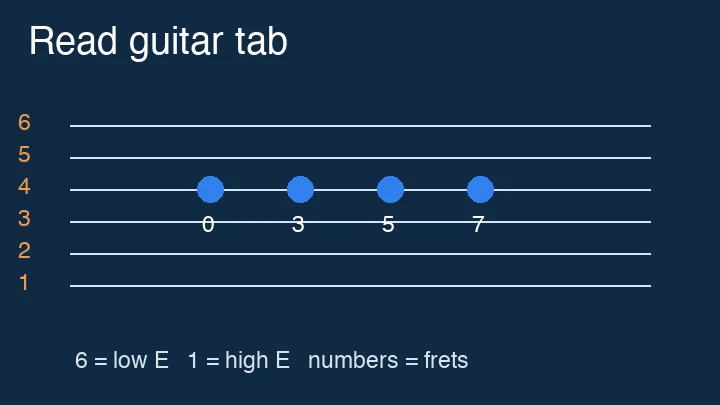
| Tab element | Meaning | Example |
|---|---|---|
| Top line | First string, high E | The highest written line |
| Bottom line | Sixth string, low E | The lowest written line |
| 0 | Play the string open | Open-string note |
| 3 | Press the third fret | Third-fret note on that string |
| Numbers stacked vertically | Play notes together | A chord or double-stop |
| Numbers side by side | Play in sequence | A melody or riff |
Strings, frets, and open notes
Standard guitar tuning is E–A–D–G–B–E from the sixth string to the first string. In tab, that order appears from the bottom line to the top line. The two outside strings are both E, but they are two octaves apart. Check the tuning before you play: a tab written for standard tuning will sound different if your guitar is tuned down, tuned up, or placed in an alternate tuning.
When a tab starts with a zero on the bottom line, play the open sixth string. When a zero appears on the top line, play the open first string. A number such as 5 is not “the fifth note”; it is the fifth fret of whichever string carries the number. This is the first detail many beginners overlook.
Numbers above 9 can touch the next number visually, so leave a small gap when you write your own tab. A dash or vertical spacing may separate beats, but spacing is not a universal timing system. Always look for a tempo, rhythm stem, audio example, or recording reference.
Frets and pitch
Each fret raises the pitch by one semitone. Moving from an open string to the first fret is one semitone; moving from the fifth to the seventh fret is two whole steps. The same pitch can often be played in more than one position. Choose a position that makes the next notes comfortable and keeps unnecessary string changes to a minimum.
If you are not yet comfortable finding notes on the neck, use the virtual guitar to hear the strings and explore positions. For standard notation, compare the tab with our beginner sheet-music reading guide.
One-bar example: combine fret numbers with counting
Suppose a tab shows four notes on the B string: 0, 2, 3, and 2. The numbers tell you the string and frets, but not necessarily the complete rhythm. If the line is written as four quarter notes in 4/4, count one note on each beat. If it is written as eighth notes, count “1 and 2 and” across the same space. The numbers have not changed; the timing has.
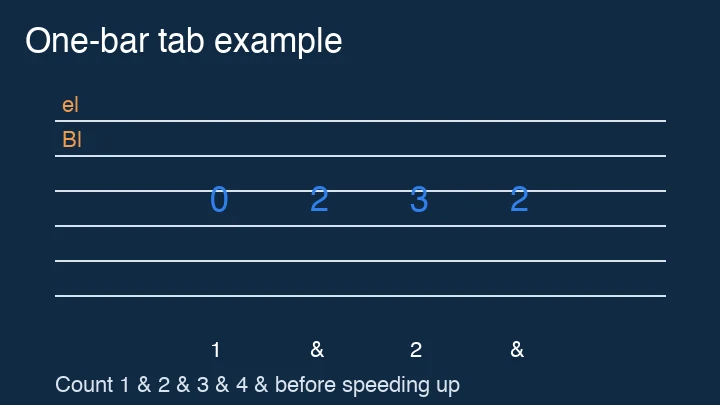
Play the example slowly and say the count aloud. Then listen to the recording and mark where the notes fall against the beat. This habit is more reliable than guessing from the horizontal distance between numbers.
Does guitar tab show rhythm?
Basic tab often shows pitch and position more clearly than timing. Some tabs include rhythm stems above the numbers, while others rely on spacing, chord names, or a linked recording. Never assume that equal-looking gaps mean equal note lengths. A riff may contain eighth notes, rests, bends, or held notes that plain numbers cannot fully explain.
Count the beat before trying to play fast. In 4/4, tap four steady beats per measure. Speak “1 and 2 and” for eighth-note subdivisions, or use a slower subdivision when the passage is dense. A metronome can help you test whether your timing remains stable; try the free online metronome after you can play the notes slowly.
| Information | Usually clear in tab | May need another source |
|---|---|---|
| String choice | Which line carries the number | Alternative positions may also work |
| Fret position | The written fret number | Finger choice and hand position |
| Pitch direction | Higher or lower frets | Exact rhythmic emphasis |
| Duration | Only when rhythm notation is included | Plain tab spacing is often incomplete |
| Articulation | When symbols are explained | Unmarked slides, bends, and muting |
Chords, arpeggios, and rolled notes
When several fret numbers line up vertically, they usually indicate notes that begin together. That may be a chord or a two-note shape. If the tab includes a roll, arpeggio arrow, or staggered notation, play the notes in that indicated order instead of striking every string at exactly the same instant. Bar lines and rhythm stems take priority over visual spacing.
A chord diagram and a tab can show the same harmony in different ways. A chord diagram describes a reusable shape; tab describes a specific sequence or voicing. If you see a group of vertically aligned numbers, check whether the passage is meant to ring together or to be picked as an arpeggio.
Common guitar tab symbols
Tab symbols describe how a note is played, not just where it is fretted. Different websites and publishers use slightly different abbreviations, so check the legend that comes with the tab. The symbols below are common in beginner and intermediate guitar tab.
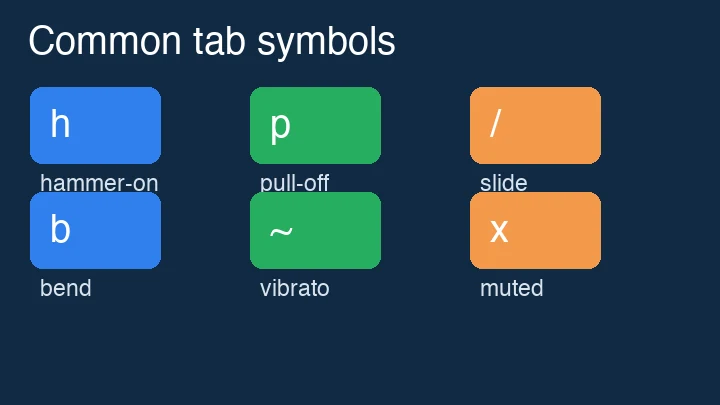
| Symbol | Name | What to do |
|---|---|---|
| h | Hammer-on | Pick the first note, then sound a higher fretted note with a finger strike. |
| p | Pull-off | Sound a fretted note, then release to a lower note without a new pick stroke. |
| / or \ | Slide | Keep pressure on the string while moving to another fret. |
| b | Bend | Push or pull the string to raise its pitch. |
| ~ | Vibrato | Make a small, repeated pitch movement while the note rings. |
| x | Muted or dead note | Touch the string without fretting a clear pitch, then strike it. |
| PM | Palm mute | Rest the picking hand lightly near the bridge to shorten the sound. |
Hammer-ons and pull-offs
A hammer-on is often written as 5h7. Pick the fifth-fret note, then sound the seventh-fret note by placing another finger firmly on the string. A pull-off might appear as 7p5. Fret both notes, pick the higher one, and release the finger so the lower note sounds. These techniques need controlled pressure; striking harder is not the same as making the note ring clearly.
Slides and bends
A slide such as 5/7 connects the fifth fret to the seventh while the string continues to sound. A backward slash usually indicates movement toward a lower fret, but the exact convention can vary. A bend such as 7b9 asks you to bend the seventh-fret note until it reaches the pitch associated with the ninth fret. Listen for the target pitch rather than guessing the amount of physical movement.
How to check a bend and troubleshoot a difficult note
A bend is judged by its target pitch, not by how far your finger appears to travel. A marking such as 7b9 commonly means bend the note at fret 7 until it reaches the pitch of fret 9. Publishers may also specify a half-step or whole-step bend, a release such as r, or a pre-bend. Listen to the target on the same string or play it first, then match the bent sound.
If a passage buzzes, check that the finger is close to the fret wire without sitting directly on it, use enough pressure for a clear note, and slow the movement down. If extra strings ring, lightly touch them with the unused fingers or picking hand. If a pull-off is weak, give the released finger a small controlled pluck rather than simply lifting it away.
Bend notation is not perfectly standardised. You may see 7b9r7 for a bend to the pitch of fret 9 followed by a release to fret 7. A pre-bend may be marked pb, sometimes with the target pitch or bend amount. Half, full and quarter describe the pitch change, not a fixed physical distance: string gauge, tuning and fret position all change how far the string must move. Read the publisher’s legend when it is provided.
Tab versus standard notation
Tab is excellent for showing where a guitar note can be played. Standard notation is better at showing rhythm, pitch relationships, key signatures, and music that can transfer between instruments. You do not have to choose one forever. Many guitarists read both: tab for fingerboard position and standard notation for rhythm or broader musical context.
Tab can also hide a useful choice. The same pitch may appear in several places on the neck, and one position may make the phrase easier than another. Standard notation shows the pitch; tab suggests a physical route. Compare both when available and choose a fingering that supports the next phrase, not only the current note.
Frequently asked questions
Is guitar tab easier than standard notation?
For many beginners, tab gives a faster route to the fingerboard because it shows string and fret directly. It may be less complete for rhythm and musical context, so learning basic standard notation and rhythm alongside tab is useful.
What do the lines in guitar tab mean?
The six lines represent the six guitar strings. The top line is normally the high E string and the bottom line is the low E string.
What does 0 mean in guitar tab?
Zero means play that string open, without pressing a fret.
How do I know how long to hold a tab note?
Look for rhythm notation or stems, listen to the recording, and count with a steady pulse. Basic tab spacing alone may not provide a reliable duration.
What do h, p, slash, and b mean in guitar tabs?
They commonly mean hammer-on, pull-off, slide, and bend. Check the tab’s legend because publishers may use different symbols.
Can I use guitar tabs on an electric or acoustic guitar?
Usually yes, as long as the tuning and instrument range match. The same tab may sound different because of tone, strings, effects, or technique, but the written frets can still be the same.
Explore notes on the virtual guitar → Practise rhythm by ear →