How to transpose music: move melodies and chords without changing their relationships
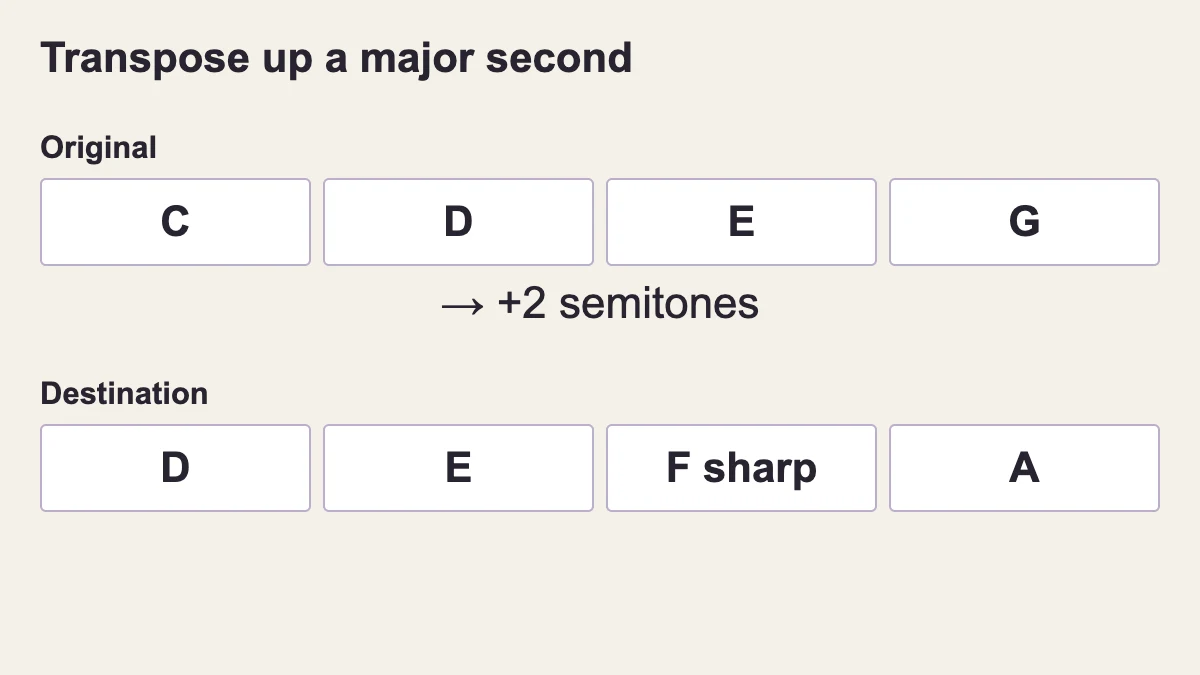
To transpose music, move every pitch by the same interval while preserving its rhythm and internal relationships. If C–D–E–G moves up a major second, it becomes D–E–F-sharp–A. For chord symbols, move the root and keep the quality: C–Am–F–G becomes D–Bm–G–A. Check both the letter-name distance and the number of semitones; moving every written note up one white key is not reliable transposition.
This guide covers practical tonal melodies and chord charts. It separates changing the key of music from writing for a transposing instrument and from pressing a digital keyboard’s transpose button. Those tasks share pitch-shifting ideas but require different checks. All note sequences below are original teaching examples rather than copied song notation.
State the direction, size and destination
“Move this to D” is incomplete if the starting key and direction are not known. C major to D major can mean up a major second or down a minor seventh. The key name is the same, but the register is very different. In a simple beginner exercise, say “C major to D major, up a major second” and keep that decision consistent across the passage.
An interval has a letter-name size and a pitch distance. C to E is some kind of third because C, D and E are three letter names counted inclusively. C to E natural spans four semitones, making a major third. C to E-flat spans three, making a minor third. Keeping only the number of semitones can produce a sounding equivalent with an inappropriate written letter.
For a major-second transposition, every letter advances by one place: C becomes D, D becomes E, E becomes F, and so on. Then choose the accidental that produces two semitones of movement. E becomes F-sharp, not F natural. This two-part method is slower at first than blindly moving a shape, but it gives you a way to explain and correct the result.
A short melody, one pitch at a time
Take C4–D4–E4–G4–E4–D4–C4 and move it up a major second. The result is D4–E4–F-sharp4–A4–F-sharp4–E4–D4. Keep each note’s duration and any rests exactly as written in your original practice version. If the first C lasted two beats, the first D should also last two beats. Transposition changes pitch level, not the rhythm unless you deliberately add another arranging decision.
Check the melodic contour: an upward step remains upward, a repeated note stays repeated, and the leap from E to G becomes the same-sized leap from F-sharp to A. Then compare the semitone distances between neighbouring notes. If only one note moved by a different amount, a local interval will change. That is often easier to hear than checking the key name alone.
Now use scale degrees as a second route. In C major, the fragment is 1–2–3–5–3–2–1. In D major, those degrees are D–E–F-sharp–A–F-sharp–E–D. The result agrees with the interval method. This shortcut is useful for clearly diatonic music, but altered notes need explicit attention; do not erase a chromatic pitch merely because it is absent from the destination’s basic scale.
Move the key signature, then verify every note
When a written piece has a key signature, transpose the tonic and use the matching destination signature. C major has no alterations; D major has F-sharp and C-sharp. That signature does not mean every note of D major must appear in the short melody. Our example uses F-sharp but never reaches C-sharp. A key describes the reference collection, while a phrase can use only part of it.
If you need help finding the destination signature, consult the circle of fifths or the major scale chart. Keep the original mode or chord quality unless the task explicitly asks for a change. Moving C major to D minor is not an exact uniform transposition of its scale; it changes interval relationships as well as the tonic.
| Original | Destination | Independent check |
|---|---|---|
| C | D | Up a major second: next letter, two semitones |
| D | E | Up a major second: next letter, two semitones |
| E | F sharp | Up a major second: next letter, two semitones |
| F | G | Up a major second: next letter, two semitones |
| G | A | Up a major second: next letter, two semitones |
| A | B | Up a major second: next letter, two semitones |
| B | C sharp | Up a major second: next letter, two semitones |
| B flat | C | Up a major second: next letter, two semitones |
| E flat | F | Up a major second: next letter, two semitones |
| F sharp | G sharp | Up a major second: next letter, two semitones |
| C sharp | D sharp | Up a major second: next letter, two semitones |
| A flat | B flat | Up a major second: next letter, two semitones |
Transpose the root and preserve the suffix
A chord symbol contains several kinds of information. In Am7, A is the root, m indicates minor quality and 7 identifies the minor seventh in that common symbol. Moving the chord up a major second gives Bm7. Replacing it with B major because B is the new root changes the harmony. First move the root; then retain the quality and extension and verify the resulting chord tones.
For C–Am–F–G moving to D major, the result is D–Bm–G–A. The relationship I–vi–IV–V stays the same. Compare this with simply adding sharps to every chord name: that does not consistently create a two-semitone move. C-sharp, A-sharp minor, F-sharp and G-sharp would be a different destination, one semitone above the original roots in those spellings.
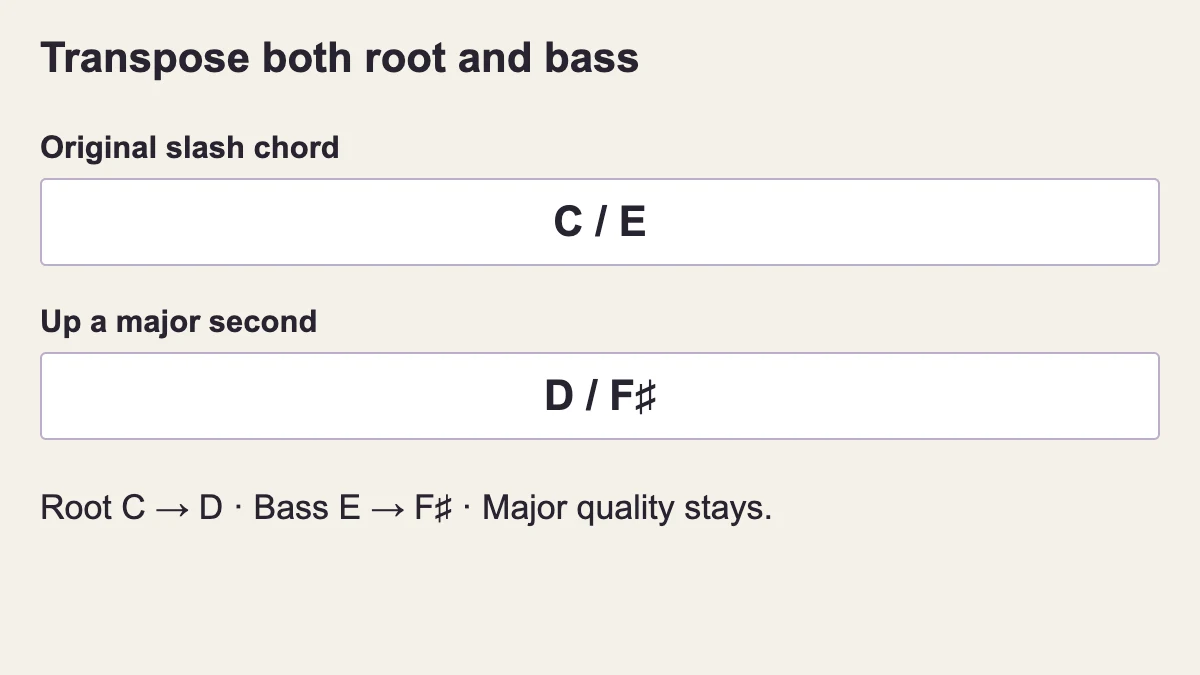
Slash chords require a second pitch check. C/E means a C major chord with E in the bass. Up a major second, both components move: D/F-sharp. Transposing only the symbol before the slash would leave the wrong bass relationship. The bass is not an optional label when the chart explicitly names it. Check the actual voicing after you have corrected both root and bass.
The same principle applies to dominant sevenths, diminished chords and suspended chords. G7 moved up a major second becomes A7, not Amaj7; the two suffixes indicate different seventh relationships. Before transposing a symbol you do not understand, spell its notes. The piano chord guide covers basic triads, while the progression guide connects known chords in time.
Keep a chromatic alteration’s function
Consider C–D–F-sharp–G in a C-major context. The F-sharp is a raised fourth degree, not a regular member of the C major scale. Up a major second, the notes become D–E–G-sharp–A. G-sharp remains the raised fourth in the destination. Changing it to G natural would fit the D major scale but would remove the chromatic relationship of the original phrase.
Do not copy the accidental glyph without interpreting the note. A sharp in one key can become a natural or a differently written alteration in another. For example, B-flat moved up a major second is C natural. The pitch moved by two semitones even though a flat sign disappeared. The relationship is preserved by the resulting note, not by preserving the shape of every accidental mark.
In notation software, check how the new key signature and local accidentals interact. A note may not need a visible sign because the signature already supplies it. Conversely, cancelling a signature alteration can require a natural sign. Read the resulting sounding pitch before deciding that a missing or newly added glyph is an error. Courtesy accidentals are a separate readability choice and should not be confused with pitch changes.
Enharmonic answers and readable spelling
On an equal-tempered keyboard, F-sharp and G-flat share a key, but they do not always give equally appropriate notation. If E is moved up a major second, F-sharp preserves both the letter step and the two-semitone distance. G-flat preserves the keyboard pitch but spells a diminished third from E. In a written interval exercise, that distinction is part of the answer.
Choose a destination key with a practical notation when the musical task allows a choice, but do not quietly change a requested interval to avoid an unfamiliar sign. If a passage genuinely requires an awkward spelling, explain it or consider an enharmonic rewrite as a separate editing step. Keeping transposition and respelling separate makes it possible to verify what changed at each stage.
Changing key for a singer or another instrument
When adapting a melody, inspect the highest and lowest notes after transposition, not only its first note. A comfortable opening does not guarantee that the later climax fits the performer. Ask the performer to try the actual demanding phrase at a comfortable level. This guide does not prescribe a universal vocal range or diagnose a voice; practical suitability depends on the person and musical context.
Also consider accompaniment range. Moving a keyboard part very low can crowd the texture, while shifting everything upward may leave the bass weak. An arranger can redistribute octaves after the exact transposition, but that is an additional decision. First verify the uniformly moved version, then document any octave changes so another musician can distinguish a deliberate arrangement from a mistake.
Transposing instruments: written and sounding pitch
For a standard B-flat trumpet, a written C sounds as B-flat a major second lower. To obtain a concert C, the player reads D. Notice the reversal of perspective: converting written notes to sounding notes moves down, while preparing the written part from concert pitch moves up. State which direction of conversion you are doing before touching the notes.
Do not apply one rule to every instrument with a similar name or to every member of a family. Some instruments also involve an octave displacement. The purpose here is to illustrate the written-versus-sounding distinction, not provide an orchestration chart covering every variant. Check the exact instrument and its standard notation before preparing a part for another performer.
A digital transpose button does not rewrite your score
A keyboard’s transpose function can shift the sound while your fingers play familiar keys. That can be useful, but the displayed score and your physical fingering may remain unchanged. If you play a written C while the setting shifts sound up two semitones, the audience hears D. Another musician reading your unaltered chord chart still sees C unless you update the chart separately.
Before rehearsing with others, confirm whether the instrument setting is neutral. An unnoticed transpose setting can make correctly played written notes sound in the wrong key. Check with one reference pitch and label the setting in your practice notes. If you are learning written transposition, occasionally work with the setting off so the device does not hide the note relationships you need to understand.
Solved transposition tasks
Write the interval, direction and reference key before answering. Check each result twice: once by letter names and once by semitones. For chord symbols, add a quality check; for slash chords, add a bass check. These tasks isolate different mistakes so you can tell whether the difficulty is spelling, arithmetic, register or reading the symbol.
Move a single note by a major second
Transpose E upward by a major second. Why is F natural insufficient?
Show explained answer
The destination letter is F, but E to F natural spans only one semitone. A major second needs two, so write F-sharp. This demonstrates the two checks: letter-name size and semitone distance. Moving to the next white key would preserve the letter step but not the requested interval quality.
Preserve a minor chord
Transpose Am up a major second and verify the result by spelling its notes.
Show explained answer
Am becomes Bm. A–C–E moves to B–D–F-sharp, preserving the minor third and perfect fifth above the root. B–D-sharp–F-sharp would be B major, which changes the third. Do not let the new key name or a familiar hand shape override the original chord-quality suffix.
Move both sides of a slash chord
Transpose C/E up a major second. Which part is most easily forgotten?
Show explained answer
The result is D/F-sharp. C becomes D and the bass E becomes F-sharp, while major quality remains. Forgetting the bass would leave D/E, a different relationship. Write root, quality and bass in separate columns during checking if the combined symbol makes it easy to overlook one component.
Keep a chromatic degree
Transpose C–D–F-sharp–G up a major second without removing the raised fourth.
Show explained answer
Write D–E–G-sharp–A. Every pitch rises by two semitones, including the altered F-sharp. G natural would belong to the destination’s major scale but would not preserve the original interval. A diatonic reference helps organise the task; it must not erase explicitly altered notes from the melody.
An accidental can disappear
Move B-flat up a major second and explain why the answer need not retain a flat sign.
Show explained answer
The result is C natural. B-flat to C spans two semitones and advances one letter name. The flat mark disappears because C is the correct resulting spelling. Copying accidental glyphs mechanically would produce C-flat, only one semitone above B-flat, and therefore fail the requested major-second movement.
Distinguish two upward intervals
Compare C moved up a minor third with C moved up a major third.
Show explained answer
The minor-third destination is E-flat; the major-third destination is E natural. Both use the letter E because both are thirds, but the semitone distances are three and four. This shows why naming only the destination letter or only “a third” leaves necessary information out of a precise transposition task.
Watch the register
C4 is moved to D. What information is missing if the task does not say D4 or D3?
Show explained answer
The direction and size are ambiguous. C4 to D4 is up a major second; C4 to D3 is down a minor seventh. The pitch class D is shared but the register differs. State the intended interval before transposing the remaining melody so you do not mix upward and downward placements accidentally.
Preserve the seventh suffix
Move G7 up a major second. Check why Amaj7 is not the same answer.
Show explained answer
G7 becomes A7: G–B–D–F moves to A–C-sharp–E–G. Amaj7 would require G-sharp instead of G and would alter the original seventh relationship. Keep the suffix and verify its notes. Similar-looking chord symbols can encode different intervals even when their roots are identical.
Do not change the rhythm
A two-beat C followed by a one-beat E and a one-beat G is moved up a major second. State the result with durations.
Show explained answer
Play D for two beats, F-sharp for one and A for one. The measure still contains four beats. If the notes are correct but the first duration shrinks, you have changed rhythm as well as pitch. Compare note and rest counts separately from the transposition calculation.
Written pitch versus concert pitch
A standard B-flat trumpet needs to sound concert C. Which written pitch is required?
Show explained answer
Write D: the instrument sounds a major second below its written pitch. Converting concert pitch into the written part therefore moves upward by that interval. This is the reverse of converting a written trumpet note to its sounding pitch. Confirm the exact instrument before extending the example to another family member.
Reverse-check a melody
You obtained D–E–F-sharp–A by moving C–D–E–G upward. What should a reverse major-second check produce?
Show explained answer
Moving the result down a major second returns C–D–E–G. If one note returns differently, inspect that note’s accidental and letter movement. The reverse test catches inconsistent shifting, but still check readability and register. A mathematically related pitch-class set can have an awkward or inappropriate written spelling.
Separate transposition from adaptation
A request changes C major to D minor. Why is it not just a uniform two-semitone shift?
Show explained answer
A uniform shift would produce D major and preserve all major-scale intervals. D minor changes selected relationships, including the third degree. Treat it as a tonal adaptation with additional choices, not exact transposition alone. Keeping the two operations separate helps you document which changes were required by the interval and which were creative decisions.
A final verification routine
First compare the number of notes, rests and measures. Exact pitch transposition should not accidentally remove a repeated note or change a rhythm. Next, compare the first and last pitches using the chosen interval. Then inspect the interior notes, paying special attention to accidentals, leaps and octave crossings. Correct endpoints alone do not guarantee a correct middle.
For chords, verify the root, quality, extension and explicit bass. If you can spell both the original and destination chord, compare each member’s movement. Then play the progression slowly on a keyboard or use the virtual piano for a short pitch check. Listening can reveal a changed interval, but do not let a vaguely familiar sound replace written verification.
Finally, reverse the operation. A phrase moved up a major second should return to its original pitches when moved down a major second. This catches many accidental changes of quality or missing alterations. It is not a substitute for musical readability, but it is a useful independent test. Save the original alongside the result until the comparison is complete.
Questions that prevent avoidable mistakes
Is changing octave a transposition?
Yes, moving every note by an octave is a uniform pitch shift. It preserves pitch classes but changes register. In arranging, you may instead move only one part or selected notes by octaves. Describe which happened, because a complete octave transposition and a redistributed voicing are different edits even when both sound related.
Can I transpose by moving a piano shape sideways?
Only if you preserve the actual interval distances, including the pattern of black and white keys. Moving each finger to the next white key changes some pitches by a semitone and others by a whole tone. Verify the destination notes explicitly before relying on a physical shape. A useful fingering pattern is not itself a proof of correct transposition.
Does transposing major music into minor keep it unchanged?
No. Uniform transposition preserves interval structure and therefore does not by itself turn a major collection into a minor one. A major-to-minor adaptation changes selected relationships. It can be a valid creative task, but name it as an additional transformation rather than calling it an exact copy at another pitch level.
Reference checks
Interval preservation was checked against Open Music Theory: Transposition; root, quality and written-versus-sounding distinctions were checked against LearnMusicTheory: Transposition. The note sequences and diagrams here are independently constructed rather than copied source exercises.