Drum rudiments for beginners: singles, doubles and paradiddles
Drum rudiments are repeatable sticking patterns used to organise strokes between the hands. Begin with single strokes, double strokes and the single paradiddle: R L R L, R R L L, and R L R R L R L L. R means right hand and L means left hand. Learn the order at a comfortable pace, then listen for even timing and sound before adding accents or moving around a kit.
This guide focuses on those three patterns rather than listing dozens of names without a practice method. You will compare hand order, note spacing, leading hand and accent placement using original diagrams and explained tasks. A suitable practice pad and sticks are useful; a full drum kit is unnecessary for understanding the sequences. The page cannot assess grip or physical technique remotely, and speed is not the only measure of progress.
Separate hand order from rhythm
The letters tell you which hand plays, not how long each note lasts. R L R L can be played as four quarter notes, four eighth notes or four sixteenth notes. State the subdivision before beginning. If you play four sixteenths per quarter-note click, those four letters occupy one beat. If you play four eighths, the same letters occupy two beats. The sticking is unchanged while its duration differs.
For the first examples, use eight equal eighth notes in 4/4: one and two and three and four and. Place one stroke on each spoken syllable. This makes a full measure easy to track. Say the hand sequence once without playing, count the rhythm once without naming hands, then combine them. If saying both becomes confusing, keep the count aloud and refer to the printed letters visually.
Do not infer an accent from a capital letter: all R and L symbols here are uppercase for readability. An accent is stated separately. Likewise, the spaces between letter groups are visual organisation, not rests. R L R R followed by L R L L continues at the same spacing through the group boundary. Adding a pause after each four strokes changes the exercise.
Set up a controllable, quiet practice
Choose a stable playing surface intended for sticks rather than striking furniture or a device screen. Place it where you can reach it without repeatedly stretching or twisting. Use a moderate sound level and enough space that sticks do not collide with nearby objects. If you are new to holding sticks, an in-person teacher can check the setup and motion more reliably than text alone.
Start with small, deliberate strokes and observe what happens after contact. The playing surface returns some energy to the stick; fighting that return or letting it produce uncontrolled extra notes can both obscure the intended pattern. The appropriate movement changes with speed and surface. Do not treat one written description as a universal grip prescription for every drummer or every technique.
Stop if practice causes pain rather than forcing a sequence to continue. This is a general boundary for the exercise, not medical advice or a claim that one grip prevents injury. A shorter attentive attempt is more useful than a long repetition that has become tense and inaccurate. Physical comfort and a clear sound remain separate checks alongside correct letters.
Single strokes: alternate without adding a gap
Play R L R L R L R L, one stroke in each eighth-note slot. Listen to the transition from one hand to the other. The two hands may initially produce different volumes or tones. Try to hear that difference without immediately increasing force. Check whether both contact the same intended area and whether the count remains equally spaced.
Repeat with L R L R L R L R. Starting with the less familiar hand may require more attention, but it does not change the rhythm. Compare the two starts at the same tempo and subdivision. If you change speed at the same time, you cannot tell whether the problem came from the leading hand or the faster movement. Keep the experiment small enough to interpret.
A single-stroke pattern does not become more correct simply because it sounds continuous at high speed. At a slower pace, you should still be able to identify every stroke and retain the intended order. Use our online metronome for a steady reference. Count in before playing, then stop at a planned measure boundary rather than trailing off when the order becomes uncertain.
Double strokes: two notes from each hand
The basic repeated order is R R L L R R L L. Each letter represents an intended note. At the introductory pace, make sure both notes from the right hand and both from the left are present and evenly spaced. A soft or missing second note can make the sequence sound like alternating single attacks even when your hands appear to move in pairs.
Do not solve a weak second note by inserting extra uncontrolled bounces. Two strokes means two intended attacks, not “let the stick bounce until the other hand takes over.” How a player combines rebound and active control develops with technique and tempo; this written guide does not prescribe a single high-speed mechanism. Listen to the result and seek direct feedback when the motion becomes difficult to understand.
Compare the internal spacing of each pair with the spacing between hands. The gap from the first R to the second R should match the gap from the second R to the first L in this equal-note exercise. Many uneven doubles consist of a compressed pair followed by a longer gap. A slow count exposes that pattern more clearly than simply asking whether the roll sounds fast.
The single paradiddle combines alternating and repeated hands
A complete two-sided single paradiddle is R L R R L R L L. Its first four strokes are R L R R; the next four mirror them as L R L L. The repeated pair comes at the end of each four-stroke group. Learning only R L R R and restarting with R creates three consecutive right-hand strokes across the restart, which is not the continuous two-sided sequence shown here.
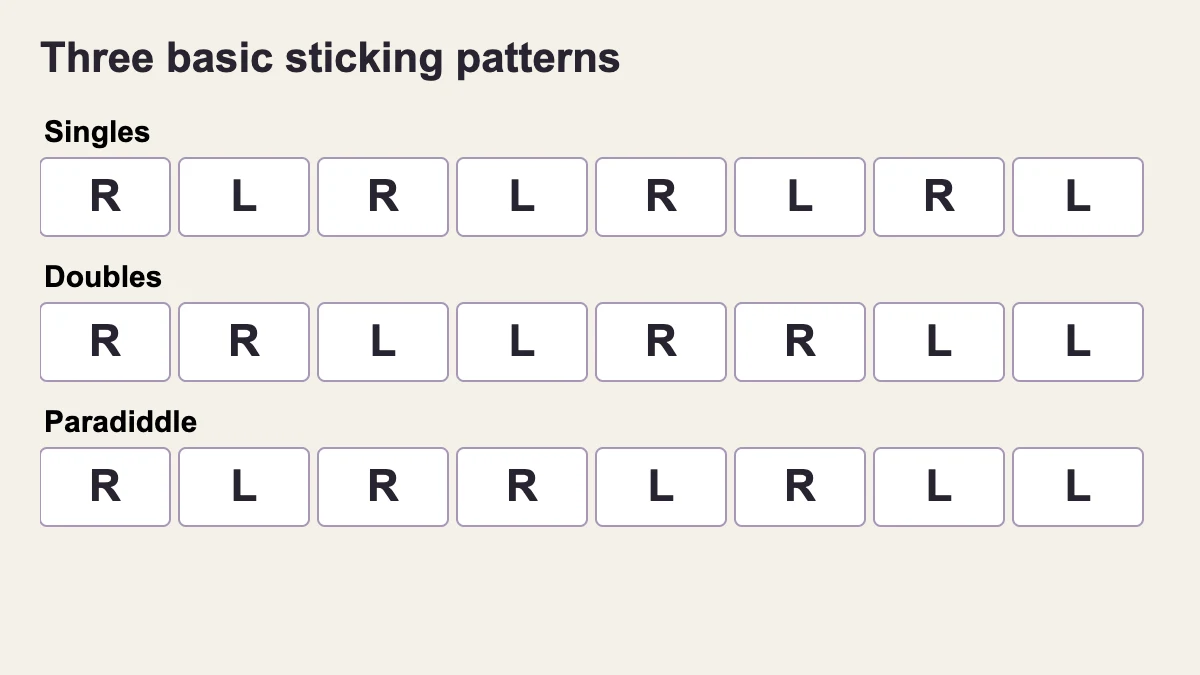
Speak the sequence in two groups while keeping the physical spacing equal. Then remove the spoken grouping and count the eighth-note measure. The fifth stroke should arrive on beat three in this version and be played by the left hand. If it arrives late, check whether you inserted a pause after the right-hand double. The group boundary is a reading aid, not an instruction to wait.
Practise the mirrored start, L R L L R L R R, separately. It uses the same relationship with the hands exchanged. Once both starts are clear, decide deliberately which one begins an exercise. A leading-hand choice can make a later orchestration easier, but accidentally changing hand order to escape a difficult transition hides the skill you intended to practise.
| Pattern and lead | Eight equal strokes | What to check |
|---|---|---|
| Singles — R | R L R L R L R L | Alternate hands; preserve equal gaps at every handover. |
| Singles — L | L R L R L R L R | Alternate hands; preserve equal gaps at every handover. |
| Doubles — R | R R L L R R L L | Hear both notes from each hand; do not compress pairs. |
| Doubles — L | L L R R L L R R | Hear both notes from each hand; do not compress pairs. |
| Paradiddle — R | R L R R L R L L | Keep the repeated pair at the end of each four-note group. |
| Paradiddle — L | L R L L R L R R | Keep the repeated pair at the end of each four-note group. |
Add an accent without changing the sticking
First play the paradiddle with no planned accent and aim for comparable notes. Then emphasise the first stroke of each four-note group: stroke one with the right hand, stroke five with the left. At the eighth-note subdivision used above, those accents fall on beats one and three. The remaining six strokes stay quieter but should not disappear or bunch together.
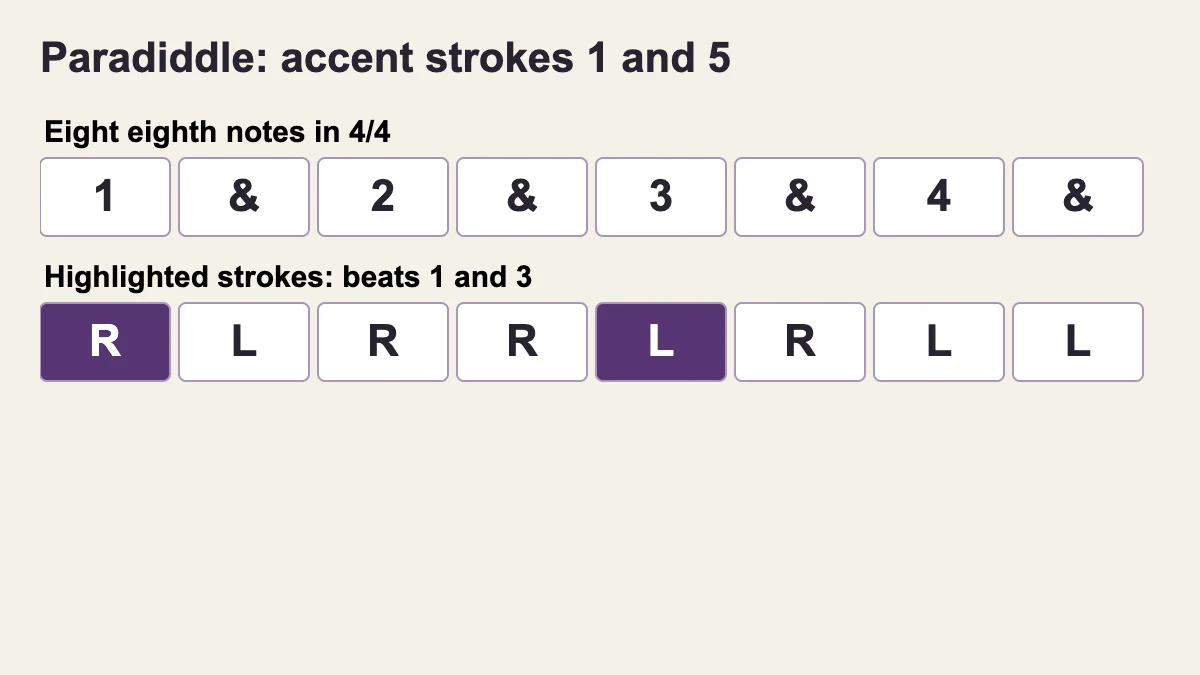
An accent is a relative dynamic difference, not permission to hit as hard as possible. Listen for a recognisable foreground and background while keeping the sequence controlled. If the stroke after the accent also becomes loud unintentionally, slow down and examine that transition. The hand has to prepare for the next role; merely remembering which note is accented does not automatically organise the motion.
Move an accent only after the original version is stable. Mark its exact stroke number and count position. For instance, accenting stroke two of an eighth-note measure places emphasis on the “and” of one. Do not move the attack itself. If the relationship to the beat is difficult to hear, read the syncopation guide before adding further dynamic changes.
Change subdivision with the click unchanged
At a quarter-note click, eighth notes require two strokes per click and sixteenth notes require four. Switching from eighths to sixteenths doubles the number of strokes in the same time even though the BPM display stays unchanged. Record subdivision alongside tempo. “I played at 80 BPM” does not describe stroke speed unless the note value is also known.
Before switching, count one measure at the new subdivision without sticks. Then play a short pattern and return to the original spacing. Avoid an unplanned acceleration between the two. The point is to establish a clear ratio, not to slide gradually until the hands feel busy. If the change fails, reduce the tempo or keep only the spoken counting transition for a while.
The eight-note paradiddle occupies a full 4/4 measure as eighth notes, but only two quarter-note beats as sixteenths. Consequently, its group-start accents land on beats one and two in the sixteenth version when the pattern begins on one. Do not copy beat labels from one subdivision to another without recalculating where the strokes occur.
Build a short routine around evidence
Choose one pattern, one leading hand and one subdivision. Count in, play a small number of complete measures and stop deliberately. Listen for one issue: uneven pair spacing, an unintended accent or a delayed restart. Write that observation in ordinary language. A focused note such as “left pair’s second stroke fades” gives the next attempt a more useful target than a general score.
In the next round, retain the same musical task and change one practical factor. Lower the tempo, reduce the phrase length or return to unaccented notes. Do not simultaneously change sticking, dynamics, surface and tempo. If the result improves, you want to know which adjustment helped. This is a practice experiment, not a test with a universal pass mark or mandatory daily duration.
Use a simple log with columns for date, pattern, leading hand, subdivision, BPM and observation. Add a final column for the next small task. A successful entry might say that the transition from R R to L L stayed evenly spaced for several short attempts. It need not announce a new speed record. Repeatability and the ability to notice errors are meaningful parts of control.
Move from a pad to a kit without losing the sequence
First keep the pattern on one surface. Next, move only one selected hand or one planned accent to a different drum, if a suitable kit is available. The changed tone makes the hand order easier to hear, but a larger physical distance adds a new coordination demand. Return to one surface if the rhythm or sticking changes unintentionally.
A rudiment is not a complete drum-set groove by itself. A groove may combine kick, snare and cymbal parts with a particular musical function. The sticking provides one way to organise a stream of notes within that texture. For that different starting task, see beginner drum beats. Do not add feet merely to make the exercise look advanced before the hands are predictable.
If you have no kit, the practice-without-drums guide separates listening and coordination tasks from instrument-specific work. A virtual instrument can help you hear a rhythm, but tapping a screen does not reproduce stick rebound or prove that a physical roll is controlled. Use each tool for the information it can actually provide.
Listen for the error instead of repeating it
When a pattern breaks, isolate the smallest transition that caused trouble. For a paradiddle this may be the fourth-to-fifth stroke, where the lead changes, rather than the entire eight-note sequence. Practise a short window containing the notes before and after that boundary, then restore the full pattern. Always preserve the original count so that the isolated fragment does not acquire an unrelated rhythm.
When timing is correct but tone is uneven, compare contact and dynamics before changing the letters. When the letters are wrong but the rhythm sounds smooth, slow down enough to observe the hand sequence. These are different errors and need different feedback. A recording can reveal sound differences but may not show which hand played; a visual check can show order while hiding a weak note.
Explained sticking exercises
Read each question, write the eight positions and then compare the explanation. Answers remain available without a login; close an answer while working if you prefer. These tasks check musical reasoning and planning, not the safety or quality of your physical technique. Stop and seek direct instruction whenever a movement feels uncertain or uncomfortable.
Read the letters correctly
What information is missing from R L R L if you want to know how long it lasts?
Show explained answer
The note value or subdivision is missing. Four eighth notes occupy two quarter-note beats; four sixteenths occupy one. Hand order alone cannot determine duration. State the subdivision and the metronome beat before playing, then place each letter on a specific count. Do not judge speed by the BPM number without this information.
Find the lost second stroke
R R L L is written, but the recording sounds like one right attack and one left attack. What should you inspect?
Show explained answer
Check whether each intended second note is present and audible. A disappearing second stroke can conceal the written double even when the hand movement appears paired. Slow the task enough to hear four separate events. Do not add random bounces to fill the gap; restore the two planned notes from each hand.
Repair a paradiddle restart
A player repeats R L R R immediately followed by R L R R. Is that the two-sided single paradiddle shown here?
Show explained answer
No. The boundary creates three consecutive right-hand strokes. The intended second group is L R L L, giving R L R R L R L L. Mark the fifth stroke before restarting. Practise the end of the right-hand double and the first left stroke together, then restore the complete eight-note sequence.
Locate the leading-hand change
In an eighth-note measure of R L R R L R L L, which hand plays beat three?
Show explained answer
The fifth stroke is L and falls on beat three. The first four strokes cover one and two and; the remaining four cover three and four and. If the left entry arrives late, check for a pause after stroke four. Visual separation into groups does not insert a rest into the rhythm.
Mirror the complete sequence
Write the same two-sided pattern beginning with the left hand without changing its structural relationship.
Show explained answer
Exchange every R and L: L R L L R L R R. Both the alternating part and the double move to the opposite hands. Changing only the first letter would produce a different pattern. Compare the mirrored starts at the same tempo and subdivision so that leading-hand familiarity is the only planned variable.
Check a compressed double
The two right notes are close together and the gap before the left hand is longer. Are equal notes being played?
Show explained answer
No. In this exercise the within-hand and between-hand intervals should match. Count all four positions evenly and place the second R and first L on their own slots. Listen to the handover rather than only the pair. A smooth-looking motion is insufficient if the resulting time intervals are unequal.
Place the group accents
Where are strokes one and five in an eight-eighth-note paradiddle starting on beat one?
Show explained answer
They are beats one and three. Accent those attacks without changing their positions or deleting the quieter notes. The first accent uses R and the second L. Write accent marks separately from the letters so that hand order and dynamics remain two independent instructions. Start with a modest contrast you can repeat.
Recalculate after subdivision changes
The same eight strokes become sixteenths at an unchanged quarter-note click. Where does stroke five now fall?
Show explained answer
On beat two, because four sixteenths fill beat one. The entire eight-stroke pattern now occupies two beats rather than four. The group-start accents occur on one and two. Reusing the old one-and-three labels would confuse the subdivision change with a different pattern. Count the new grid before adding the sticks.
Distinguish groove from sticking
Does knowing R L R R L R L L automatically specify kick, snare and cymbal parts?
Show explained answer
No. It specifies a hand order for the notes, not a complete kit arrangement or musical role. Choose which surface receives each planned stroke separately and preserve the timing. Add other limbs only when their role is clear. A familiar rudiment can be used within a groove, but the two descriptions are not interchangeable.
Identify a useful recording limit
A recording reveals uneven sound but does not show the hands. Can it prove which sticking you used?
Show explained answer
Not by itself. Similar sounds can come from different hand orders, particularly on one surface. Use listening to compare timing and tone, then a suitable visual check for order and movement. Keep the two observations distinct. Neither a clean recording nor a correct letter sequence remotely certifies the safety of physical technique.
Choose a controlled transfer
The pad pattern is stable, but moving both hands around several drums breaks it. What is a smaller next task?
Show explained answer
Move only one selected hand or one planned accent to another surface, leaving the rest unchanged. The greater travel distance and changed sound are new demands. If timing breaks, return to one surface and reintroduce the move gradually. Do not change tempo, sticking and orchestration simultaneously when trying to identify the cause.
Write a meaningful progress note
Yesterday used right-led eighths; today used left-led sixteenths. Can a worse result be called simple regression?
Show explained answer
No. Leading hand and subdivision both changed, so the tasks are not equivalent. Repeat a small reference exercise under the same conditions before comparing progress. Record pattern, lead, subdivision, BPM and the specific observation. Keep the harder attempt as useful information, but do not treat unlike tasks as a reliable before-and-after measure.
Common questions before the next session
Do I need to learn every rudiment immediately?
No. A manageable set with clear timing and application is more useful than recognising many names without controlling the patterns. These three introduce alternation, same-hand pairs and a mixed sequence. Expand when a musical task or teacher identifies a reason. A larger vocabulary is valuable, but collecting it does not replace listening to how the current exercise actually sounds.
Should I always begin with the right hand?
No. Practise deliberately chosen starts with either hand and label them clearly. The R-first examples are a readable reference, not a claim that every drummer should lead right. Exchanging R and L preserves the mirrored pattern. Do not assume one side is always weaker; compare your own attempts at the same tempo and subdivision.
Can I judge a double-stroke roll on my phone?
You can study the order and listen to a model, but a touchscreen does not provide the rebound of a drum or practice pad. Device latency can also affect timing. Treat online tools as a way to understand and hear the task, not as a remote certification of stick technique. A teacher observing the actual movement can answer a different and important set of questions.
Reference and originality
Names and basic sticking orders were checked against Vic Firth’s rudiment education and its introductory teaching material. The diagrams, diagnostic tasks and routine here are independently written. No textbook page, proprietary exercise sheet, audio track or performance recording is copied.