Syncopation: how to count, hear and practise it
Syncopation makes a normally weaker part of the rhythm stand out against an established beat. A note may begin between beats and continue across the next beat, or an unexpected accent may challenge the regular pattern. The beat itself does not have to move. To practise the relationship, keep a steady pulse, divide it into equal smaller units, and place the notes without letting those units stretch.
This guide uses short, original counting examples rather than excerpts from songs. Start with the eighth-note grid, then work through held notes, rests and accents. You do not need a drum kit: speaking, gentle tapping or a single piano note is enough to explore the timing. The exercises are listening and coordination tasks, not a diagnosis of rhythm ability or a promise of instrumental progress.
Hear the beat before moving the emphasis
Imagine four evenly spaced quarter-note beats: one, two, three, four. Those numbers provide a reference. Now say “one and two and three and four and,” keeping every syllable equally spaced. Each number and its following “and” divide a beat into two equal parts. The “and” is not an extra beat that lengthens the measure. It is a location inside the existing time.
Tap only the numbers while speaking all eight syllables. Next, continue the numbers with a quiet foot motion and clap only the “ands.” You should hear a relationship between two layers: the regular pulse and the sounds between it. If the foot starts following the claps, stop and recover the reference. Playing the offbeats in isolation can conceal that you have reinterpreted them as new downbeats.
A metronome can supply the reference while your hands explore the other layer. Use our online metronome at a comfortable speed, with one click per quarter-note beat. Count a complete measure before entering. The correct starting speed is one at which you can explain and place each event; a particular BPM is not a universal beginner requirement.
Syncopation is more than any note between beats
A continuous stream of equal eighth notes contains offbeat notes, but their presence alone does not explain the rhythmic emphasis. Listen for a weaker location gaining prominence through duration, accent or the absence of an expected attack. Context matters: a melody, bass line and drum part can establish different layers of expectation. Identify the reference before declaring every “and” a syncopation.
One particularly clear example starts a note on the “and” of one and sustains it through beat two. The note crosses a stronger point without a fresh attack there. Another example keeps all eighth notes sounding but accents an offbeat. These are useful comparisons, not a complete classification of every musical style. Work with one device at a time so that your ear can follow the cause of the effect.
Syncopation also differs from simply losing time. An intended early attack has a precise relationship to the grid and can be repeated. An accidental rush changes the spacing unpredictably. Do not try to make a phrase “feel syncopated” by playing slightly ahead at random. First learn a clear notated or counted pattern; expressive timing is a separate musical decision.
Read an eighth-note grid without guessing
Our grid has eight slots in a 4/4 measure: 1, &, 2, &, 3, &, 4, &. An X means a new attack. A dash means continue the previous sound without starting it again. A dot means silence for that slot. The symbols are a teaching shorthand, not a replacement for standard notation. Their meaning stays constant throughout these examples.
For the pattern “X X – X – X – .”, attack on beat one, the “and” of one, the “and” of two and the “and” of three. Hold through beats two, three and four as indicated, then leave the final “and” silent. Count every slot aloud even when there is no new attack. Four attacks occupy a complete measure because attacks and duration are different quantities.
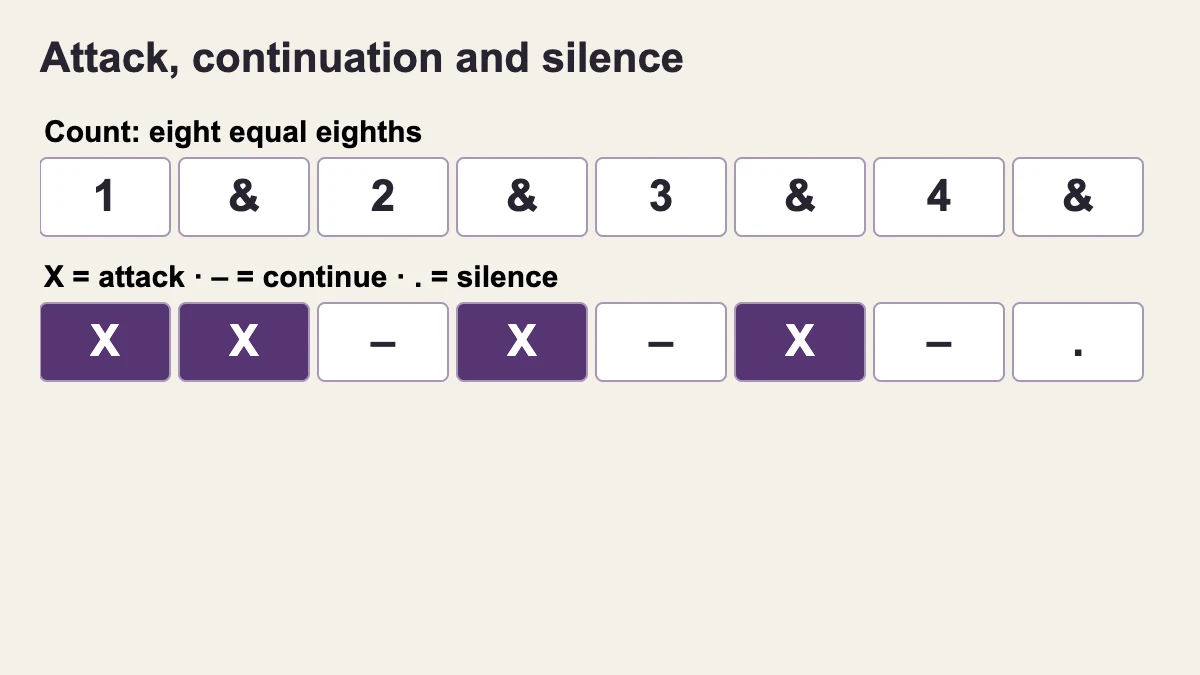
On a keyboard, a held sound is easy to distinguish from a new attack. With a clap, the sound naturally fades, so use your voice to represent the continuation: say “taa” across the held slots without adding another consonant. A fading sound does not change the written duration. What matters is that you do not insert a second attack where the example asks for continuation.
| Slot | Count | Action in the example |
|---|---|---|
| 1 | 1 | Start a new sound here; keep the subdivision equal. |
| 2 | and | Start a new sound here; keep the subdivision equal. |
| 3 | 2 | Continue the preceding sound; do not attack again. |
| 4 | and | Start a new sound here; keep the subdivision equal. |
| 5 | 3 | Continue the preceding sound; do not attack again. |
| 6 | and | Start a new sound here; keep the subdivision equal. |
| 7 | 4 | Continue the preceding sound; do not attack again. |
| 8 | and | Remain silent for this complete eighth-note slot. |
What a tie changes—and what it leaves alone
A tie joins durations of the same written pitch into one sustained event. If an eighth note on the “and” of one is tied to an eighth note on beat two, the combined duration is one quarter note, but its onset is halfway through beat one. The note lasts one beat without beginning on a numbered beat. Duration and position must be read separately.
Do not strike the tied note again just because your count reaches two. Continue counting and let the original sound carry through. Conversely, two adjacent notes without a tie may require two attacks even when their pitch is identical. A slur is a different marking and should not automatically be treated as a tie. When uncertain, check whether the notation connects the same pitch and what articulation is requested.
Counting ties across a barline uses the same principle. A note beginning on the “and” of four can continue over the next one. Say the new measure’s one while withholding the attack. The measure boundary is still present in your count; it has not disappeared because the melody is held. This is an effective test of whether you follow the underlying pulse or only the audible notes.
Use silence deliberately
A rest is not unmeasured waiting. In an eighth-note grid, a dot occupies the same time as any other slot. Begin by speaking all subdivisions and making a sound only at X positions. If you shorten the silent slot, the next note arrives early. If you hold your breath and pause the count, it arrives late. Keep the internal motion continuous through the gap.
Compare two patterns with an attack on the “and” of one: one sustains across beat two, while the other stops before it and leaves beat two silent. Their attack positions can match while their durations differ. Listen to both on a single key. This distinction is easy to miss when reducing every exercise to clapping, because claps do not make long note values obvious.
Write the expected next numbered beat before practising a rest. After the “and” of three comes four, not a new one. A short spoken count-in and a clear ending prevent the repeated loop from acquiring an accidental extra beat. If you need more general note-value reading, use the rhythm worksheets alongside this narrower study.
Keep accents separate from note spacing
An accent makes a particular attack stand out relative to its neighbours; it does not automatically make the note longer or move it earlier. Play eight evenly spaced taps, then make only the second tap more prominent. The interval before and after that tap should remain the same. A louder tap that steals time from the following gap introduces a second change.
Try the reverse comparison as well: preserve the same timing but remove the accent. If the pattern becomes hard to recognise, its identity depended strongly on emphasis. If it remains distinctive, rests or held notes may be carrying more of the structure. This is a practical listening question rather than a rule that assigns one correct interpretation to every piece of music.
Why 3+3+2 is not an equal triplet
Divide one 4/4 measure into eight equal eighth-note slots. Group them as three, three and two. The group beginnings fall on beat one, the “and” of two and beat four. If you accent those positions while keeping all eight slots equal, you create unequal groups inside an unchanged measure. The last group is shorter; do not stretch it to match the first two.
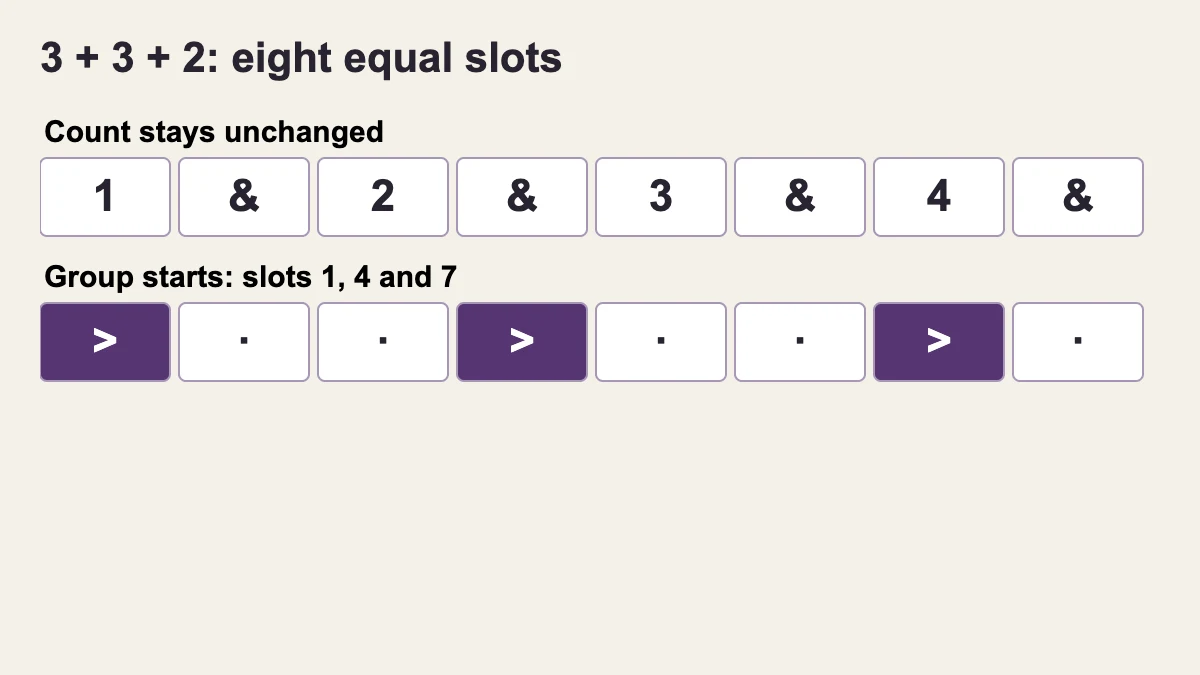
A triplet divides a specified duration into three equal parts. Three accent groups containing three, three and two eighth notes are not equal parts, so they are not an eighth-note triplet simply because there are three groups. Count the actual subdivisions before naming the rhythm. Group quantity, group length and the unit being divided answer different questions.
For an independent check, point to numbered slots one through eight. Mark group starts at slots one, four and seven. Translate them back to spoken counting: one, the “and” of two, four. Then keep the quarter-note metronome running underneath. If the click appears to move, you may be following group beginnings as though each were a new equal beat.
Move to sixteenth notes only when the reference is stable
For four equal subdivisions per beat, use a consistent count such as “one e and a.” A note on “e” arrives one sixteenth after the number; a note on “a” arrives one sixteenth before the next number. The syllables are labels, not instructions to alter spacing. First speak all sixteen slots of a 4/4 measure at an unhurried tempo.
Place one attack on the “a” of two and continue the count through three. Add nothing else until that location is repeatable. Then compare it with the “and” of two. The difference is one sixteenth, which can sound small while requiring a different written position. Doubling the number of grid slots should make the location clearer, not invite extra notes that obscure it.
A focused session with one measurable question
Begin by choosing one pattern and one difficulty: entering an offbeat, holding across a beat, or keeping rests measured. Count two plain measures, attempt two patterned measures, then return to plain beats. The return is important. It reveals whether the exercise displaced your pulse, even if the middle passage sounded convincing in isolation. You can shorten the sequence whenever concentration drops.
Record a small number of repetitions if your own device allows it, without uploading personal recordings to an unfamiliar service. Listen specifically for the selected issue. Does beat two acquire an unwanted attack? Does the final rest shrink? Does the first note after the loop arrive late? A precise observation gives the next attempt a useful target; “my rhythm is bad” does not.
Change only one variable in the next attempt. Keep the same pattern and lower the tempo, or keep the tempo and remove one accent. When several consecutive attempts retain the count and the intended onsets, make a small change in difficulty. A successful faster attempt once is less informative than a repeatable pattern at a pace you can describe and control.
Transfer the pattern to an instrument
On piano, begin with one comfortable note and no sustain pedal. A held finger and a new finger attack make the distinction between continuation and rearticulation clear. Then apply the rhythm to two notes without changing its timing. Our virtual piano offers a quick sound check, but a browser keyboard is not a substitute for evaluating physical piano technique.
On drums, keep one simple pulse layer and add the chosen rhythm separately. You do not need to distribute every note around the kit immediately. If hand order becomes the limiting problem, isolate it with basic drum rudiments. A sticking exercise solves a different question from identifying where a syncopated attack belongs, even though the skills can later work together.
For singing or melodic instruments, first speak the rhythm and then add pitch. A difficult interval can pull attention away from the count. Work on that interval separately rather than assuming every missed entrance is a rhythm problem. The rhythm listening guide can help you compare an original pattern with your response without treating one attempt as a fixed ability label.
Explained exercises: find the exact problem
Keep a written grid beside these tasks. Read the question before the answer, and close the explanation if you want to test your reasoning first. The aim is to identify onset, duration, accent or counting errors independently. None of the tasks requires a copyrighted melody, a commercial backing track or a special instrument.
Locate the missing attack
Count 1 & 2 & 3 & 4 &. A note starts on the first & and continues through 2. Should you attack again on 2?
Show explained answer
No. Beat two is still counted, but the earlier note continues across it. Put X in the second slot and a continuation dash in the third. If you add a new attack on two, you replace the intended sustained relationship with two separate notes. Check the onset and duration independently.
Count four attacks in a full measure
How can X X – X – X – . contain only four attacks but last an entire 4/4 measure?
Show explained answer
Every symbol occupies an eighth-note slot. The four X symbols start sounds, three dashes continue them and the final dot is a measured silence. Eight slots total four quarter-note beats. Counting only the X symbols confuses the number of attacks with elapsed time; speak every subdivision even where your hands do not strike.
Repair an early restart
A player skips the final dot in that pattern and immediately starts the next measure. What changed?
Show explained answer
The final eighth-note silence disappeared, so the loop now lasts seven slots instead of eight. Restore the last & before returning to one. Do not fix it by slowing an unrelated note earlier in the measure: that would hide the total-length error while changing the internal rhythm. Keep all eight units equal.
Separate accent from timing
Eight equal taps are correct, but accenting tap two makes tap three arrive early. Which variable needs attention?
Show explained answer
The dynamic change is disturbing the spacing. Retain the same eight-note grid and make the accent smaller until the next gap remains equal. An accent does not require borrowing time from its neighbour. Compare an unaccented attempt and an accented attempt at the same tempo so the effect is easy to identify.
Find the 3+3+2 starts
In eight eighth-note slots, where do groups of three, three and two begin in spoken counting?
Show explained answer
At slots one, four and seven: beat one, the & of two and beat four. The next group begins after the previous group has used its full number of slots. The final group is only two slots long. Three group beginnings do not imply three equal durations or a triplet division.
Cross a barline
A note starts on the & of four and is tied across the next one. Does the new measure begin late?
Show explained answer
No. The measure begins at its normal time, but the melody does not create a new attack there. Count the new one while maintaining the existing sound. This separates the metrical boundary from the note onset. If you cannot retain the boundary, first practise the count alone and add the sustained sound afterward.
Distinguish silence and continuation
Two versions both attack on the & of one. One has a dash at two, the other a dot. Are they identical?
Show explained answer
Their onset is the same, but the first continues sounding through two and the second is silent there. On a sustaining instrument you can compare the difference directly. With clapping, use a spoken sustained vowel to represent the dash. Do not infer duration only from how long a clap naturally remains audible.
Locate a sixteenth
Which arrives later within beat two: the & or the a in the count two e & a?
Show explained answer
The a arrives one sixteenth later than the &. Both occur before beat three. Keep four equal subdivisions per beat while comparing them; do not squeeze the final syllable against the next number. Marking sixteen slots instead of eight makes the distinction visible without changing the quarter-note pulse.
Choose the right simplification
You can speak a pattern correctly but lose it when changing piano notes. Should the rhythm automatically become harder?
Show explained answer
No. Return to one pitch and check whether the timing remains stable. Then add only one planned pitch change. The difficulty may be coordinating pitch selection with the established rhythm, rather than understanding the count. Increasing rhythmic complexity would introduce another problem before the current one is identified.
Check the reference layer
Your foot starts tapping the offbeat claps rather than the numbered beats. Is that proof the pattern is complete?
Show explained answer
It shows that the reference has changed. Stop the claps, restore the numbered beat with the metronome and then add one offbeat at a time. Offbeat attacks can sound perfectly regular by themselves; the exercise asks you to preserve their position relative to another regular layer, not merely produce an even series.
Read two equal pitches
Two adjacent notes have the same pitch but no tie. Should the second always disappear because the pitch repeats?
Show explained answer
No. Repeating a pitch and sustaining one note are different actions. Read the written duration and articulation, and use separate attacks where required. A tie would explicitly combine appropriate same-pitch durations. Do not add one mentally just because it seems easier to hold the key instead of playing again.
Design a useful next attempt
After several loops, the count is stable but the final rest keeps shrinking. What should your next note in the practice log say?
Show explained answer
Record the specific issue: retain the full last eighth-note rest before the next one. Practise a short ending-to-beginning window with spoken subdivisions, then restore the complete loop. Keep the tempo unchanged or lower it. A general instruction to get faster does not address the measured gap that is actually failing.
Questions that often interrupt practice
Should the metronome click on the offbeats?
It can be an additional exercise, but first establish what the click represents. Moving the reference while also learning a new pattern changes two variables. Start with quarter-note clicks, count the offbeats yourself, and only later experiment with a displaced click. Announce its role before starting so that you do not mistake the new reference for an accidental timing error.
Is swing the same thing as syncopation?
No. Swing concerns how subdivisions are performed in a particular musical context; syncopation concerns their relationship to expected emphasis. They can coexist, but one does not require the other. These introductory grids use equal subdivisions. Do not turn them into unequal pairs unless that becomes a separate, explicitly defined exercise with an appropriate musical example.
Why can I imitate a rhythm but not read it?
Imitation and translating notation into timed action are related but distinct tasks. Add an intermediate step: locate each attack on a grid, speak the count, and only then perform it. Conversely, if the notation is clear but the sound is hard to remember, shorten the phrase. The solution depends on which link fails, not on collecting more difficult patterns.
Sources and scope
The distinction between metric expectation and displaced emphasis was checked against Open Music Theory: Syncopation. The Turkish companion also checks terminology against MEB’s rhythm textbook. Grids, explanations and practice tasks here are independently constructed; no source score, song recording or textbook exercise is reproduced.