Piano chord progressions: connect chords smoothly and practise with purpose
A piano chord progression is an ordered sequence of harmonies. To practise one well, identify the chords, choose comfortable note positions and decide when each change happens. Start with C–F–G–C or C–Am–F–G, playing one chord per measure. Keep the pulse steady before adding a complicated accompaniment. Correct notes matter, but an even change and a clear musical ending matter too.
This guide assumes you can locate a basic major or minor triad. If that is still uncertain, use the piano chords reference first. Here the focus is the movement between chords: common tones, inversions, bass choices, harmonic rhythm and small listening comparisons. The examples are original practice material, not transcriptions of commercial songs.
Read the number and the chord quality together
Roman numerals describe chord roots relative to a key. In C major, I starts on C, IV on F and V on G. Uppercase numerals conventionally represent major triads; lowercase numerals represent minor triads. Therefore vi in C major is A minor, not A major. The root’s place in the scale and the chord’s quality are separate pieces of information that must both survive when you change key.
Build a triad by selecting alternate scale members. In C major, degree two gives D–F–A, a minor triad, while degree five gives G–B–D, a major triad. This explains why ii–V–I becomes Dm–G–C. Do not read every numeral as a major chord simply because the overall key is major. Major keys contain several minor diatonic chords and a diminished triad as well.
The numbering convention for minor-key progressions varies between educational and popular chord charts. This page names the actual chords whenever a minor example is used, rather than relying on an unexplained VI or flat-VI label. If you compare another chart, check its reference system. Two writers can use different numeral conventions for the same sounding progression; the written chord notes settle the practical question.
Choose a small progression with a clear task
C–F–G–C provides a straightforward departure and return in C major. Begin with root-position triads so you can verify the pitch content. Then improve the connections without changing the chord sequence. This separates two tasks that beginners often mix: knowing which harmony comes next and finding a comfortable way to play its notes.
C–Am–F–G gives four different harmonies and returns naturally to C when you repeat the loop. C and Am share C and E; Am and F share A and C. Those shared notes make the progression useful for learning to keep fingers near the next position. A loop is not the same as a final cadence, however: stopping on G may sound open, while returning to C can provide closure.
Dm–G–C is a compact ii–V–I example in C major. At first, use triads. Later, Dm7–G7–Cmaj7 introduces sevenths and gives you additional voice-leading possibilities. Do not jump to richer symbols before you can name the notes they require. A progression with extensions is not automatically more musical than a clear, well-timed set of triads.
| Key | Pattern | Actual chords |
|---|---|---|
| C major | I–IV–V–I | C major → F major → G major → C major |
| C major | I–vi–IV–V | C major → A minor → F major → G major |
| C major | ii–V–I | D minor → G major → C major |
| C major | I–V–vi–IV | C major → G major → A minor → F major |
| G major | I–IV–V–I | G major → C major → D major → G major |
| G major | I–vi–IV–V | G major → E minor → C major → D major |
| G major | ii–V–I | A minor → D major → G major |
| G major | I–V–vi–IV | G major → D major → E minor → C major |
| D major | I–IV–V–I | D major → G major → A major → D major |
| D major | I–vi–IV–V | D major → B minor → G major → A major |
| D major | ii–V–I | E minor → A major → D major |
| D major | I–V–vi–IV | D major → A major → B minor → G major |
| F major | I–IV–V–I | F major → B flat major → C major → F major |
| F major | I–vi–IV–V | F major → D minor → B flat major → C major |
| F major | ii–V–I | G minor → C major → F major |
| F major | I–V–vi–IV | F major → C major → D minor → B flat major |
| B flat major | I–IV–V–I | B flat major → E flat major → F major → B flat major |
| B flat major | I–vi–IV–V | B flat major → G minor → E flat major → F major |
| B flat major | ii–V–I | C minor → F major → B flat major |
| B flat major | I–V–vi–IV | B flat major → F major → G minor → E flat major |
The table offers reference spellings, not a requirement to practise every key immediately. Pick one row and one progression. Cover the chord names, derive them from the numerals and check your answer. When that becomes comfortable, change key while preserving the same numeral pattern. Our transposition guide explains how to move note relationships without changing chord quality.
Keep common tones instead of moving every finger
A chord can appear in different note orders and registers. For C major, C–E–G, E–G–C and G–C–E contain the same three pitch classes. Choosing a different order can reduce the distance to the next chord. This is not a change from major to minor and does not automatically create a new harmony. It is a change of voicing or inversion, depending on the bass of the complete texture.
For a right-hand C–Am–F–G practice sequence, try C4–E4–G4, C4–E4–A4, C4–F4–A4 and B3–D4–G4. The first change keeps C and E while G moves to A. The second keeps C and A while E moves to F. The final change is larger but remains in a compact area. Scientific octave labels here use middle C as C4.
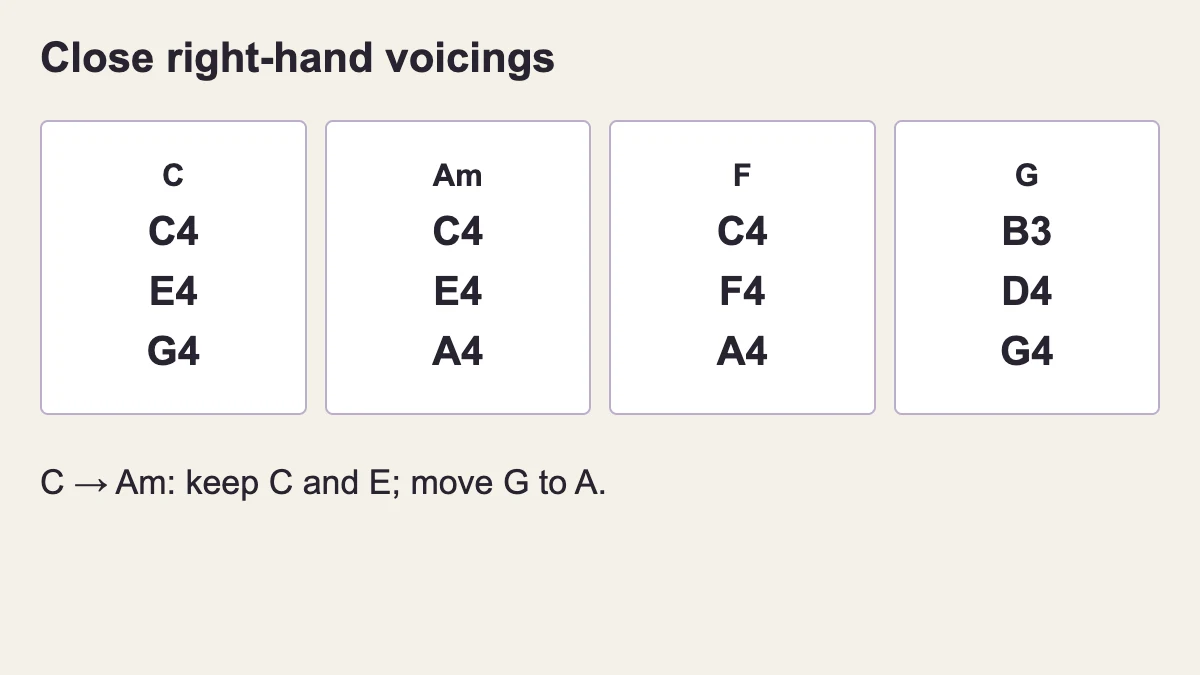
If the left hand plays the chord roots C, A, F and G underneath, the overall bass is different from the lowest note of the right hand alone. That matters when naming inversions. Calling the entire C chord “second inversion” merely because the right hand begins with G can be wrong if the left hand supplies a lower C. Analyse the complete sounding texture, not a hand in isolation.
Keep the chosen voicing comfortable. A written close-position solution is an example, not a universal fingering prescription. Hand size, register and the surrounding music affect what is practical. You can first play one hand, then add a single bass note. If combining the parts makes the pulse collapse, simplify the texture before trying to force both hands through the full pattern.
Harmonic rhythm: decide when a chord changes
Harmonic rhythm is the timing of harmony changes. A progression label such as C–Am–F–G does not tell you whether each chord lasts a beat, a measure or several measures. State that timing explicitly. In an initial 4/4 exercise, give every chord four quarter-note beats. Count through the entire measure, including the time after the chord has sounded.
Next, compare two versions with the same total length. In the first, each chord lasts a full measure. In the second, place two chord changes within selected measures while allowing another chord to last longer. The sequence may remain recognisable, but the sense of motion changes. Do not change the tempo at the same time if you want to hear harmonic rhythm rather than overall speed.
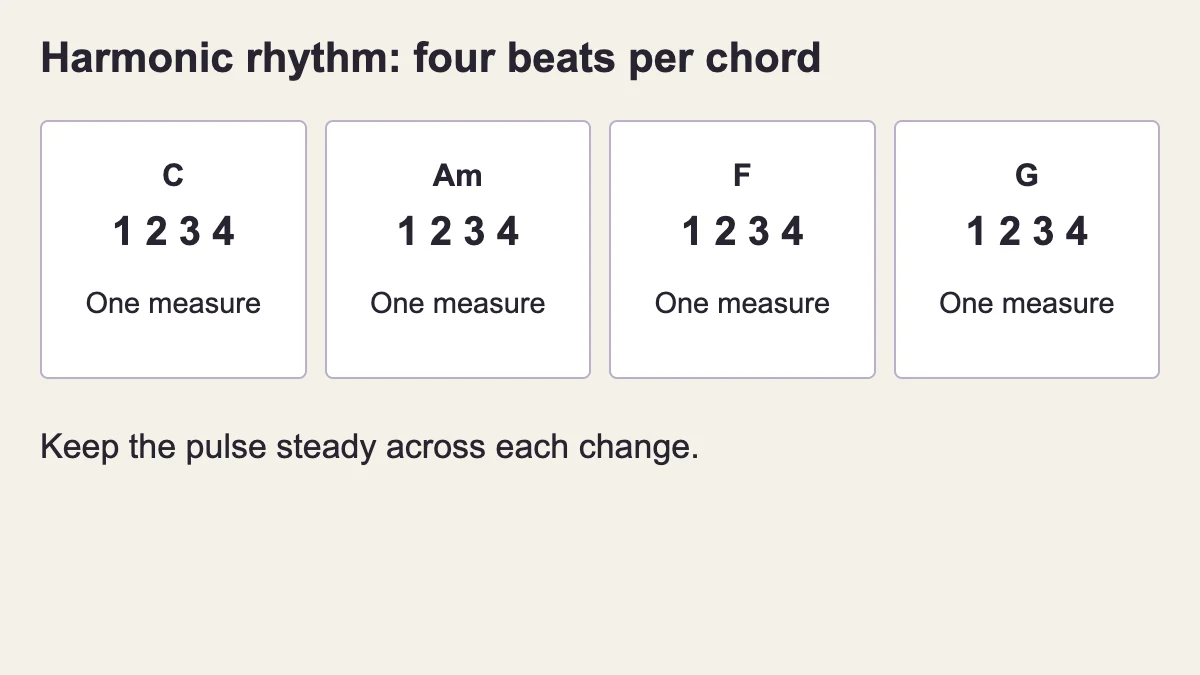
A common timing problem occurs just before a difficult change. The player stretches the last beat to buy time, then resumes the original tempo. The extra time can be hard to notice while concentrating on the fingers. Practise only the boundary: two beats of the current chord, the change, then two beats of the next chord. Repeat that small segment until the transition fits the pulse.
Separate the bass, the chord and the melody
An accompaniment can become crowded when every part is played with equal weight in the same register. Start with one low root and a simple right-hand triad. Listen for whether the bass supports the harmony without hiding the upper notes. Adding more doubled notes is not the only way to make the sound fuller; spacing and duration can matter more.
If you add a melody, identify its important notes at each chord change. A sustained E belongs to a C major chord but creates a different relationship over F major. That difference may be intentional. Do not automatically replace the chord because one melodic note is not a chord tone. First hear the duration, emphasis and resolution, then decide what the phrase needs.
For an original experiment, keep E as a repeated upper note while alternating C major and A minor underneath. Both chords contain E, yet the bass changes their identity. Then compare C major and F major while the upper E continues. You can hear a new tension without changing the melody. These small comparisons explain accompaniment choices more clearly than a long list of alleged emotional chord formulas.
Major and minor do not prescribe one emotion
Chord progressions are often sold with labels such as happy, sad or cinematic. Those words can describe a listener’s impression, but they do not establish a universal property of the chord order. Tempo, register, articulation, melody and cultural familiarity contribute. Use the labels as informal observations, not promises that one sequence will reliably make every listener feel the same way.
Compare Am–Dm–E–Am using quiet sustained chords, then shorter notes at a different tempo. The E major chord contains G-sharp, a raised seventh relative to A natural minor, which supports the return to A. That theoretical relationship can be identified precisely. The emotional effect of the whole performance cannot be reduced to that single note. Keep the musical fact separate from the descriptive impression.
What to do with the sustain pedal
Learn the basic change without relying on a long pedal hold. Sustaining every chord across the next can blend notes that you meant to hear as separate harmonies. That may be a deliberate texture later, but it makes a beginner accuracy check harder. First listen to the clean chord sequence, then add pedal only if your instrument and the musical context call for it.
A browser piano may not reproduce the physical pedal, acoustic resonance or touch response of a real instrument. Use it to check a short pitch relationship, not to judge the full quality of your piano technique. If a web sound continues after release, distinguish the instrument’s envelope from a notation instruction. The written duration and the sound engine’s decay are related in performance but are not identical settings.
Solved tasks: notes, timing and voice leading
Try each task before reading the explanation. Some answers are exact note spellings; others ask you to design a controlled listening comparison. For the latter, state which variable you kept fixed. That habit prevents a practice session from becoming a series of unrelated trials whose results are difficult to interpret.
Spell I–vi–IV–V in G major
Use the G major scale to name the four chords, keeping uppercase and lowercase qualities distinct.
Show explained answer
The result is G–Em–C–D. The sixth-degree root is E and its diatonic triad is E–G–B, so it is minor. Do not turn Em into E major merely because the overall key is major. Play each chord separately before linking them, and check that the D chord contains F-sharp.
Keep two notes through a change
Find a compact way to move C–E–G into A minor without moving every upper voice.
Show explained answer
Keep C and E, then move G to A. The resulting C–E–A is an A minor voicing. If a lower A is added by the left hand, it supplies the root bass for the whole texture. Check what actually sounds lowest before naming the inversion of the complete chord.
Name a seventh correctly
Compare G7 and Gmaj7 before using either as the fifth-degree harmony in a C-major example.
Show explained answer
G7 contains G–B–D–F, while Gmaj7 contains G–B–D–F-sharp. The seventh differs by a semitone. In the basic dominant-to-tonic exercise here, G7 supplies the F natural. Do not treat maj7 as a longer spelling of 7; the suffix changes the pitch content and therefore the voice-leading possibilities.
Preserve the pulse at the boundary
Your F chord is correct, but the change to G delays the next downbeat. What smaller task can you practise?
Show explained answer
Play two beats of F and two beats of G, repeating only that boundary at a comfortable speed. Prepare the destination without stretching the final beat. If the notes remain uncertain, pause the timed exercise and check them separately. Speeding through the following measure merely hides the delay instead of fixing it.
Separate right-hand position from bass
The right hand plays G–C–E while the left hand plays a lower C. Is the whole chord necessarily second inversion?
Show explained answer
No. The complete texture has C in the bass, so the chord is in root position overall. The right-hand order alone does not determine the inversion when another part supplies a lower note. Listen to and identify the true bass before applying an inversion label to a two-handed arrangement.
Change harmonic rhythm, not tempo
Keep C–Am–F–G but compare one chord per measure with one chord every two beats. What changed?
Show explained answer
The rate of harmonic change increased while the beat can remain the same. This is a harmonic-rhythm change, not necessarily a tempo change. Count a steady pulse in both versions and make the chord durations explicit. Without that shared reference, a faster hand movement can be mistaken for a faster underlying beat.
Explain the raised note in minor
In Am–Dm–E–Am, why does the E chord contain G-sharp instead of G natural?
Show explained answer
E major requires G-sharp as its third. In the A-minor context, that pitch also acts as the raised seventh leading toward A. Replacing it with G gives E minor and changes the progression’s sound. Both can occur in music, but they are different choices; preserve the one the exercise actually specifies.
Hear a shared melody note
Repeat E in the melody while alternating C major and A minor below it. What stays and what changes?
Show explained answer
E is a chord tone in both harmonies, but the bass and remaining chord tones establish different roots and qualities. Keep melody rhythm and register constant so you can focus on accompaniment. This shows why the same melodic pitch can be supported by more than one harmony without the accompaniment becoming identical.
Do not confuse a loop with an ending
C–Am–F–G repeats smoothly, but you stop on G and feel the phrase is unfinished. Must the progression be wrong?
Show explained answer
No. A repeating loop and a closed ending serve different purposes. Try adding a return to C and compare the sense of arrival. Keep the preceding measures unchanged. You are choosing where the phrase stops, not proving that every appearance of G must resolve immediately or that open endings are forbidden.
Transpose without changing chord quality
Move Dm–G–C up a major second and state both the new chord names and their relationship.
Show explained answer
The result is Em–A–D, still ii–V–I in the new key of D major. The first chord remains minor. Verify E–G–B, A–C-sharp–E and D–F-sharp–A. Changing every chord to major would preserve some root motion but destroy the original qualities and diatonic relationship.
Test a muddy accompaniment
The notes are correct but consecutive chords blend into an unclear sound. What should you isolate before adding new harmonies?
Show explained answer
Compare the same sequence without sustained overlap, then inspect the register and bass doubling. A long pedal hold or several closely spaced low notes may be obscuring the changes. Change one condition at a time. More complicated chord symbols will not diagnose a release or spacing problem in the current texture.
Record an actionable result
Replace the note “I am bad at chord progressions” with information useful for the next practice session.
Show explained answer
Write the exact key, sequence, chord duration and difficult boundary: for example, C–Am–F–G, one measure per chord, hesitation before G. Add the small task you will repeat next. This turns a vague self-judgment into a reproducible observation and avoids confusing one unfinished transition with a general statement about musical ability.
A practical sequence for learning one progression
Write the key and numeral pattern first. Spell every chord, then check its quality. Play each chord separately without a tempo target. When the notes are secure, choose one compact voicing for the entire loop. Mark any shared notes and notice which fingers can remain close to their next destination. The preparation should make the eventual timed version easier, not become an endless writing exercise.
Now set a comfortable pulse with the online metronome. Give each chord a full measure and count aloud if helpful. If you miss a change, do not immediately speed through the rest to catch up. Stop, identify whether the error was a note, a position or a timing issue, and practise the smallest section that contains it.
Once the full loop is steady, record a brief practice note: key, chord order, voicings, tempo, chord duration and the transition that still needs attention. A useful note might say “C–Am–F–G; one measure each; F to G hesitates on beat four.” This points to an actionable task. “Bad at chords” does not tell you what to change and needlessly turns a specific difficulty into a personal label.
For the next session, retain the same progression and change only one feature. Try a different inversion, a simpler bass or a different harmonic rhythm. Later, move the progression to another key. If every session introduces a new chord order before the previous transitions settle, you may collect many labels without gaining reliable control over any of them.
When a progression does not sound as expected
Check the basic notes before searching for a sophisticated explanation. A major third played as a minor third changes the harmony immediately. Next, check the bass: an unintended low note can alter the perceived inversion or create a clash. Then check chord duration and release. Only after those are clear should you decide that the sequence itself does not fit your intended melody or style.
Also compare the starting point with the ending. A loop beginning on Am and using F, C and G can be heard differently depending on what is emphasised and where the phrase rests. A four-chord list alone may not establish a unique tonal centre. Listen to a complete phrase and avoid treating the first chord in any printed list as automatic proof of the key.
Questions worth asking before adding complexity
Should I learn all twelve keys immediately?
No. Learn the relationship in one or two manageable keys, then expand. The point of numerals is that you can carry the pattern into other keys deliberately. Memorising twelve disconnected strings of chord names is less flexible than understanding why the second chord is minor and how its root relates to the tonic.
Are inversions always better than root position?
No. They offer options for register and connection. Root position can be exactly right when the bass line or desired weight calls for it. Compare alternatives in context instead of assuming that minimal hand movement is the only musical goal. A smooth exercise and a dramatic leap can each be useful for different reasons.
Can a familiar progression still support original music?
A shared harmonic pattern does not determine every melody, rhythm, voicing or arrangement choice. For your practice, create your own short phrases instead of copying a recognisable recording. This page uses original examples and does not provide a legal clearance opinion for any particular song or commercial release.
Reference checks
The distinction between tonic, predominant and dominant relationships was checked against Music Theory for the 21st-Century Classroom: Harmonic Function. The voicings, comparison tasks and diagrams here were independently constructed for KulakApp; no source notation or recording is reproduced.